
Social and Economic Networks - Understanding Power, Beliefs, and Behaviors
Explore how social networks shape power, beliefs, and behaviors, and their impact on information spread, economic resilience, and societal structures with Stanford economist Matthew Jackson.
Models of Identity Signaling
Explore mathematical models of identity signaling, examining their impact on cooperation, conflict, and social learning in complex human behavior and communication strategies.
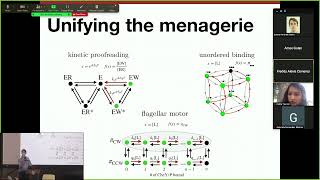
The Laws of Sensitivity for Small Nonequilibrium Systems
Explore laws constraining sensitivity in small, nonequilibrium systems. Uncover mechanisms behind biochemical switches, sensors, and molecular discrimination, with implications for gene regulation models.
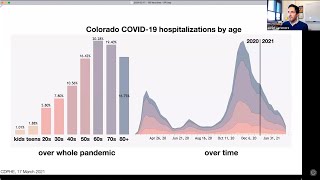
Vaccination Strategies - Prioritization, Dose Sparing, and Decisions Under Uncertainty and Inequity
Explore vaccination strategies for COVID-19, including prioritization and dose-sparing, considering uncertainties in variants, human behavior, and global inequities through mathematical models.
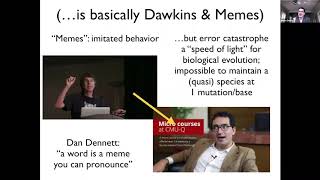
Explosive Proofs of Mathematical Truths
Explore how mathematical proofs achieve certainty through network structure, enabling explosive emergence of belief even under skepticism. Data science analysis reveals insights into proof validity and mathematical reasoning.
Loss of Self-Organization in Earth's Climate
Análisis de cambios en la autorregulación del clima terrestre mediante herramientas de sistemas complejos, comparando datos de temperatura global con el modelo Daisyworld.
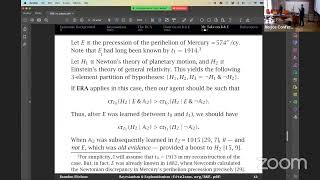
Bayesianism and Explanationism in Scientific Reasoning
Explore the philosophical approaches of Bayesianism and Explanationism, examining their principles, applications, and implications for scientific reasoning and knowledge acquisition.
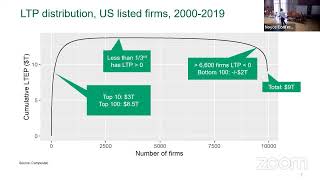
A Simple Law for the Distribution of Long-term Profits
Explore the distribution of long-term profits among US firms, examining statistical models and their implications for understanding economic dynamics and 'superstar' effects.

The Dynamics of Computation and the Computational Power of Dynamics
Explore the intersection of computation and dynamics, examining computational models, physical systems, and mathematical concepts to understand the nature of computation and its manifestation in various forms.

The Future of Physics
Exploring physics beyond fundamental laws: designing new forms of matter and addressing Anthropocene challenges. Insights into the evolving landscape of physics research and its societal implications.
Is Mathematics Obsolete?
Explore the evolving role of mathematics in the age of AI and computational power, examining its relevance and potential obsolescence in modern scientific inquiry.
Community Detection and Data Topology in Network Science
Exploring network science and mathematical approaches to uncover hidden structures in complex data. Discusses community detection, data topology, and applications in social networks and opinion dynamics.

Fluctuations in Complex Network-coupled Oscillators
Explore the dynamics of network-coupled oscillators, examining fluctuations and their impact on complex systems behavior and stability.
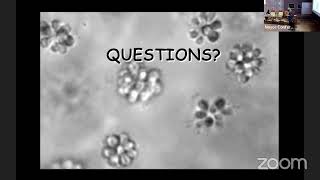
Evolution of Multicellularity in the Ancestors of Animals - Hydrodynamic Performance and Selective Factors
Explore how choanoflagellates provide insights into the evolution of multicellularity in animal ancestors, examining hydrodynamic performance and selective factors affecting colony formation and survival.

Free of Scale - Structural Balance
Explore the concept of structural balance in complex systems and its implications for understanding social networks, organizational dynamics, and decision-making processes.
The Thermodynamics of Communication - Exploring Energy and Information Limits
Exploring the fundamental relationship between energy, information, and matter in communication processes. Discusses nonlinear dynamics of communication channels and their implications for collective intelligence and limits to human knowledge.
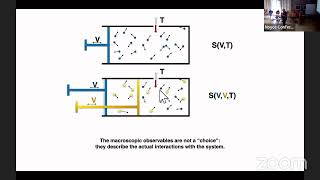
What Makes the Past Different from the Future?
Explore the fundamental differences between past and future, examining scientific concepts and philosophical implications in this thought-provoking lecture on time's arrow.
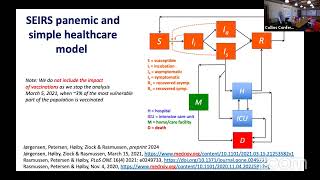
SARS-CoV-2 Infection Tracing Efficiency in Denmark Before Vaccine Impacts
Explore Denmark's pre-vaccine SARS-CoV-2 infection tracing strategies, analyzing their effectiveness and impact on pandemic control measures.

Effective Resistance Against Pandemics - Mobility Network Sparsification
Explore strategies for pandemic resistance through mobility network analysis, focusing on identifying crucial links for effective intervention and control measures.
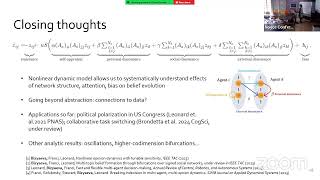
Nonlinear Dynamics of Beliefs over Social Networks
Explore how social networks, internal biases, and belief systems shape group dynamics and decision-making in complex social environments.
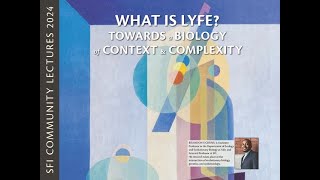
What is Lyfe? Towards a Biology of Context and Complexity
Exploring a multidimensional view of biology beyond genomics, emphasizing history, context, environment, and narrative to reframe our understanding of life and its complexities.