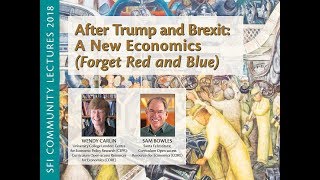
After Trump and Brexit: A New Economics - Towards a Sustainable and Just Global Future
Economists discuss a new economic paradigm for a sustainable and just global future, addressing the failures of unregulated profit pursuit and the rise of economic nationalism.
Using Buckingham's Π Theorem for Dimensionless Similarity Parameters in Macroecology
Explore dimensionless similarity parameters in macroecology using Buckingham's Π theorem, presented by Sandra Chapman from the University of Warwick.
Technological Requirements for Sustaining Socio-ecosystems with Hyper-dense Humans
Exploring ecological theory to analyze human societies' energy use and density compared to other mammals, and modeling sustainable conditions for hyper-dense populations through green technologies.
Fluctuations and Order in Randomly Evolving Environments
Explore non-equilibrium systems where giant fluctuations coexist with long-range order, examining particle behavior, interface properties, and applications in various scientific domains.

Gene-Culture Co-Inheritance of Behavioral Traits: A Price Equation Approach
Explores gene-culture co-inheritance of behavioral traits using a Price equation model, examining how cultural selection can overcome genetic selection and modify genetic selection pressures for complex phenotypes like altruism.

The Geometry of Consonance - Music and Mathematics
Explore the fascinating intersection of music theory and geometry, uncovering how musical chords inhabit unique geometric spaces and how classical compositions trace paths through multidimensional objects.

Beauty and Truth in Mathematics and Science - Lecture 1
Explore the role of beauty in guiding humanity's quest for understanding the world, examining interactions between beliefs, values, and scientific truth.
Effective Theories for Computational Systems - Lecture 2
Explore effective theories for computational systems, covering aggregation, finite state machines, regular languages, and emergence in complex systems modeling.

Parables from Complex Systems and Their Possible Meanings for Our Lives - Lecture 2
Explore complex systems through parables, examining prediction models, chaos theory, and market dynamics to gain insights applicable to everyday life and decision-making.
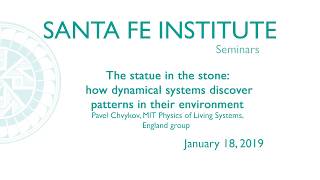
The Statue in the Stone: How Dynamical Systems Discover Environmental Patterns
Explores how complex systems adapt to environmental patterns, favoring stable configurations that match external forces. Illustrates with toy models and swarm-robotics experiment.

The Connected World - Networks and Their Properties
Explore the hidden world of networks, from social connections to cellular metabolism, and discover how scientists study these complex systems to unravel their mysteries.
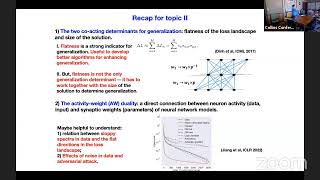
Stochastic Learning Dynamics and Generalization in Neural Networks
Explore stochastic learning dynamics and generalization in neural networks, uncovering key insights into their behavior and performance in various applications.

The Shape of Music - Mathematical Order in Western Tonality
Exploring the mathematical structure of Western music, revealing hidden geometries and patterns that connect diverse musical styles from Bach to The Beatles, and their relation to complex systems science.
Fractal Inequality and the Complexity of Repair - Part 1
Exploring how complex systems science can address societal inequalities, from vaccine distribution to economic opportunities. Insights on repairing structural inequities using network analysis and modeling to protect vulnerable populations.
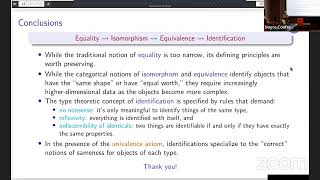
On the Art of Giving the Same Name to Different Things - Higher Dimensional Mathematics
Explore the mathematical concept of sameness, from isomorphism to equivalence, and its evolution in higher-dimensional mathematics. Discover new foundations that align with centuries of mathematical practice.
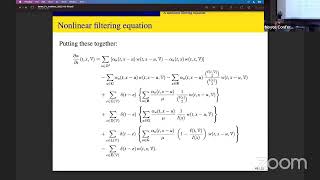
Phylodynamics and Markov Genealogy Processes
Explore phylodynamics and Markov genealogy processes to infer disease transmission from genomic data. Learn about a unified approach using exact likelihood expressions and dynamic genealogy evolution.
On the Shape of Epidemics
Explore the patterns and dynamics of epidemic spread, examining factors that influence their shape and progression through populations.
Prim Dreams of Order vs. Messy Vitality in Economics, Math, and Physics - Part 2
Exploring the limitations of algebraic theory in economics and advocating for algorithmic approaches to capture the evolving nature of innovation and exchange in complex systems.

Thoughts on Rational Inference - Is Information Theoretic Inference Rational?
Exploring rational inference approaches for incomplete information in complex sciences. Discusses defining and implementing rational methods, handling misspecifications, and addressing model uncertainty and robustness.
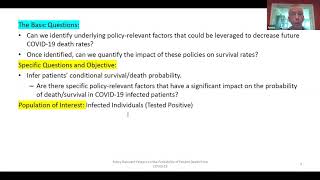
Effect of Universal TB Vaccination and Other Factors on Probability of Patient Death from COVID-19
Explore how universal TB vaccination, air pollution, and health expenditure impact COVID-19 survival rates across countries, with quantified probability changes by age and sex using information-theoretic methods.

Statistical Workflow and the Fractal Nature of Scientific Revolutions
Explore AI's role in statistical workflow, focusing on model building, checking, and revision. Discover how automated inference and best practices can enhance quantitative data analysis across various fields.