
Ice Science Advances: From Antarctic Cores to Future Mars Sampling
Explore advances in ice science through Antarctic cores and potential Mars sampling, uncovering insights about Earth and Mars' ancient climates and environments.
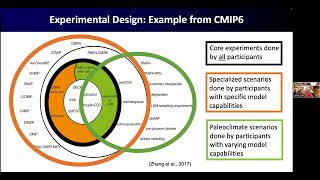
Looking Ahead to the Future of Exoplanet Climate Modeling
Explore the evolution of exoplanet climate modeling, from 1D models to sophisticated 3D simulations, and learn how JWST observations will shape future research and model refinement.
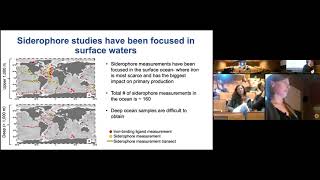
Microbial Iron Acquisition and Adaptations at Hydrothermal Vents
Explore microbial adaptations for iron acquisition in hydrothermal vents, focusing on siderophores and their role in maintaining bioavailable iron in deep-sea ecosystems.
MagIC Data Repository Overview - 2023
Explore MagIC data repository's features, workflows, and collaborations. Learn about sample-based measurements, standardized datasets, and FAIR principles in rock and paleomagnetic data management.
BiCEP and TROUT: Objective Methods for Reanalysis of MagIC Measurement Data
Explore objective methods for reanalyzing MagIC paleomagnetic data using BiCEP and TROUT, improving interpretation of legacy data and enhancing understanding of Earth's magnetic field history.
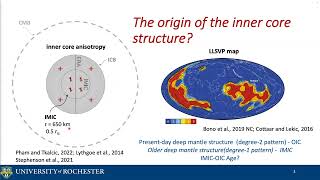
Paleomagnetism and the Origin of Inner Core Structure
Explore paleomagnetism's role in understanding Earth's inner core structure. Discover insights on core nucleation, geomagnetic field evolution, and implications for deep mantle dynamics.
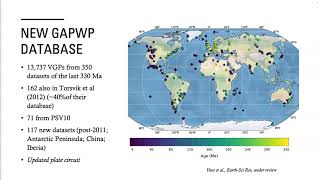
Apparent Polar Wander Paths for the Last 320 Million Years from Site-Level Data - 3/1/23
Explore global plate motion through paleomagnetic data analysis. Learn to calculate Apparent Polar Wander Paths using site-level data for improved accuracy in paleogeographic reconstructions.
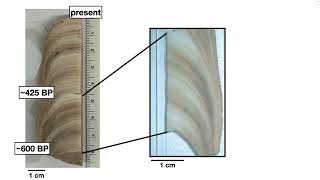
High-resolution Paleomagnetic Records from Speleothems using SQUID Microscopy
Explore high-resolution paleomagnetic records from speleothems using SQUID microscopy. Learn about advanced techniques for measuring paleomagnetism and compare with traditional methods.
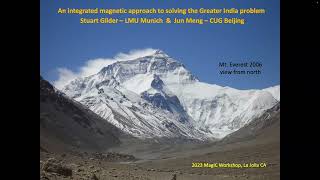
An Integrated Magnetic Approach to Solving the Greater India Problem
Explore an integrated magnetic approach to solving the Greater India problem, focusing on paleomagnetism and rock magnetism to unravel the tectonic history of India-Asia collision.
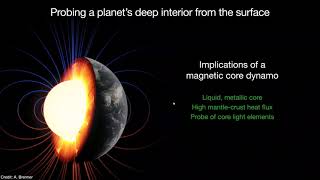
Pushing Back the Record of Tectonic Motion and Geodynamo Reversals via Magnetic Imaging
Explore advanced magnetic imaging techniques to uncover Earth's ancient tectonic movements and geodynamo reversals, revealing crucial insights into planetary habitability and early geological processes.
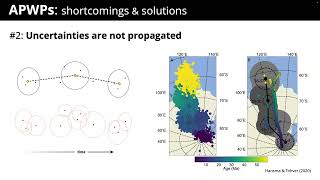
Constructing APWPs from VGPs - Going Virtual
Explore innovative methods for constructing Apparent Polar Wander Paths (APWPs) using Virtual Geomagnetic Poles (VGPs) to enhance understanding of Earth's paleogeography and polar wandering.
Signal Preservation: Global Perspective on Magnetite Dissolution and Local Insights into Greigite Formation
Explore magnetite dissolution and greigite formation in sediments. Gain insights into factors affecting magnetic mineral preservation and formation in modern environments, with implications for paleomagnetism.
Exploring Mercury's Petrologic Evolution Through Experimental and Modeling Approaches
Uncover Mercury's volcanic history through experimental and modeling techniques, exploring mantle structure and magma ocean dynamics to explain surface diversity.
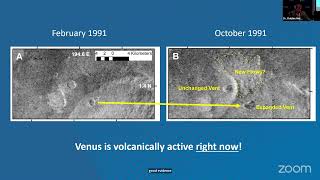
First Direct Observation of Present Day Volcanic Activity on Venus
Explore groundbreaking evidence of active volcanism on Venus through radar imagery analysis, revealing recent changes in Maat Mons volcano's vent.
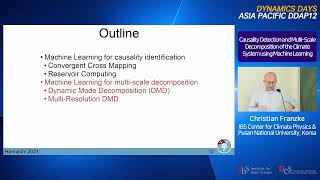
Causality Detection and Multi-Scale Decomposition of the Climate System Using Machine Learning
Explore machine learning approaches for detecting causal relationships and meaningful patterns in climate systems, focusing on Reservoir Computing and Multi-Resolution Dynamic Mode Decomposition techniques.
Mammatus Clouds and Sedimentation Instabilities - Kirk Lecture
Explore the formation of mammatus and asperitas clouds through droplet sedimentation, thermodynamics, and wind shear. Analyze stability and patterns in cloud formations using mathematical models.
The Hawaiian Plume: What Surface Observables Tell Us - Rothschild Lecture
Explore the Hawaiian plume's impact on surface observables through fluid mechanical models, revealing insights into mantle dynamics and intraplate volcanism.
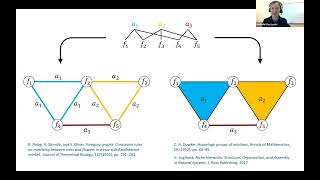
Persistent Homology of Plant-Pollinator Interactions - The Importance of Flowering Plant Surveys
Explore persistent homology in plant-pollinator interactions, analyzing topological features and the impact of flowering plant surveys on understanding community structures.
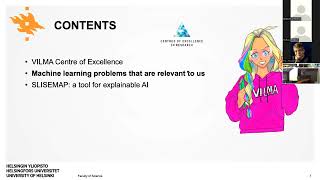
Explainable and Robust AI for VILMA Virtual Laboratory
Explore explainable AI and uncertainty quantification in atmospheric research. Learn about SLISEMAP, a supervised manifold visualization method for local explanations and dimensionality reduction.
Productive Performance Engineering for Weather and Climate Modeling with Python
Optimize weather and climate models using Python-embedded DSL and data-centric techniques. Improve productivity and performance through abstraction, semi-automated workflows, and transfer tuning for efficient scaling on supercomputers.

Using Python to Assess Landslide Risk: A Matter of Life and Death
Exploring Python's role in analyzing landslide risk in Southeast Alaska, showcasing how data analysis can create a community-driven early warning system for potential disasters.