Waves and Wind-Driven Flows in the Ocean - Lecture 2
Explore Kelvin-Stuart vortices in fluid mechanics, plasma physics, and planetary rings. Analyze stability, applications, and magnetic island equilibria in 2D ideal MHD equations.
Clouds - Their Formation and Importance for Present and Future Climate
Explore cloud formation, aerosol impacts on climate, and potential cloud modification strategies to mitigate global warming. Gain insights into atmospheric science and climate change.
Artificial Intelligence Meets the Natural World
Explore AI's impact on biodiversity research, climate solutions, and natural world protection. Discover opportunities and challenges in applying AI to evolutionary studies and environmental conservation.
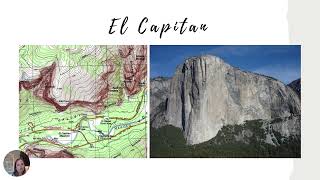
Topographic Maps: An Introduction
Explore topographic maps: learn to read contour lines, interpret elevation, and understand terrain features for navigation and land analysis.
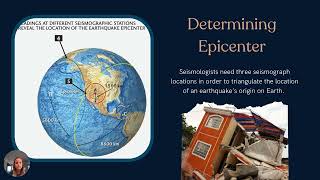
Earth's Geosphere - Crustal Deformation: Earthquakes
Explore earthquakes, seismic waves, and their impacts. Learn to determine epicenters and magnitudes while examining notable seismic events worldwide.
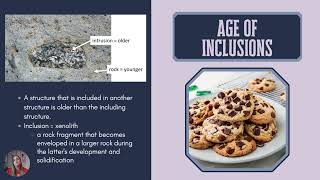
Earth's Past: Geochronology
Explore Earth's history through geochronology, learning dating techniques and geological timescales. Gain insights into our planet's ancient past and evolutionary timeline.
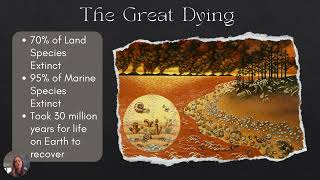
Mass Extinctions: A Brief Summary of Earth's Major Catastrophic Events
Explore Earth's major mass extinctions, their causes, and impacts on biodiversity throughout geological history.
The Creation, Collections, and Curators of the Rutgers University Geology Museum
Explore the rich history, diverse collections, and dedicated curators of the Rutgers University Geology Museum, uncovering its significance in geological education and research.
Planetary Geology: Mars Exploration - Presentation Only
Explore Mars through a graduate student's presentation, delving into the Red Planet's geological wonders and scientific mysteries.
Mineral Identification - Ask a Geologist Series
Learn mineral identification techniques from a geology expert, exploring physical properties and tools used to classify rocks and minerals found in nature.
Reconstructing the Early Solar System
Explore early solar system formation through meteoritic analysis, isotopic anomalies, and integrated data to uncover the origins of our cosmic neighborhood.
The New Jersey Heat Vulnerability Index: Understanding and Applying the Tool
Explore the Heat Vulnerability Index for New Jersey, its construction, application, and importance in identifying at-risk communities during extreme heat events.
Improving Education and Career Pathways for Underrepresented Minority Students in the Geosciences
Explore strategies to enhance diversity and inclusion in geoscience education, focusing on underrepresented minority students' pathways to success.
How Squishy is the Middle Crust? - Exploring Crustal Rheology
Explore the deformation of Earth's middle crust and its implications for geological processes with Dr. Steven Kidder's insightful analysis.
Adaptive Potentials of Marine Calcifiers in an Ever-Changing Ocean
Explore adaptive potentials of marine calcifiers amid ocean changes, focusing on their resilience and evolutionary strategies in response to environmental shifts.
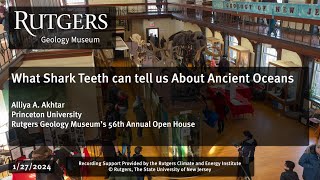
What Shark Teeth Can Tell Us About Ancient Oceans
Explore ancient oceans through shark teeth fossils, uncovering climate history and marine ecosystem evolution with Princeton researcher Alliya A. Akhtar.
The Serpent Rises from the Waves - Origin of Mosasaurus, Lizard King of the Cretaceous
Explore the fascinating evolution of Mosasaurus, the dominant marine predator of the Cretaceous period, through expert insights and paleontological discoveries.
Earth and Planetary Sciences - Lightning Talks
Explore diverse Earth & Planetary Sciences topics through rapid-fire faculty presentations, covering geology, climate change, oceanography, and more in concise 3-minute talks.
Linking Petrological and Geophysical Monitoring of Volcanic Eruptions - La Palma Example
Explore the connection between petrology and geophysics in volcanic eruption monitoring, focusing on La Palma's case study with Dr. Marc-Antoine Longpré.
Building a Reliable Record of Animals' First Homes
Explore ancient sedimentary rocks to uncover the puzzling late emergence of complex life on Earth and its implications for the search for extraterrestrial life.
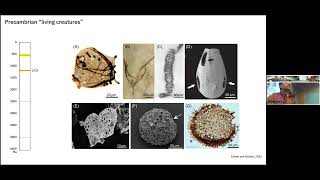
Insights into Ancient Sedimentary Environments via Three-Dimensional Reconstructions
Explore ancient sedimentary environments through 3D reconstructions, uncovering Earth's history and early life evolution via innovative analysis of rock records and fossils.