
Additive Decoders for Latent Variables Identification
Explore additive decoders for latent variable identification and out-of-support image generation in representation learning. Gain insights into nonlinear ICA and object-centric representation learning.
Generalization in Diffusion Models from Geometry-Adaptive Harmonic Representation
Explore generalization in diffusion models through geometry-adaptive harmonic representation. Analyze denoising DNNs, score functions, and inductive biases to understand high-dimensional density learning and optimal basis adaptation.
Consistency Trajectory Models: Learning Probability Flow ODE Trajectory of Diffusion
Explore advanced diffusion models with Consistency Trajectory Models, improving sample quality and efficiency in AI-driven image generation. Learn novel sampling techniques and state-of-the-art results.
Reflected Diffusion Models: Principled Data Constraints in Generative Modeling
Explore reflected diffusion models for improved image generation. Learn about reversing stochastic differential equations, addressing numerical errors, and incorporating data constraints in principled ways.
PFGM++: Unlocking the Potential of Physics-Inspired Generative Models
Explore PFGM++, a physics-inspired generative model unifying diffusion models and PFGMs. Learn about its flexible embedding, unbiased objectives, and superior performance on image datasets.

One Pixel Adversarial Attacks via Sketched Programs
Explore a novel approach for one-pixel adversarial attacks using program synthesis, achieving state-of-the-art success rates with fewer queries and transferable programs for neural network classifiers.

Face Anonymization with Python - Blurring and Pixelating Techniques
Anonymize faces in images using Python: detect, blur, and pixelate for privacy. Learn CPU and GPU techniques, compare results, and ensure data protection in your projects.
Computer Vision Workshop on OpenShift: AI/ML Platform for Model Development and Deployment
Explore computer vision use cases on OpenShift, from data collection and annotation to model training and deployment, with practical demonstrations on cars and trains detection.
Learning with Marginalized Corrupted Features
Explore machine learning with marginalized corrupted features, a novel approach to enhance generalization and scalability in finite data scenarios. Discover applications in risk minimization and document representation.
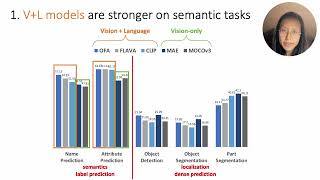
Localization vs. Semantics: Visual Representations in Unimodal and Multimodal Models
Explore visual representations in unimodal and multimodal models, comparing their strengths in label prediction and dense prediction tasks. Gain insights into language's role in visual learning.
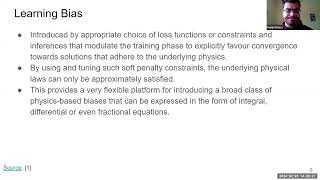
Intersection of Physics and AI - Incorporating Physics into Data-Driven Computer Vision
Explore the fusion of physics and AI, covering applications in NLP, healthcare, and computer vision. Learn innovative approaches to incorporate physics into data-driven models.
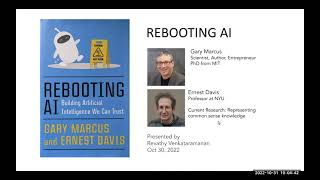
Rebooting AI: Building Artificial Intelligence We Can Trust - Part 1
Explore key insights from "Rebooting AI" in this book review, examining current AI limitations and future potential for more robust and reliable artificial intelligence systems.
Deep Learning of Generative Models - 2014
Explore generative models in deep learning with Yoshua Bengio, covering motivations, applications, and fundamental challenges in AI and machine learning.

Learning Energy-Based Models of High-Dimensional Data - 2002
Explore energy-based models for high-dimensional data analysis. Learn about deterministic networks, perceptual inference, and efficient learning techniques for large-scale models.

Autonomous Driving: Technology, Benefits, and Challenges
Explore self-driving car technology, including autonomy levels, sensors, AI systems, and their impact on transportation. Gain insights into cutting-edge research projects in autonomous driving.

Introduction to Generative AI Tools
Explore generative AI tools and their applications in various fields. Gain insights into cutting-edge technologies shaping the future of artificial intelligence.
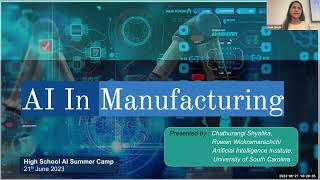
AI in Manufacturing
Explore AI's transformative role in manufacturing, from historical context to current applications and future trends, with a focus on South Carolina's industrial landscape.
Applications of AI
Explore diverse AI applications across industries, from healthcare to finance, and learn how AI is revolutionizing problem-solving and decision-making processes.
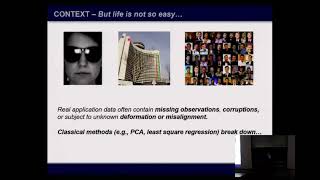
Pursuit of Low-dimensional Structures in High-dimensional Data - 2013
Explore techniques for extracting low-dimensional structures from high-dimensional data, with applications in computer vision, image processing, and pattern recognition. Learn about convex optimization and regularization methods.

A Stochastic Feedback Model for Image Retrieval
Explore a stochastic feedback model for image retrieval, presented by Donald Geman from Johns Hopkins University's Center for Language & Speech Processing.

Make Your Own Scheduler in ComfyUI
Create custom schedulers in ComfyUI for various AI models. Learn scheduler functionality, benefits, and implementation techniques for enhanced image generation control.