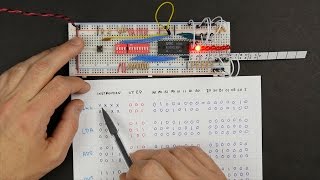
8-bit CPU Control Logic - Implementing EEPROMs for Microinstructions - Part 3
Explore EEPROM-based control signal generation for an 8-bit CPU, translating instruction cycles and register contents into microinstructions, culminating in running a complete program.
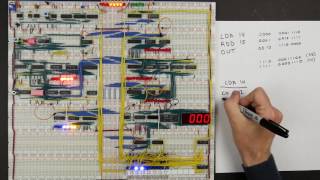
8-Bit CPU Control Logic - Part 1
Explore the creation of a custom machine language and learn how control logic executes programs in an 8-bit CPU, providing insights into low-level computer architecture.

Build an 8-Bit Decimal Display for 8-Bit Computer
Learn to create a multiplexed decimal display for an 8-bit computer using EEPROM, exploring both unsigned and signed modes, and enhancing your digital electronics skills.
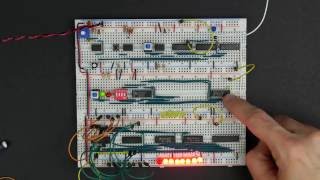
RAM Module Build for 8-Bit Computer - Part 2
Constructing a RAM module with memory address register and DIP switches for an 8-bit computer, focusing on address setting and switching logic.
Subroutine Calls with RAM - 6502 Part 7
Explore subroutine calls and RAM usage in 6502 assembly programming. Learn advanced techniques for efficient memory management and code organization in retro computing.

Making a Computer Turing Complete
Explore Turing completeness, Turing machines, and Lambda calculus, and learn how to make an 8-bit breadboard computer capable of solving any computable problem.

Adding Machine Language Instructions to the CPU
Explore CPU enhancements with new instructions: STA, LDI, and JMP. Learn to write and execute programs using these additions, expanding your understanding of machine language.
8-Bit CPU Control Logic - Instruction Cycle and Fetch Implementation - Part 2
Explore instruction cycles, build a ring counter, and implement a fetch cycle in this hands-on tutorial on 8-bit CPU control logic.
8-Bit CPU Control Signal Overview
Detailed overview of control signals in an 8-bit breadboard computer, covering memory, RAM, instruction register, and program counter operations with practical demonstrations.
8-Bit Computer Build - Connecting the Bus and Output Register
Learn to build an 8-bit register and connect components through a common bus and clock signal, advancing your understanding of computer architecture and digital logic design.
RAM Module Testing and Troubleshooting - Fixing Issues and Modifying Clock Edge Triggering
Learn to test, troubleshoot, and modify a RAM module, focusing on fixing issues and improving clock-triggered writes in digital circuit design.
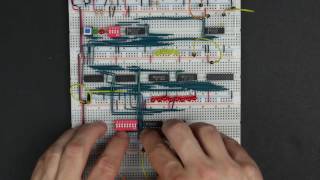
RAM Module Build for 8-Bit Computer - Part 3
Constructing a RAM module with DIP switches and logic for manual data input in program mode, while enabling bus-to-RAM data writing in run mode.
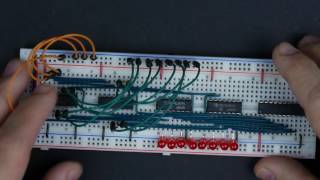
RAM Module Build for 8-Bit Computer - Part 1
Detailed walkthrough of building a RAM module for an 8-bit computer, focusing on component selection and initial assembly steps.

Introduction to 16-Byte Static RAM for 8-Bit Computer
Introduction to building a 16-byte by 8-bit static RAM for an 8-bit computer, exploring its functionality and the use of the 74LS189 chip in the construction process.

ALU Design for 8-Bit Computer
Explore the design of an 8-bit computer's Arithmetic and Logic Unit, covering binary addition and negative number representation in digital systems.
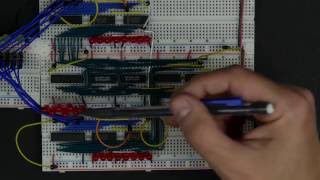
Building the ALU for an 8-Bit Computer
Construct an 8-bit computer's ALU using basic electronic components. Learn about binary addition, logic gates, and digital circuit design principles.

Twos Complement - Representing Negative Numbers in Binary
Explore binary representation of negative numbers, comparing sign bit, ones complement, and twos complement methods. Learn why twos complement is widely used in hardware implementations.
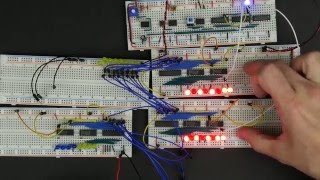
Testing Computer Registers - 8-Bit Register Construction - Part 5
Explore 8-bit register testing and connection in computer building. Learn about A, B, and Instruction registers while gaining hands-on experience with electronic components.

Making Logic Gates from Transistors
Learn how transistors form the building blocks of digital logic, from basic inverters to complex XOR gates, in this hands-on exploration of fundamental computer architecture.

Stepping Through a Program on the 8-Bit Breadboard Computer
Explore the inner workings of an 8-bit breadboard computer by stepping through a program, gaining insights into its operation and construction.
Programming an 8-Bit Breadboard Computer
Learn to program an 8-bit breadboard computer, exploring its inner workings and gaining hands-on experience in low-level computing concepts.