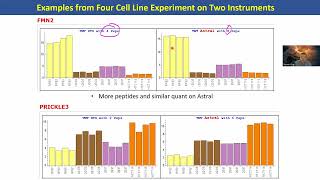
Targeted Pathway Proteomics Using TMT and Real-Time Analytics to Create GoDig Assays
Explore targeted pathway proteomics using TMT and real-time analytics for GoDig assays. Learn innovative techniques for hypothesis-driven research in systems biology.
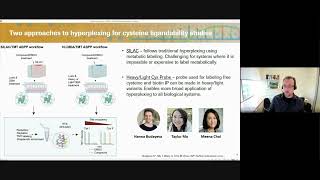
An Intelligent Data Acquisition Approach to Increase the Throughput of Multiplexed Proteome Analyses
Explore an intelligent data acquisition approach for increasing throughput in multiplexed proteome analyses, enhancing efficiency in quantitative proteomics research.
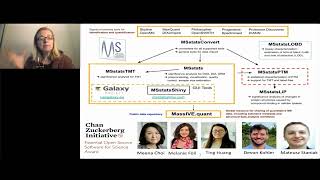
Multilevel Statistical Modeling for Proteomic Experiments With Complex Designs and Isobaric Labeling
Learn advanced statistical modeling techniques for complex proteomic experiments using isobaric labeling, focusing on multilevel designs and time-series data analysis.
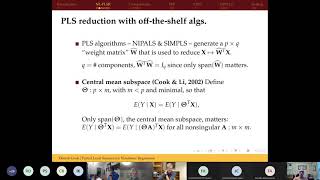
Partial Least Squares for Nonlinear Regression
Explore dimension reduction in PLS regression for nonlinear relationships, challenging traditional views and proposing new insights into PLS-like methods for predictive modeling.
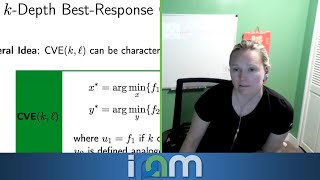
Learning via Conjectural Variations - IPAM at UCLA
Explore learning via conjectural variations, including challenges, equilibrium concepts, experiments, and applications in collective intelligence mathematics.
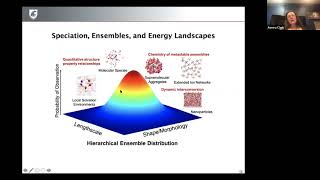
Topology in Chemistry Applications
Explore topological data analysis in chemistry, focusing on molecular relationships, graph theory, and network analysis to extract new insights from chemical data.
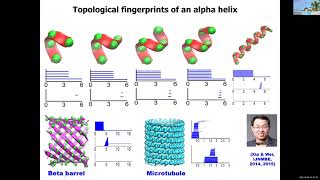
How Math and AI Are Revolutionizing Biosciences
Exploring how mathematics and AI revolutionize biosciences, focusing on tackling challenges in biological data complexity, dimensionality, and nonlinearity to enhance AI's capabilities in drug design and viral mutation prediction.
Persistence and First-Passage Properties of Stochastic Processes by Satya N Majumdar
Explore stochastic processes, focusing on persistence and first-passage properties. Covers applications in chemistry, finance, astrophysics, and more. Examines Markov processes and run-and-tumble particle models.
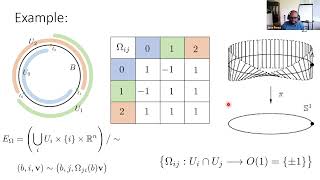
Vector Bundles for Data Alignment and Dimensionality Reduction
Explore vector bundles in data science, focusing on synchronization problems and topology-preserving dimensionality reduction. Applications in computational chemistry and dynamical systems are presented.
Sampling Using Diffusion Processes, From Langevin to Schrödinger
Explore diffusion processes in sampling, from Langevin dynamics to Schrödinger bridges, with insights on geometric methods in optimization and their applications.
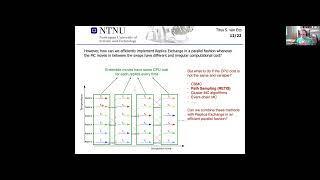
Exchanging Replicas with Unequal Cost, Infinitely and Permanently
Innovative replica exchange method for parallel simulations with varying computational costs, enhancing efficiency in Monte Carlo algorithms and path sampling techniques.
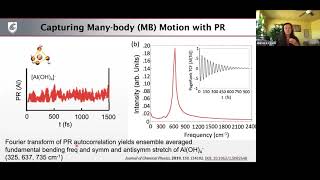
Multiscale Many-body Correlations and Structure in Chemistry Data
Integrating graphs, topology, and geometry to analyze complex chemistry data, providing insights into multiscale correlations and structures beyond traditional methods.
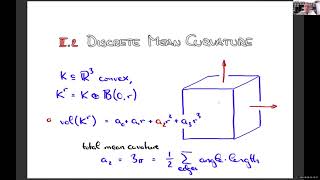
The Intrinsic Volumes of a Space Filling Diagram and Their Derivatives
Explore intrinsic volumes in molecular dynamics, focusing on space-filling diagrams and their derivatives. Learn formulas for weighted volumes and curvatures in Alpha shape representations.
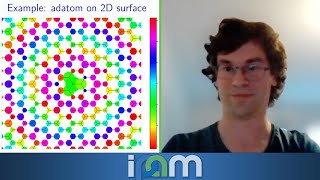
Numerical Methods for Scattering and Resonance Properties in Molecules and Solids
Explore numerical methods for discretizing continuum states in electronic structure, addressing scattering, photo-ionization, and resonances. Learn efficient computational techniques with applications in condensed matter physics and chemistry.
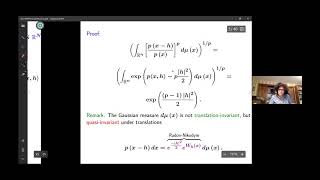
Stochastic Analysis and Geometric Functional Inequalities
Explore methods for proving functional inequalities in hypoelliptic diffusions, including geometric and probabilistic approaches, with applications to Langevin dynamics ergodicity.
Entropy Techniques for Nonlinear Partial Differential Equations - A Few Examples
Explore entropy techniques for nonlinear PDEs, focusing on Fokker-Planck equations. Learn applications in polymeric fluids, molecular dynamics, and high-dimensional algorithms.
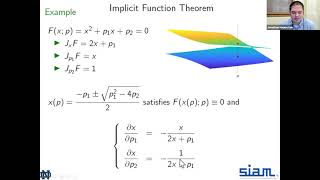
Applications of Homotopy Continuation in Science and Engineering
Explore homotopy continuation in numerical algebraic geometry and its applications in chemistry, mechanical engineering, and biological modeling. Learn about tracking solutions to parameterized nonlinear equations.
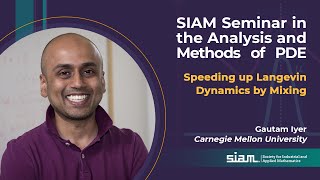
Speeding up Langevin Dynamics by Mixing
Explore a method to accelerate Langevin dynamics using mixing drift, improving convergence to stationary distribution in polynomial time for systems with multiple local minima.
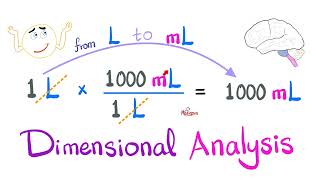
Dimensional Analysis Made Easy
Simplify complex calculations using dimensional analysis. Learn conversion factors, SI units, and practical applications in science and medicine. Master this essential skill for problem-solving.
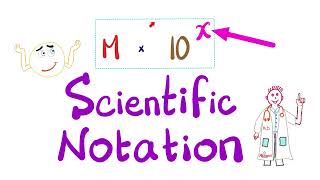
Scientific Notation & Significant Figures
Learn essential math skills for science: scientific notation and significant figures. Master expressing large numbers and rounding for precise calculations in chemistry, physics, and biology.
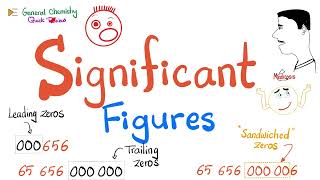
Significant Figures - Questions and Answers
Comprehensive guide on significant figures with 20 Q&As, covering key concepts and applications in chemistry, physics, and mathematics for accurate measurements and calculations.