CSIR NET Problems and Answers
Comprehensive video series explaining CSIR NET life sciences exam problems, covering molecular biology, genetics, biochemistry, and cell biology. Includes step-by-step solutions and practical applications of key concepts.
Characterization of Construction Materials
Explore advanced techniques for analyzing construction materials, including calorimetry, X-ray diffraction, thermal analysis, microscopy, and spectroscopy. Gain practical skills for material characterization.
Basic Definition of Multivariate Data Analysis - Chemometrics
Explore fundamental concepts of multivariate data analysis and chemometrics, including univariate vs. multivariate data, latent variables, and their applications in analytical chemistry.
Method Development and Validation in Pathology - Lecture 6
Develop and validate measurement methods for pathology, including metrological traceability, reference materials, calibrants, and controls for accurate diagnostic services.
New Search Methods for Primitive and Intelligent Life Beyond Earth
Explore novel techniques for detecting primitive and intelligent life beyond Earth, from our solar system to distant stars, and discuss the implications for our cosmic understanding.
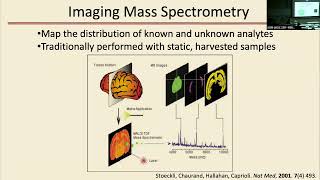
Spatial SILAC - Developing Isotopic Zip Codes for Drug Development in 3D Cell Cultures
Explore innovative drug development techniques using Spatial SILAC in 3D cell cultures, presented by Prof. Amanda Hummon from Ohio State University.
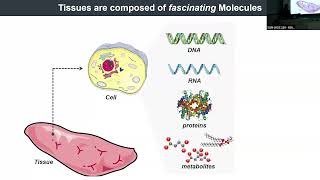
Mass Spectrometry Analysis in Cancer Research - Winter 2023
Explore cutting-edge mass spectrometry techniques for cancer research, focusing on direct analysis methods and their applications in basic and translational studies.
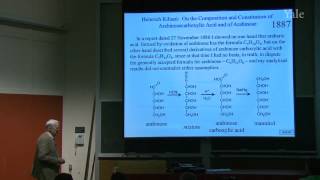
Proving the Configuration of Glucose and Synthesizing Cyclobutadiene - Lecture 37
Explore glucose structure, configuration proof, and synthesis of unnatural products. Delve into historical developments and modern spectroscopic techniques in organic chemistry.
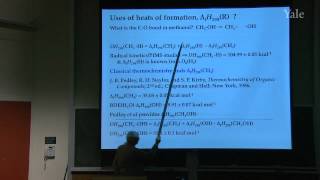
Measuring Bond Energies in Organic Chemistry
Prof. Ellison explores advanced techniques for measuring bond energies in polyatomic molecules, combining spectroscopy, mass spectrometry, and thermochemistry to provide insights into chemical bonding and resonance.
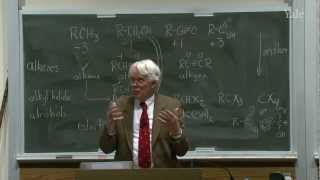
Oxidation States and Mechanisms in Organic Chemistry - Lecture 30
Explore oxidation states, spectroscopy, and reaction mechanisms in organic chemistry. Learn about carbon oxidation states and alcohol oxidation processes through practical examples and exam questions.

Organic Chemistry by CrashCourse
Comprehensive introduction to organic chemistry covering nomenclature, structure, reactions, and spectroscopy. Develop skills in mechanism sketching, synthesis planning, and connecting chemical properties to real-world applications.
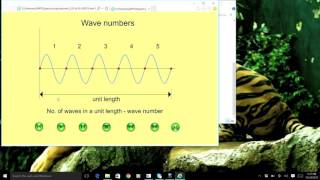
Chemistry - II
Explore advanced molecular spectroscopy, including vibrational and rotational spectra, microwave spectroscopy, and Raman spectroscopy. Gain insights into molecular structure and dynamics.
Chemistry I - Introduction to Quantum Chemistry and Molecular Spectroscopy
Explore quantum chemistry and molecular spectroscopy, covering topics from Bohr's atom to polyatomic vibrations, with a focus on mathematical foundations and practical applications.
Biophysical Chemistry
Explore protein structure, folding mechanisms, and biophysical techniques. Gain insights into forces driving protein stability, denaturation processes, and experimental methods for studying protein dynamics.
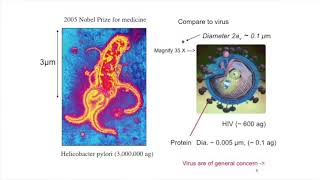
NYU Tandon's Ultra-sensitive Whispering Gallery Mode Biosensor - Part One: Motivation and History
Explore ultra-sensitive biosensors for pathogen detection, focusing on whispering gallery mode technology and its applications in virus detection and molecular spectroscopy.
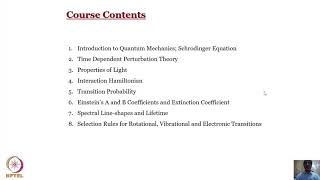
Quantum Mechanics and Molecular Spectroscopy
Explore fundamental principles of quantum mechanics and molecular spectroscopy through comprehensive lectures, gaining insights into atomic and molecular behavior and spectroscopic techniques.
Quantum Mechanics and Molecular Spectroscopy
Explore fundamental principles and applications of quantum mechanics and molecular spectroscopy through comprehensive lectures, enhancing understanding of atomic and molecular behavior.

Introduction to Principles of Plasma Diagnostics - Lecture 1
Explore the fundamentals of plasma diagnostics, including their importance and applications in various types of plasmas. Gain insights into this crucial field of study.

Equilibria and Imaging in Plasma Diagnostics - Lecture 15
Explore X-ray imaging in plasma diagnostics, covering spectra modeling, filters, and detectors. Learn key techniques for analyzing plasma equilibria and interpreting imaging data.

Line Broadening in Plasma Diagnostics - Lecture 16
Explore natural, Doppler, Stark, and Zeeman mechanisms for line broadening in plasma diagnostics. Gain insights into advanced spectroscopic analysis techniques for plasma research.

Principles of Plasma Diagnostics - Neutral Particles - Lecture 18
Explore neutral particle behavior in plasmas, their diagnostic applications, and impact on plasma dynamics. Gain insights into advanced plasma physics concepts and measurement techniques.