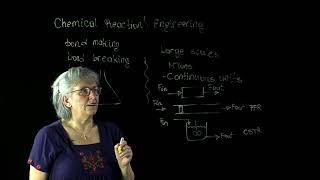
Advanced Chemical Reaction Engineering - Prof. Dr. Deniz Üner
Explore advanced concepts in chemical reaction engineering, including reactor design, energy balances, kinetics, and complex reactions for both ideal and non-ideal systems.
Stanford Chemical Engineering Online Master's Degree Program Webinar
Explore Stanford's online Chemical Engineering MS program: curriculum, career benefits, and enrollment details. Faculty discuss this part-time degree's unique features and answer questions.

Chemistry by CrashCourse
Crash Course creates free, high-quality educational videos used by teachers and learners of all kinds. In 46 episodes, Hank Green will teach you chemistry!

Chemical Kinetics - Initial Rates Method
Learn to calculate reaction rates, identify rate law expressions, and determine rate constants in this comprehensive introduction to chemical kinetics, with practical examples and problem-solving techniques.
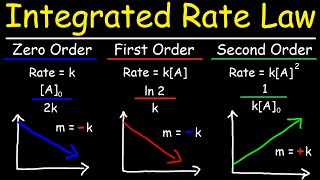
Integrated Rate Laws - Zero, First, and Second Order Reactions - Chemical Kinetics
Comprehensive introduction to chemical kinetics, covering integrated rate laws for zero, first, and second-order reactions. Includes problem-solving techniques for rate constants, concentrations, and half-life calculations.
Surface Tension and Role of Surfactant
Comprehensive exploration of surface tension and surfactants, covering fundamental concepts, applications, and their crucial role in various biological and industrial processes.
Chemical and Biological Thermodynamics - Principles to Applications
The course is designed to benefit students of chemistry, chemical engineering, biotechnology and pharmaceutical sciences to learn from basic concepts of chemical thermodynamics to applications in chemical and pharmaceutical industries including protein f…
Measuring Bond Energies in Organic Chemistry
Prof. Ellison explores advanced techniques for measuring bond energies in polyatomic molecules, combining spectroscopy, mass spectrometry, and thermochemistry to provide insights into chemical bonding and resonance.
Cation Intermediates and Alkene Reactions - Formation, Addition, and Stability
Explore cation intermediates, alkene reactions, and isomer stability. Learn about SN1 and E1 mechanisms, electrophilic addition, and using the NIST Webbook for thermochemical data analysis.
Chemistry - Rate Processes
Explore reaction rates, complex reactions, and theories in chemistry. Learn about specific reactions, enzyme inhibition, oscillatory reactions, and advanced topics like ultrafast processes and reaction dynamics.
Thermodynamics & Kinetics
Comprehensive exploration of chemical thermodynamics and kinetics, covering laws, equilibrium, electrochemistry, and reaction dynamics. Ideal for deepening understanding of fundamental chemical principles.
Combustion
Comprehensive exploration of combustion principles, from chemical reactions and kinetics to flame dynamics, diffusion processes, and advanced topics like turbulent combustion and detonations.
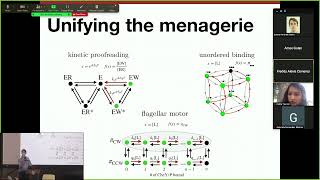
The Laws of Sensitivity for Small Nonequilibrium Systems
Explore laws constraining sensitivity in small, nonequilibrium systems. Uncover mechanisms behind biochemical switches, sensors, and molecular discrimination, with implications for gene regulation models.
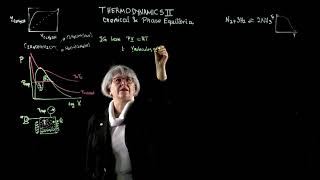
Thermodynamics II - Prof. Dr. Deniz Üner
Explore advanced thermodynamics concepts, including chemical equilibria, phase stability, fugacity, and multicomponent mixtures. Gain insights into Gibbs energy, activity coefficients, and chemical reaction equilibrium.
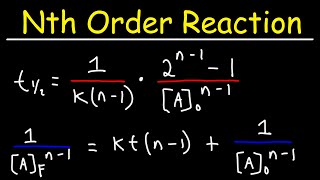
Integrated Rate Laws and Half Life Formula - Nth Order Reaction - Chemical Kinetics
Explore integrated rate laws and half-life formulas for nth order reactions in chemical kinetics, enhancing your understanding of reaction rates and mechanisms.
Kinetics-Reactor Design - Non-Isothermal Reactors
Explore non-isothermal reactor design, covering activation energy, heat effects, adiabatic systems, heat exchange, and multiple steady-states through comprehensive screencasts with closed captioning.
MEB - Energy Balances
Comprehensive exploration of energy balances in chemical engineering, covering nonreactive and reactive systems, steam tables, psychrometric charts, and thermochemistry concepts.
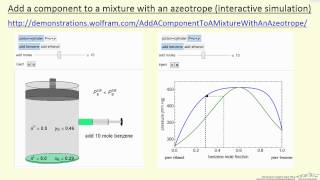
Thermodynamics - Interactive Simulations
Interactive simulations exploring thermodynamic phenomena, from phase diagrams to chemical equilibrium. Hands-on learning of complex concepts using Mathematica, covering a wide range of topics in thermodynamics.
Thermodynamics: Reaction Equilibria
Explore reaction equilibria, equilibrium constants, Gibbs energy, and colligative properties through comprehensive screencasts covering key thermodynamic concepts and applications.
Chemistry
Explore advanced chemistry topics including quantum theory, computational methods, and nonlinear dynamics with expert lectures on cutting-edge research and applications.
Fundamentals of Combustion - I
Explore combustion fundamentals, thermodynamics, stoichiometry, and chemical equilibrium. Learn about fuel types, flame temperatures, and reaction kinetics in this comprehensive introduction.