Principles and Applications of NMR Spectroscopy
The objective of the course is to teach the basic aspects of nuclear magnetic resonance (NMR) spectroscopy, which is an important analytical tool in chemical and pharmaceutical industry for the structural characterization of molecules.
Proving the Configuration of Glucose and Synthesizing Cyclobutadiene - Lecture 37
Explore glucose structure, configuration proof, and synthesis of unnatural products. Delve into historical developments and modern spectroscopic techniques in organic chemistry.
Oxidation States and Mechanisms in Organic Chemistry - Lecture 30
Explore oxidation states, spectroscopy, and reaction mechanisms in organic chemistry. Learn about carbon oxidation states and alcohol oxidation processes through practical examples and exam questions.
Higher-Order Effects, Dynamics, and the NMR Time Scale - Lecture 24
Explore advanced NMR concepts: higher-order effects, dynamics, and time scales. Learn about hybridization, spin-spin splitting, and spectral prediction for complex molecular structures.
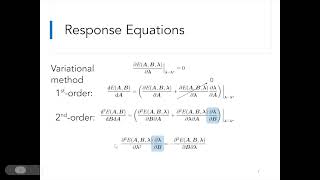
Calculating NMR Shielding with GIAO - Q-Chem Webinar 70
Explore numerical finite difference approach for NMR shielding calculations using gauge-including atomic orbitals. Learn theory, implementation, and results with κ-MP2 and MP2.X methods in Q-Chem software.
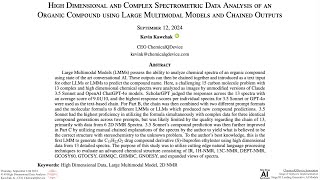
High Dimensional and Complex Spectrometric Data Analysis of an Organic Compound Using Large Multimodal Models
Explore advanced spectrometric data analysis using Large Multimodal Models to identify complex organic compounds, focusing on (S)-ibuprofen ethylester as a case study.
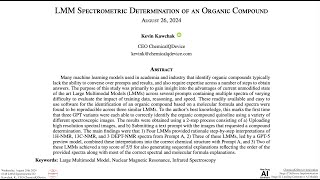
LMM Spectrometric Determination of an Organic Compound
Explore how Large Multimodal Models analyze chemical spectra to determine organic compounds, focusing on a groundbreaking study using GPT-based models to identify quinoline.
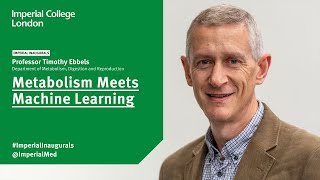
Metabolism Meets Machine Learning: Computational Metabolomics
Explore computational metabolomics, combining metabolism and machine learning. Discover metabolite measurement, data analysis, and future directions in biomedical science.
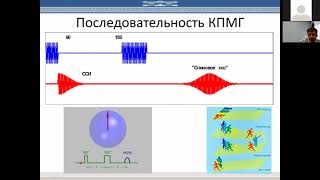
Ядерный Магнитный Резонанс
Изучите основы ядерного магнитного резонанса, его принципы и применение в различных областях науки и техники.