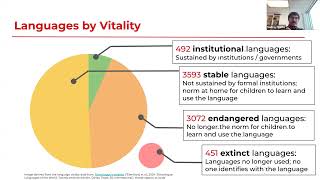
Multilingual Large Language Models - Fundamentals and Applications
Explore the capabilities and applications of multilingual language models through an in-depth technical lecture covering key concepts, challenges, and implementation strategies.
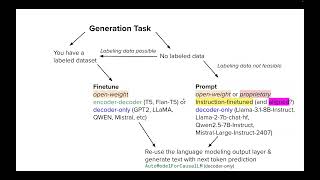
Abstractive Summarization and Text Generation Evaluation
Explore advanced techniques in abstractive summarization and learn effective methods for evaluating text generation outputs in natural language processing.
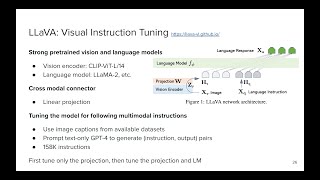
Vision and Language Large Language Models
Explore the intersection of vision and language in Large Language Models, understanding their capabilities, architectures, and real-world applications in AI systems.
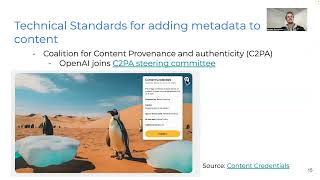
Detecting AI-Generated Content - Advances in Generative AI
Explore cutting-edge techniques for detecting AI-generated content, focusing on latest methodologies, challenges, and practical applications in content authentication and verification.
Evaluating World Models in Generative AI - A Critique of AI Intelligence Assessment
Explore groundbreaking research from top universities challenging AI evaluation methods, revealing limitations in language models' structural understanding and proposing new assessment frameworks.
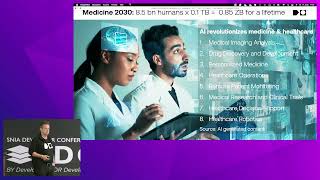
Will AI Stay Dumb for the Lack of Memory and Storage? - Impact of Storage Technologies on AI Development
Explore the critical relationship between AI advancement and data storage limitations, examining how memory constraints could impact AI's future development and potential solutions.
Standards-based Data Platforms for HPC and AI
Explore how standardized frameworks optimize data platforms for HPC and AI, focusing on interoperability, data movement, and system integration for enhanced performance and efficiency.

Accelerating Data Movement with Peer-to-Peer Direct Memory Access (P2PDMA) Technology
Delve into advanced P2PDMA technology for optimizing data transfers between PCIe devices, focusing on AI applications, computational storage, and practical implementation strategies.
PCIe Cabling Solutions for Next Generation AI, HPC and Storage Applications
Explore PCIe cabling innovations including CopprLink specifications and external cabling solutions for high-speed data transmission in AI, storage, and data center applications.

What Can Storage Do for AI? - Optimizing NVMe Storage for Large Language Models
Explore how NVMe flash storage enables AI model deployment at scale, from data center training to edge device inference, with focus on optimization techniques and performance improvements.
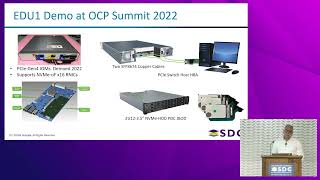
Optimizing HDD Interface for the Generative AI Era
Explore how AI's explosive data growth impacts mass storage requirements and discover strategies for optimizing HDD interfaces, workloads, and performance in modern AI-driven datacenters.
Cloud Storage Considerations for RAG in AI Applications
Explore cloud object storage implementation in RAG systems, covering LLM-OS concepts, domain-specific data handling, and practical applications for building AI-powered solutions with vector databases.

Storage for AI Fundamentals - Introduction to AI Workloads and Storage Requirements
Gain insights into AI workload fundamentals, storage requirements, and data transport systems while learning to identify and understand key characteristics of AI infrastructure demands.

Supercharging OpenAI Training with Azure Blob Storage - Architecture and Best Practices
Dive into Azure Blob Storage's architecture and innovations enabling massive-scale AI training, featuring insights on achieving multi-exabyte storage and terabit-level throughput for advanced workloads.

Memory Optimizations in Machine Learning
Discover essential memory optimization techniques for machine learning, from data quantization to model pruning, and learn efficient strategies for minimizing resource consumption across different hardware setups.

Smart Data Accelerator Interface (SDXI) - Use Cases, Proof Points and Future Development
Explore SNIA's Smart Data Accelerator Interface standard, covering use cases in AI, implementation demos, v1.1 features, and opportunities to contribute to this emerging memory-to-memory data movement technology.

CXL Technology for AI and ML Workloads - Memory Expansion and Performance Optimization
Explore how CXL technology revolutionizes AI/ML workloads through memory expansion, pooling, and sharing. Master performance optimization techniques for large language models and learn practical implementation strategies.

Storage in the Era of Large-scale AI Computing
Explore the critical storage challenges and solutions in large-scale AI computing, focusing on emerging applications like Vector DBs and RAGs while examining full-stack infrastructure requirements.
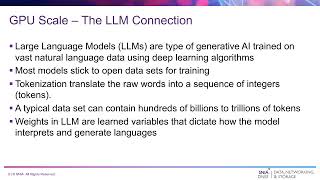
Ethernet in the Age of AI - Adapting to New Networking Challenges
Explore how Ethernet networks are evolving to handle AI workloads, from network topologies to congestion management, with focus on practical solutions for machine learning implementations.
Games and Filters: A Road to Safe Intelligence
Explore game-theoretic approaches and safety principles in AI systems, from robotic control to human-AI interactions, focusing on developing reliable safety guarantees for autonomous systems.
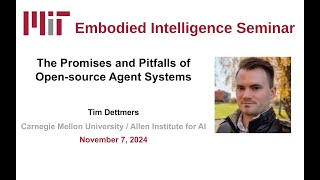
The Promises and Pitfalls of Open-source Agent Systems
Explore the potential and challenges of open-source AI agent systems, examining their performance compared to closed-source alternatives and key issues in evaluation and generalization.