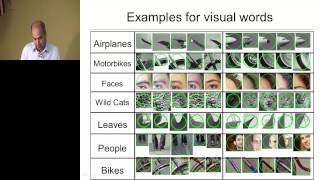
Bag-of-Features for Image Classification - Lecture 17
Learn about Bag-of-Features in computer vision, covering image classification, feature distribution, clustering, and support vector machines for visual recognition tasks.
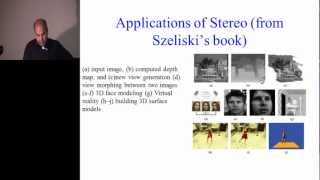
Stereo Vision and Depth Perception in Computer Vision - Lecture 16
Explore stereo vision techniques, including shape reconstruction, rectification, correspondence, and correlation methods for depth perception in computer vision applications.
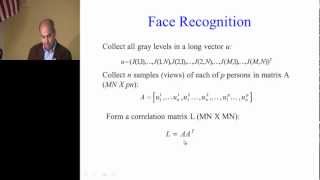
Face Recognition Techniques and Applications - Lecture 14
Explore face recognition techniques, from simple approaches to advanced methods like PCA and Linear Discriminant Analysis. Learn about eigenvectors, image compression, and scatter matrices.
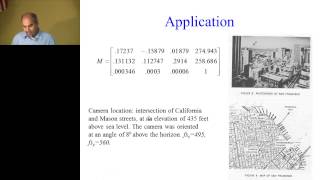
Camera Model and Perspective Projection - Lecture 12
Explore camera models, coordinate systems, and transformations in computer vision. Learn about perspective projection, focal length, and essential concepts for image analysis and 3D reconstruction.
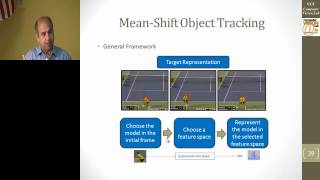
Mean Shift Algorithm for Computer Vision - Lecture 11
Explore mean shift algorithm for computer vision, covering theory, implementation, and applications in tracking and segmentation. Learn from expert Dr. Mubarak Shah.
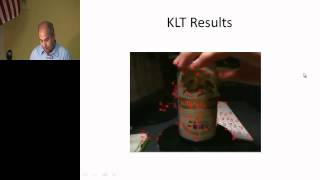
Lucas-Kanade Tracker (KLT) - Global Motion Estimation - Lecture 10
Explore Lucas-Kanade Tracker (KLT) for computer vision, covering global motion estimation, object tracking, and 2D transformations. Gain insights into advanced tracking algorithms.
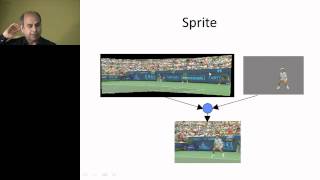
Global Motion in Computer Vision - Lecture 9
Explore global motion in computer vision, covering motion models, flow estimation, image warping, video mosaics, and projective transformations for advanced visual analysis techniques.
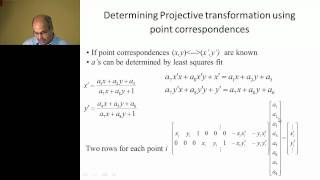
Motion Models in Computer Vision - Lecture 8
Learn about optical flow, rotation, image formation, and 3D rigid motion in computer vision. Explore displacement models and projective transformations using point correspondences.
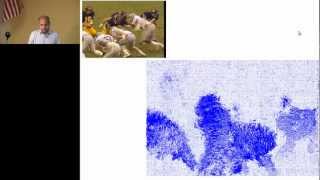
Optical Flow in Computer Vision - Lecture 6
Learn about optical flow in computer vision, covering applications, optimization problems, Laplacians, and solutions, with practical examples and in-depth explanations.
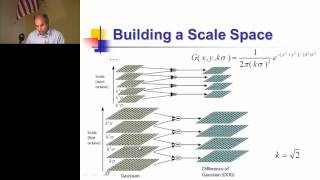
Scale-invariant Feature Transform (SIFT) - Lecture 5
Learn about Scale-invariant Feature Transform (SIFT), a robust algorithm for detecting and describing local features in images. Explore key point extraction, scale space, and descriptor generation.
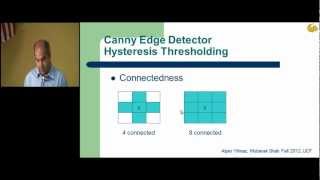
Edge Detection in Computer Vision - Lecture 3
Explore edge detection techniques in computer vision, including Marr-Hildreth and Canny methods. Learn about 2-D Gaussian filters, zero crossings, and hysteresis thresholding for improved image analysis.
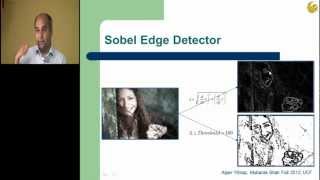
Filtering in Computer Vision - Lecture 2
Learn about image filtering techniques, including noise reduction, edge detection, and smoothing. Explore applications in computer vision and gain hands-on experience with MATLAB functions for image processing.
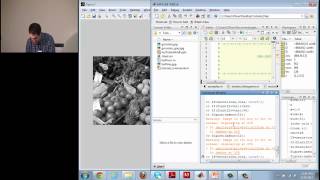
Matlab Tutorial
Learn MATLAB basics for computer vision: variables, vectors, matrices, image operations, filters, and more. Practical tutorial for beginners and intermediate users.
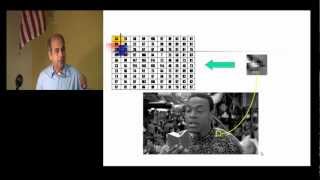
Introduction to Computer Vision - Lecture 1
Explore fundamental concepts of computer vision, including image processing, object detection, and facial recognition. Learn about real-world applications in various fields.
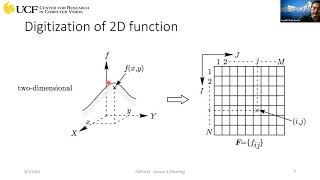
CAP5415 - Digital Image Processing: Filtering and Noise Reduction - Lecture 3
Explore image processing fundamentals, including digitization, histograms, noise types, and filtering techniques. Learn about derivatives, averages, and correlation in the context of digital image analysis.
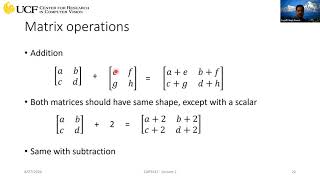
Linear Algebra Basics for Computer Vision - Lecture 2
Explore essential linear algebra concepts including vectors, matrices, transformations, and SVD, with practical applications in computer vision and machine learning.
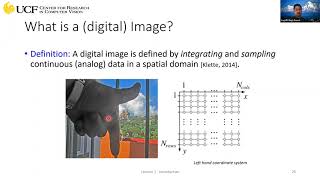
Introduction to Computer Vision - Lecture 1
Introduction to computer vision concepts, applications, and recent advancements. Explores visual perception, image types, object recognition, facial analysis, action detection, and video processing techniques.
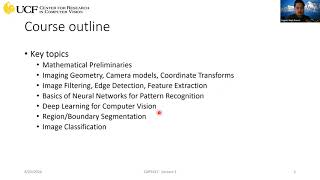
Computer Vision - Administrative Introduction - Fall 2020
Introduction to computer vision course covering topics, grading, expectations, and projects. Provides essential administrative information for students to succeed in the class.

SILCO: Show a Few Images, Localize the Common Object
Innovative approach to object detection using few support images, combining spatial similarity and feature reweighting for improved localization in challenging scenarios.
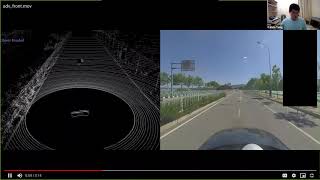
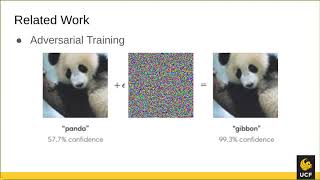
Trust Region Based Adversarial Attack on Neural Networks
Explore trust region optimization for adversarial attacks on neural networks, covering various attack methods and their applications in computer vision and object detection.
Why Can't I Dance in the Mall? Mitigating Scene Bias in Action Recognition
Explores scene bias in action recognition, proposing solutions like adversary training and human mask confusion loss to improve accuracy across different environments.