The Switching Lemma - PRST Version - Graduate Complexity Lecture at CMU
Explore the Switching Lemma in computational complexity theory, focusing on the PRST version and its proof, with insights on decision trees and probability bounds.
IP = PSPACE - Graduate Complexity Lecture at CMU
Explore interactive proof systems and their relationship to complexity classes, focusing on the IP = PSPACE theorem and its implications for computational theory.
Approximate Counting - Graduate Complexity Lecture at CMU
Explore advanced computational complexity theory, focusing on approximate counting techniques, Chebyshev's Inequality, and interactive proofs in this graduate-level lecture.
More on Constant-Round Interactive Proof Systems - Graduate Complexity Lecture at CMU
Explore constant-round interactive proof systems in computational complexity theory, covering MA, AM, BPP, and efficient error reduction techniques.

Time-Space Tradeoffs for SAT - Graduate Complexity Lecture at CMU
Explore time/space tradeoffs for SAT in this graduate-level complexity theory lecture, covering key results, proofs, and techniques like padding and alternation elimination.

The Polynomial Time Hierarchy: Graduate Complexity Lecture at CMU
Explore the Polynomial Time Hierarchy in computational complexity theory, covering definitions, examples, and key concepts like quantifying over circuits and alternation.
Hierarchy Theorems - Time, Space, and Nondeterministic: Graduate Complexity Lecture at CMU
Explore hierarchy theorems in computational complexity, covering time, space, and nondeterministic aspects. Gain insights into encoding schemes, Turing machines, and nondeterministic certificates.
Hopcroft-Paul-Valiant Theorem - Graduate Complexity Lecture at CMU
Explore the Hopcroft-Paul-Valiant theorem in computational complexity, covering simulation, graph analysis, and pebble games. Gain insights into low space simulation and depth reduction techniques.
Circuits - Graduate Complexity Lecture 4 at CMU
Explore graduate-level computational complexity theory, focusing on circuits, complexity measures, and lower bounds in this advanced lecture from Carnegie Mellon University.
Hardness of Approximation - Part 1
Explore hardness of approximation in computational complexity, covering Max Cut, Independent Set, and K-Cover problems. Learn key definitions, algorithms, and current research state.
Great Ideas in Theoretical Computer Science: Time Complexity - Spring 2016
Explore time complexity in theoretical computer science, covering running time, worst-case scenarios, and common runtime scaling, with practical examples and formal definitions.
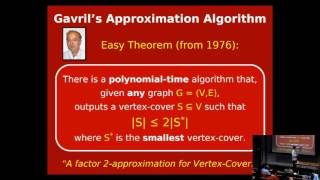
Approximation Algorithms
Explore approximation algorithms for NP-hard problems, focusing on vertex cover, k-coverage, and traveling salesperson. Learn greedy approaches and their limitations, as well as more advanced techniques.
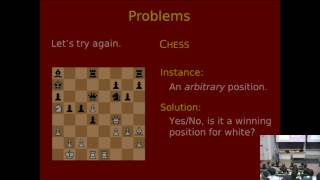
Time Complexity
Learn about time complexity in algorithms, covering input sizes, running time analysis, worst-case scenarios, and efficiency considerations for various computational problems.
Great Ideas in Theoretical Computer Science - Approximation Algorithms
Explore approximation algorithms for NP-hard problems, focusing on Vertex Cover, k-Coverage, and Traveling Salesperson. Learn techniques to find near-optimal solutions efficiently.
Analysis of Boolean Functions at CMU - Constraint Satisfaction Problems
Explore constraint satisfaction problems in boolean functions, covering topics like Max3SAT, Max3Coloring, and approximation algorithms for complex computational challenges.
Undergrad Complexity at CMU - Why is P vs. NP Difficult?
Explore the challenges of the P vs. NP problem in computational complexity theory, including negative results, Ladner's theorem, and simulations.
Undergrad Complexity at CMU - Hardness within P
Explore computational complexity theory, focusing on hardness within P, time hierarchy theorem, and fine-grained complexity. Delve into reductions, algorithms, and open questions in this advanced undergraduate lecture.
Dynamic Algorithms for Packing-Covering LPs via Multiplicative Weight Updates
Explore dynamic algorithms for packing-covering LPs using multiplicative weight updates, focusing on near-optimal approximation algorithms and complexity analysis in dynamic settings.
Tracking Techniques in Computer Vision - Session 25
Explore advanced tracking techniques and algorithms for object detection and motion analysis in computer vision applications.
Alan Turing and the Other Theory of Computing and Can a Machine Be Conscious?
Explore neuroscience advances in understanding consciousness, including the Global Workspace Model and its computational implications, with insights on free will and determinism.
A* Star Search Algorithm in Game Programming - Episode 100
Learn to implement the A* search algorithm for efficient pathfinding in game development. Gain practical skills to optimize your game's AI and navigation systems.