
Advanced Algorithms - COMPSCI 224
Explore cutting-edge algorithmic techniques through comprehensive lectures, enhancing problem-solving skills and deepening understanding of complex computational challenges.
Theory of Automata, Formal Languages and Computation
Explore automata theory, formal languages, and computation through grammars, finite state automata, pushdown automata, Turing machines, and advanced topics in theoretical computer science.
Design & Analysis of Algorithms
Comprehensive exploration of algorithm design techniques, analysis frameworks, and problem-solving strategies, covering divide-and-conquer, greedy algorithms, dynamic programming, and NP-completeness.
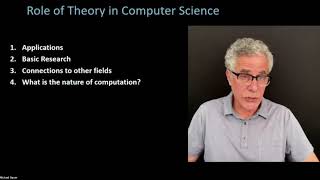
Theory of Computation, Fall 2020
Explore computability and complexity theory with MIT's in-depth course. Covers automata, Turing machines, undecidability, NP-completeness, and advanced topics in computational theory.
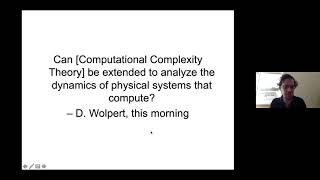
Tutorial on Computer Science - Josh Grochow
Explore key concepts in computer science, from model independence to computational complexity theory, with insights on P vs NP and various computational models.
The Parallelism Tradeoff: Understanding Transformer Expressivity Through Circuit Complexity
Explore transformer neural nets' computational power and limitations through circuit complexity analysis, revealing insights into parallelism tradeoffs in large-scale model architectures.
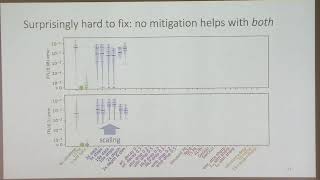
Limitations of Attention Mechanism in Transformers - Implications for Generalization and Optimization
Explore Transformer's reasoning capabilities and limitations in sequential tasks, examining optimization challenges and out-of-distribution generalization issues compared to RNNs.
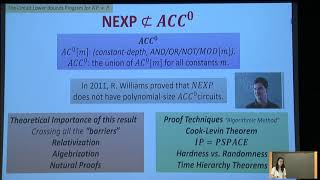
Strong Average-Case Circuit Lower Bounds from Non-trivial Derandomization - Lijie Chen
Explore advanced topics in computational complexity, including circuit lower bounds, derandomization, and their connections. Gain insights into cutting-edge research and theoretical developments in computer science.
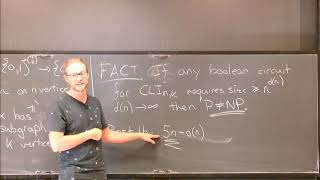
Proof and Circuit Complexity - Robert Robere
Explore proof and circuit complexity with Robert Robere, delving into Boolean circuits, monotone circuits, slice functions, and the Click function to understand computational limitations.
Fixed-Parameter Tractability of Scheduling Dependent Tasks on m Machines Subject to Release Times and Deadlines
Explore fixed-parameter tractability in scheduling dependent tasks on multiple machines with release times and deadlines. Gain insights into parameterized complexity and dynamic programming approaches.
Et si SAT était vraiment difficile? Quelques conséquences des hypothèses ETH - Lecture
Explorez les implications des hypothèses ETH sur la difficulté du problème SAT et ses conséquences en informatique théorique et complexité algorithmique.
A Quick and Partial Survey on the Complexity of Query Answering
Explore the complexity of query answering in this survey, covering key concepts and recent developments in discrete mathematics and logic.
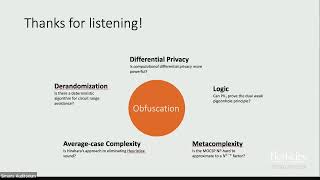
Tales of Obfuscation in Bounded Arithmetic, Metacomplexity, and Differential Privacy
Explores obfuscation's role in theoretical computer science, covering Circuit Range Avoidance, metacomplexity of Kolmogorov complexity, and computational differential privacy, with focus on recent results and open questions.
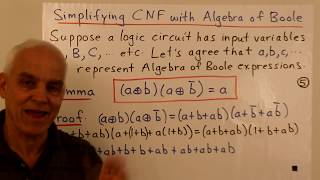
Trying to Sidestep the SAT Problem - N J Wildberger
Explores the SAT problem in Boolean algebra and logic circuits, introducing the Algebra of Boole approach as an alternative for analyzing smaller circuits and potentially addressing larger-scale issues in integrated circuit design.
Expander Graph Application 2: Derandomization - Lecture 16c of CS Theory Toolkit
Explore derandomization techniques using expander graphs to reduce error in randomized algorithms without significantly increasing random bits used.
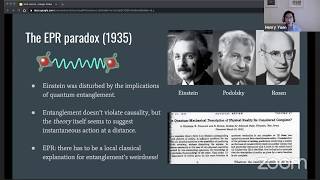
A Tale of Turing Machines, Quantum-Entangled Particles, and Operator Algebras
Explore the convergence of computational complexity, quantum information, and operator algebras in solving long-standing problems, including Connes' Embedding Problem, in this accessible lecture for a general scientific audience.
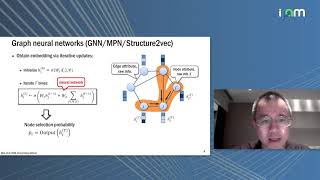
A Framework for Differentiable Discovery of Graph Algorithms
Explore graph algorithm discovery using deep learning and tree decomposition. Learn effective techniques for NP-complete problems with interpretable results and expanded search space.

Sparse Integer Programming Is FPT
Explore sparse integer programming's fixed-parameter tractability, its implications for parameterized complexity, and related concepts in variable dimension optimization.
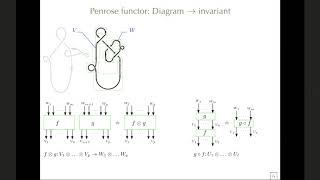
Parameterized Complexity of Quantum Invariants of Knots
Explore quantum invariants of knots, their parameterized complexity, and efficient algorithms for computation using graphical calculus and tree embeddings.
Introduction to Parameterized Algorithms and Applications
Explore parameterized complexity and its applications in discrete optimization, focusing on LP-guided techniques, Lenstra's algorithm, and structured ILPs using Graver bases.
How Hard is it to Solve This? - Computational Complexity in Problem Solving
Explore problem-solving techniques in mathematics and statistics through lectures, hands-on sessions, and interactions with distinguished researchers. Gain broader exposure to key topics and enhance analytical skills.