
Optimizing Mandelbrot Fractal Rendering - Brute Force Processing Strategies
Explore strategies to optimize Mandelbrot Fractal rendering, from algorithm improvements to vector co-processing and thread-pools, maximizing CPU performance.
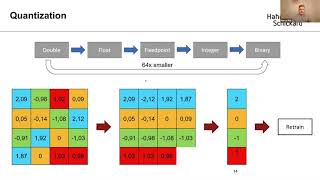
Introduction to Optimization Algorithms to Compress Neural Networks
Explore optimization techniques for compressing neural networks, including pruning and quantization, to enable deployment on resource-constrained devices like smartphones.
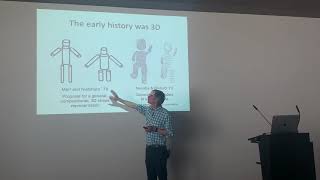
Estimating Human Motion: Past, Present, and Future
Explore the evolution of human motion estimation techniques, from early computer vision approaches to modern 3D body modeling, with insights on challenges and future directions.

ZigZag - An Architecture-Mapping Design Space Exploration Framework for Deep Learning Accelerator
Explore ZigZag, a framework for optimizing deep learning accelerator design through architecture-mapping space exploration, enhancing efficiency in embedded systems.

Probabilistic Programming
Explore probabilistic programming concepts, from intuitive physics to computational theory of mind, with hands-on practice in web-based probabilistic programming languages.
Undergrad Complexity at CMU - Oracle Turing Machines and P^NP
Explore oracle Turing machines and P^NP in computational complexity theory, focusing on solving algorithms, consequences, and the Minimum Circuit Problem.
Undergrad Complexity at CMU - BPP
Explore probabilistic algorithms and complexity class BPP in this advanced lecture on computational theory, featuring axis property amplification and upper bounds.
Undergrad Complexity at CMU - Randomized Complexity- RP, coRP, and ZPP
Explore randomized complexity classes RP, coRP, and ZPP, covering probabilistic Turing machines, error amplification, and nondeterminism in computational complexity theory.
Undergrad Complexity at CMU - The Immerman-Szelepcsényi Theorem
Explore the Immerman--Szelepcsényi Theorem in computational complexity theory, covering key concepts, proofs, and implications for nondeterministic space complexity classes.
Undergrad Complexity at CMU - From P-Completeness to PSPACE-Completeness
Explore P-completeness, reductions, and PSPACE-completeness in computational complexity theory, covering key concepts like the Cook-Levin Theorem and TQBF.
Undergrad Complexity at CMU - Savitch's Theorem and NL
Explore Savitch's Theorem and NL in computational complexity theory, focusing on space complexity, recursion, and pseudocode implementation for advanced undergraduate-level understanding.
Undergrad Complexity at CMU - NP
Explore NP complexity, verification, and key features in computational theory. Delve into stronger conjectures, brute force algorithms, and proofs for squares and colors.
Undergrad Complexity at CMU - SAT
Explore the intricacies of SAT in computational complexity theory, covering Boolean circuits, algorithms, and CNF formulas in this comprehensive undergraduate lecture.
Undergrad Complexity at CMU - Problems in P
Explore computational complexity theory, focusing on problems in P, simulations, and Turing machine variants. Learn about time hierarchy, natural problems, and efficient algorithms.
Undergrad Complexity at CMU - Turing Machines
Explore Turing Machines in computational complexity theory, covering formalization, the Turing Thesis, examples, and mathematical definitions for a comprehensive understanding.

Quantum Computing with Just 1 Qubit - The Elitzur-Vaidman Bomb Algorithm
Explore quantum computing fundamentals and the Elitzur-Vaidman bomb detection algorithm using a single qubit, covering key concepts and practical applications in this engaging lecture.
Constraint Satisfaction Problems - Lecture 20b of CS Theory Toolkit
Explore Constraint Satisfaction Problems, their formal definition, examples, and algorithms. Learn about the Dichotomy Theorem and its implications for theoretical computer science research.
The Word RAM Model - Lecture 6c of CS Theory Toolkit
Explore the Word RAM model for algorithms and its impact on integer sorting complexity in this graduate-level lecture on theoretical computer science fundamentals.
Quantum Complexity - Quantum Computation at CMU
Explore quantum complexity, error probabilities, and complexity classes in this advanced lecture on quantum computation and information theory.
Razborov-Smolensky Lower Bounds for AC0[p] - Graduate Complexity Lecture at CMU
Explore Razborov-Smolensky lower bounds for AC0[p] circuits, covering key theorems, gate replacements, and error bounds in computational complexity theory.
Permanent is #P-Complete: Graduate Complexity Lecture at CMU
Explore the #P-completeness of the Permanent problem in this advanced computational complexity theory lecture, covering key concepts and reduction techniques.