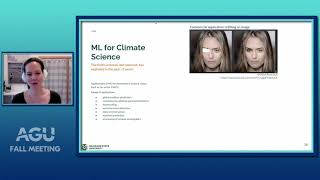
Explainable AI for the Geosciences
Explore machine learning interpretation techniques in geoscience, focusing on climate science applications and their potential for scientific discovery and increased trust in AI outputs.
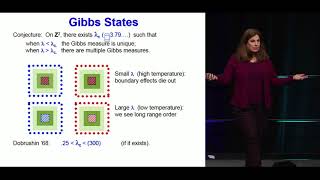
Emergent Phenomena in Random Structures and Algorithms
Explore emergent phenomena in random structures and algorithms, focusing on mathematical insights and applications in complex systems and computational methods.
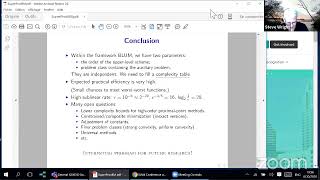
Inexact Accelerated High-order Proximal-point Methods in Convex Programming
New framework for accelerated methods in convex programming using approximations of high-order proximal points. Presents second-order method with O(k^(-4)) convergence rate, surpassing traditional complexity limits.

Bubble Sort With Example
Learn to implement and understand the Bubble Sort algorithm, including its efficiency and practical applications in sorting data structures.

Binary Search with Example
Learn efficient array searching techniques with binary search, reducing search space for faster implementation compared to linear search. Includes practical examples.

Searching an Element in Binary Search Tree - Data Structures
Learn efficient element searching in Binary Search Trees (BST) through key comparisons with the root node, navigating left or right subtrees based on value relationships.

Radix Sort / Bucket Sort - Data Structures
Learn efficient sorting algorithms for non-comparative integer sorting, including implementation techniques and time complexity analysis.

Quick Sort with Example
Learn the Quick Sort algorithm through a detailed example, understanding its steps, partitioning process, and implementation for efficient sorting of data.

Stack Application - Balancing Symbols in Data Structures
Learn to implement stack applications for balancing symbols in data structures, including infix to postfix conversion and postfix expression evaluation techniques.

Stack Application - Examples for Converting Infix to Postfix Expression - Data Structures
Learn to convert infix expressions to postfix using stack applications, with practical examples and step-by-step explanations for efficient data structure manipulation.

Double Linked List - Deletion from Beginning, Ending, and Specified Position - Data Structures
Learn efficient deletion techniques for double linked lists, including removal from the beginning, end, and specific positions within the data structure.

Circular Linked List - Deletion from Beginning, Ending, and Specified Position - Data Structures
Learn efficient deletion techniques for circular linked lists, including removal from the beginning, end, and specified positions within the data structure.

Linked List - Creation and Display - Data Structures
Learn to create and display linked lists, a fundamental data structure. Understand node composition, memory allocation, and basic operations for efficient data management.

Better Algorithms and Data Structures for BPF
Explore advanced algorithms and data structures for optimizing BPF performance in Linux systems, enhancing network processing and system observability.

Dynamic Graphs on the GPU
Explore GPU-accelerated techniques for dynamic graph algorithms, focusing on efficient data structures and parallel processing for real-time graph updates and analysis.

MGLRU: Multi-Generational Least Recently Used Algorithm
Explore MGLRU, a memory management technique for Linux systems, presented by Yu Zhao. Learn about its implementation, benefits, and impact on system performance.

A.I.'s Rendezvous with Art - The Future of Creative Expression
Alexander Reben explores AI's impact on creative expression, discussing its potential to bridge imagination and reality through his 15-year artistic practice that blends automation, algorithms, and art with playfulness and humor.
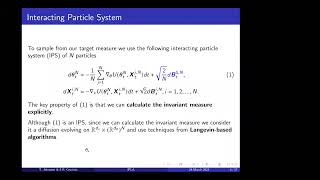
Interacting Particle Systems for Expectation Maximization in Latent Variable Models
Explore a novel interacting particle system for EM optimization in latent variable models, featuring Langevin diffusion analysis and non-asymptotic concentration bounds for maximum likelihood estimation.
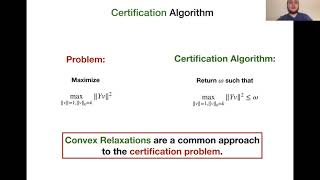
Sparse PCA: Algorithms, Adversarial Perturbations and Certificates
Explore algorithms, adversarial perturbations, and certificates in Sparse Principal Component Analysis, a crucial technique for high-dimensional data analysis and feature selection.
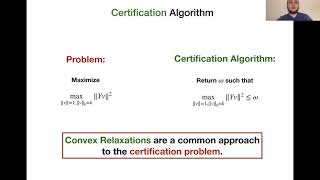
Sparse PCA: Algorithms, Adversarial Perturbations and Certificates
Explore algorithms, adversarial perturbations, and certificates in Sparse Principal Component Analysis, a crucial technique for high-dimensional data analysis and feature selection.
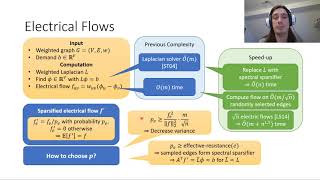
Bipartite Matching in Nearly-linear Time on Moderately Dense Graphs
Discover efficient algorithms for bipartite matching in moderately dense graphs, exploring nearly-linear time solutions and their implications for graph theory and optimization.