
Mestrado: Computação, Lógica e Teoria dos Conjuntos - Aula 01
Explore fundamentos de computação, lógica e teoria dos conjuntos em aula de mestrado. Aborde linguagens formais, máquinas de registro, decidibilidade, complexidade algorítmica e lógica de primeira ordem.
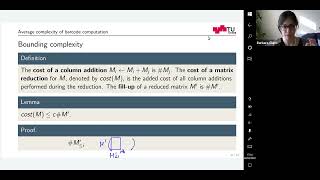
Barbara Giunti - Average Complexity of Barcode Computation for Vietoris-Rips Filtrations
Explore algorithmic complexity of persistent homology in random Vietoris-Rips filtrations, focusing on boundary matrix fill-up and its implications for computational efficiency.
Daniel Dadush- Integer Programming and the Kannan-Lovasz Conjecture
Explore advanced integer programming techniques, lattice theory, and the Kannan-Lovasz conjecture in this high-level overview of solving n-variable integer programs efficiently, with insights into recent progress and key concepts.
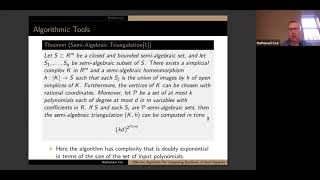
Nathanael Cox - Effective Algorithms for Quotients of Semi-Algebraic Equivalence Relations
Explore efficient algorithms for computing quotients of semi-algebraic equivalence relations, focusing on complexity, tools, and key results in applied algebraic topology.
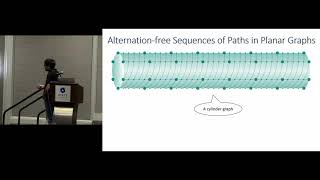
Parametric Shortest Paths in Planar Graphs
Explore efficient algorithms for computing shortest paths in planar graphs with varying edge weights, enhancing understanding of graph theory and optimization techniques.
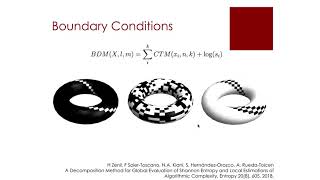
Graph and Tensor Algorithmic Complexity - Unit 6, Module 5
Explore algorithmic complexity in graphs and tensors, focusing on computational approaches to causality and living systems from networks to cells.
Optimizing Causal Objective Functions - Algorithms and Complexity
Explore causal objective functions, their optimization, and algorithmic complexities. Delve into structural causal models, unit selection, and variable elimination techniques for associational queries.
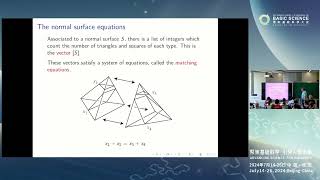
Polynomial Bounds on Reidemeister Moves in Knot Theory
Explore polynomial bounds on Reidemeister moves in knot theory, examining algorithms for trivial knot recognition and the relationship between diagram complexity and move sequences.
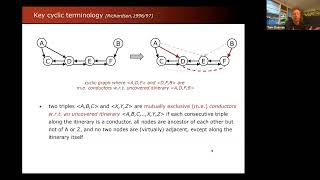
Establishing Markov Equivalence in Cyclic Directed Graphs - UAI 2023 Oral Session 3
Explore an efficient procedure for establishing Markov equivalence in cyclic directed graphs, based on the Cyclic Equivalence Theorem and ancestral perspective.
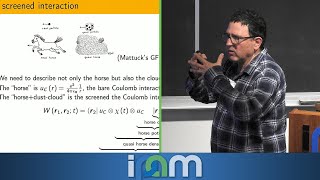
Stochastic Vector Methods for Extended Systems - IPAM at UCLA
Explore stochastic vector approaches for electronic structure in condensed matter systems, reducing complexity and enhancing efficiency in computational quantum mechanics.
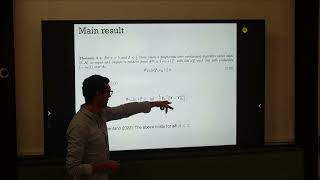
Sampling from the SK Measure via Algorithmic Stochastic Localization
Explore algorithmic stochastic localization for sampling from the SK measure in spin glass systems. Gain insights into advanced statistical physics techniques.
What Computers Can't Do - With Kevin Buzzard
Explore the P vs NP problem in computer science with mathematician Kevin Buzzard, delving into computational complexity, security implications, and unsolved mathematical challenges.
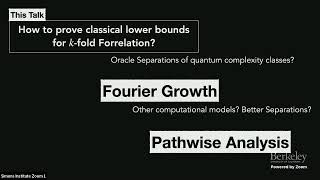
Separating Quantum from Classical with K-Fold Forrelation and Friends
Explore quantum-classical separations through k-fold Forrelation, examining l1-Fourier growth and pathwise analysis to understand algorithmic differences and their broader implications in computing.
Incremental View Maintenance - Part 1
Explore efficient techniques for updating database views as underlying data changes, focusing on algorithmic approaches and their applications in modern data management systems.
The Future of Wireless and What It Will Enable
Explore the future of wireless technology, its potential, and innovative approaches like millimeter waves, small cells, and software-defined networks to overcome current limitations.
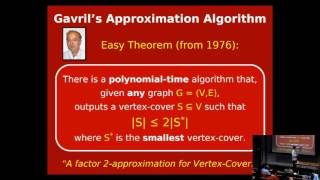
Approximation Algorithms
Explore approximation algorithms for NP-hard problems, focusing on vertex cover, k-coverage, and traveling salesperson. Learn greedy approaches and their limitations, as well as more advanced techniques.
Coding Theory in Almost Linear Time and Sublinear Space
Explore efficient error-correcting codes with near-linear time and sub-linear space encoding/decoding algorithms. Learn about innovative techniques in hashing, locally correctable codes, and derandomization.
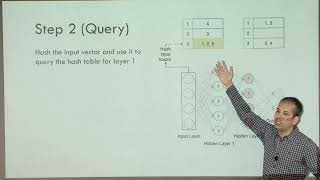
Sub-Linear Algorithms Meets Large Language Models
Explore emerging ideas and successful trends in sub-linear algorithms for future LLMs, addressing compute, memory, and energy challenges in training and inference.
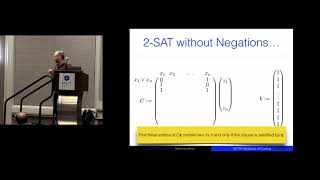
Hardness of Coding Problems
Explore SETH hardness in coding problems, focusing on linear codes, nearest codeword problem, and minimum distance problem. Learn about reductions and key concepts in computational complexity.
How Modern SQL Databases Come Up With Algorithms That You Would Have Never Dreamed Of
Discover how modern SQL databases outperform hand-written algorithms with cost-based optimization, enabling complex queries on large datasets to run in milliseconds. Learn why SQL is the ideal language for business logic.
The Factoring Dead - Preparing for the Cryptopocalypse
Explore cryptographic vulnerabilities, recent breakthroughs in discrete mathematics, and their impact on RSA. Learn how to prepare for potential crypto apocalypse scenarios and operate in a post-RSA world.