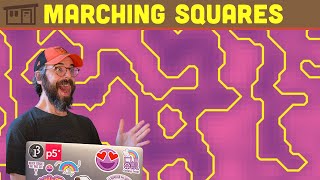
Coding in the Cabana - Marching Squares
Explore the Marching Squares algorithm and its application to Open Simplex Noise in Processing, covering 2D grid creation, isoline visualization, and noise-based point generation.
Graph Algorithms and Graph Theory - Session 7A
Explore advanced concepts in graph algorithms and theory, delving into cutting-edge research and applications presented at the FOCS 2020 conference.
Linear Time and Efficient Distributed Algorithms for List Coloring Graphs on Surfaces
Explore efficient algorithms for list coloring graphs on surfaces, focusing on linear time complexity and distributed computing approaches.
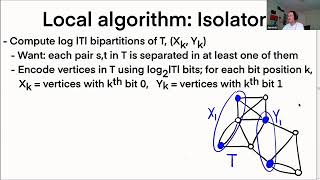
Deterministic Min-cut in Poly-logarithmic Max-flows
Explore cutting-edge algorithms for efficiently solving network flow problems, focusing on deterministic min-cut techniques and their relationship to max-flow computations.

Thallus 3D Printed Sculpture With Kangaroo Physics - Grasshopper Tutorial
Explore 3D-printed Thallus sculpture creation using differential growth algorithms and Kangaroo Physics in Grasshopper, focusing on structural connections and pattern tweaking.

Algorithmic Opportunities in Matching Markets
Explore algorithmic opportunities in matching markets, focusing on innovative approaches and their potential impact on economic efficiency and social welfare.
2019 ADSI Summer Workshop- Algorithmic Foundations of Learning and Control
Explore advanced techniques in reinforcement learning, focusing on randomized value functions and their applications in exploration strategies for complex decision-making problems.
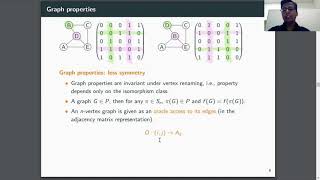
Symmetries, Graph Properties, and Quantum Speedups
Explore quantum speedups in graph theory, focusing on symmetries and properties. Discover cutting-edge research on quantum algorithms and their applications in computational complexity.
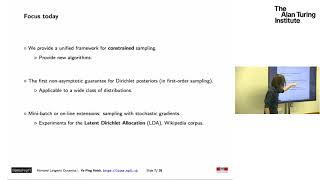
Mirrored Langevin Dynamics - Ya-Ping Hsieh
Explore posterior sampling in constrained distributions, focusing on Latent Dirichlet Allocation. Learn about a unified framework for deriving novel sampling schemes with improved convergence rates.
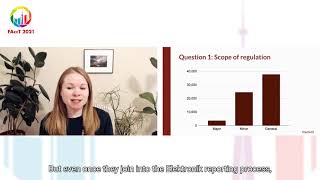
The Distributive Effects of Risk Prediction in Environmental Compliance - Algorithmic Design, Environmental Justice, and Public Policy
Explore the impact of risk prediction algorithms on environmental compliance, justice, and policy. Uncover the distributive effects and implications for algorithmic design in environmental regulation.
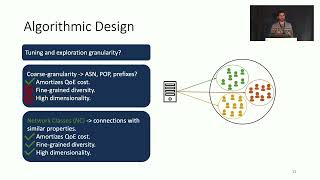
Configanator - A Data-driven Approach to Improving CDN Performance
Explore a data-driven approach to optimize CDN performance by dynamically configuring web server parameters based on network and device characteristics, improving tail web performance by 32-67%.

Programming Your Way up a Skyscraper - Python in the Built World
Explore how architects use Python to enhance building design, from geometry editing to algorithmic design, data sorting, and software integration, unlocking new possibilities in architecture.

LinkedIn's Insights on AI Fairness in Hiring
Explore LinkedIn's approach to AI fairness in hiring, focusing on mitigating bias in algorithmic and product design, and data processing for more equitable recruitment practices.

Lessons from Texas, COVID-19, and the 737 Max - Efficiency vs. Resilience
Exploring the critical balance between efficiency and resilience in computer science and economics, with insights from recent disasters and a call for prioritizing system robustness.