
Design & Analysis of Algorithms
Comprehensive exploration of algorithm design techniques, analysis frameworks, and problem-solving strategies, covering divide-and-conquer, greedy algorithms, dynamic programming, and NP-completeness.
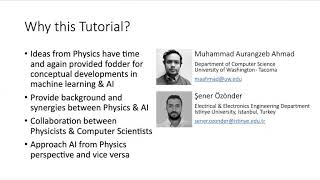
KDD 2020: Physics Inspired Models in Artificial Intelligence
Explore the intersection of physics and AI, covering paradigms, generalization, complexity, interpretability, and physics-informed neural networks. Gain insights into the synergy between these fields.
CS50 2012 - Week 3 Continued: Search Algorithms and Sorting Techniques
Explore efficient search and sorting algorithms, including linear and binary search, bubble sort, selection sort, and merge sort. Learn asymptotic notation for algorithm analysis.
Stanford Lecture - Don Knuth - "A Conjecture That Had To Be True"
Donald Knuth explores a fascinating problem in combinatorial geometry, presenting an intriguing formula and its unexpected universal application, showcasing the beauty of mathematical discovery.
The Analysis of Algorithms - 2015 Recreation of 1969 Lecture
Explore the foundations of algorithm analysis with legendary computer scientist Donald Knuth as he recreates his inaugural Stanford lecture from 1969.
The Challenges of Training Infinitely Large Neural Networks
Explore challenges in training infinitely large neural networks with Mikhail Belkin. Gain insights into foundational advances in machine learning for biomedical applications.
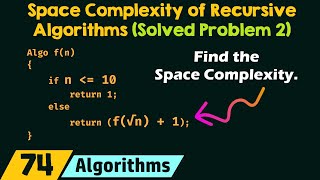
Space Complexity of Recursive Algorithms - Solved Problem 2
Analyze space complexity of recursive algorithms through a solved problem, enhancing understanding of memory usage in algorithmic design.
Iterated Models: Expressive Power, Learning, and Chain of Thought
Explore sequence-to-sequence models, focusing on transformers, their computational power, and learning complexities. Gain insights into iterated functions and chain of thought.
Transformers, Parallel Computation, and Logarithmic Depth
Explore the computational power of transformers, their connection to parallel processing, and efficiency in solving complex tasks with logarithmic depth.
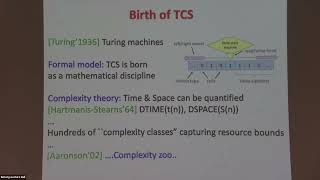
Reading Alan Turing - Exploring Turing's Influential Ideas in Theoretical Computer Science
Explore Turing's influential papers and their impact on theoretical computer science with Avi Wigderson. Gain insights into Turing's visionary ideas and their modern relevance.
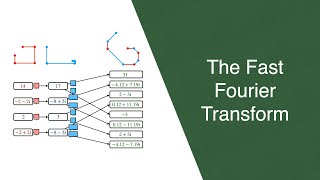
The Fast Fourier Transform - Efficient Algorithm for Signal Processing
Dive into the Fast Fourier Transform, exploring its efficiency over the Discrete Fourier Transform and understanding the crucial Butterfly algorithm in signal processing.
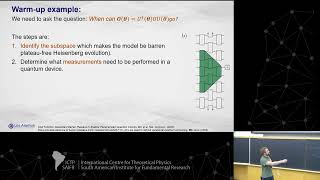
Prospects and Challenges for Quantum Machine Learning - Class 2
Explore prospects and challenges of quantum machine learning with Marco Cerezo, delving into advanced concepts and potential applications in this comprehensive lecture.
Prospects and Challenges for Quantum Machine Learning - Class 1
Explore the potential and obstacles of quantum machine learning with Marco Cerezo, delving into cutting-edge research and applications in this emerging field.
When Do Dependencies in Your Data Help? - Emerging Generalization Settings
Explore how dependencies in data can overcome computational barriers in learning graphical models, using the Glauber dynamics process as a natural data generation method.
Prospects and Challenges for Quantum Machine Learning - Class 3
Explore prospects and challenges of quantum machine learning with Marco Cerezo, delving into cutting-edge research and potential applications in this advanced lecture.
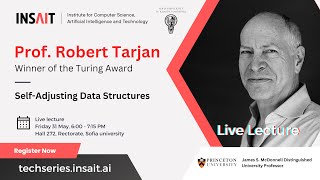
Self-Adjusting Data Structures - Designing for Efficient Operation Sequences
Explore self-adjusting data structures with Prof. Robert Tarjan. Learn about adaptive designs that optimize total operational costs, enhancing efficiency in various computational scenarios.

Understanding the Discrete Fourier Transform - Week 14
Explore Discrete Fourier Transform using Julia, from basic concepts to implementation. Compare DFT with Fast Fourier Transform, analyze sounds, and understand computational complexity.
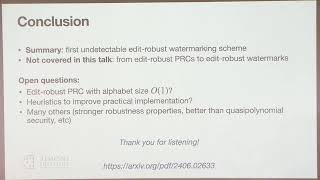
Edit Distance Robust Watermarks - Beyond Substitution Channels in Language Models
Delve into advanced watermarking techniques for language models, focusing on robust detection methods that withstand text modifications while maintaining cryptographic undetectability.
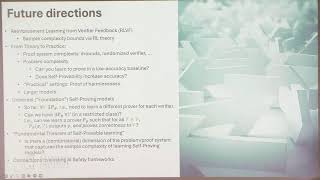
Self-Proving Models: Learning Algorithms with Interactive Proof Systems
Explore self-proving models and interactive proof systems for ensuring AI output correctness, focusing on algorithms, learning complexity, and practical applications in computational tasks.
Complessità e Disordine - Dal Premio Nobel al Machine Learning
Esplorazione del legame tra la teoria dei sistemi disordinati di Parisi e le sfide del Machine Learning, evidenziando come la complessità influenzi l'ottimizzazione dei sistemi.
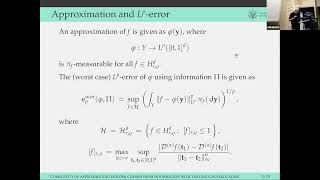
Complexity of Approximating Holder Classes from Information with Varying Gaussian Noise
Explore approximation complexity for Holder classes with varying Gaussian noise, focusing on mathematical applications and information theory concepts.