Introduction to Cryptology
Explore cryptology fundamentals, including ciphers, perfect secrecy, public key systems, and hash functions. Learn algorithms and techniques for secure communication and data protection.
Foundations of Data Science II
Explore advanced data science concepts including SVD, Gaussian mixtures, and Markov chains. Learn about randomized algorithms and low-rank approximations for efficient data handling.
Sketching and Randomized Linear Algebra
Explore advanced techniques in randomized linear algebra, focusing on sketching methods for efficient data analysis and algorithm design in high-dimensional spaces.
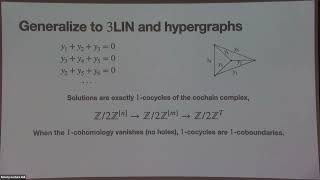
Expanders and Property Testing
Explore expanders and property testing in graph theory, focusing on their applications and connections to theoretical computer science.
Karger's Mincut Algorithm - Introduction and Implementation
Explore Karger's mincut algorithm, its motivation, problem definition, and implementation through a practical example.
Stochastic Minimum Vertex Cover with Few Queries: A 3/2-Approximation
Explore a 3/2-approximation algorithm for stochastic vertex cover using O(n/p) non-adaptive queries, improving upon previous 2-approximation methods and discussing extensions to correlated edge realizations.
Graph Connectivity Using Star Contraction
Explore edge connectivity in simple graphs using cut queries, introducing star contraction for efficient graph simplification and discussing randomized and quantum algorithms for connectivity determination.
Sketching Techniques for Data Structures and Optimization - Part 2
Explore advanced sketching techniques for data structures and optimization in fast algorithms, focusing on practical applications and theoretical foundations.
Sketching Techniques for Data Structures and Optimization - Part 1
Explore data structure optimization techniques for fast algorithms, focusing on sketching methods to enhance computational efficiency and performance.
Designing Robust Algorithms for Data Streams with Adversarial Generation
Explore advanced techniques for designing robust streaming algorithms that maintain accuracy even under adversarial data manipulation, focusing on Missing Item Finding and graph coloring challenges.
Coresets for Machine Learning - Tensor Factorization and Bregman Clustering
Explore advanced techniques for data summarization through coresets, focusing on tensor factorization and Bregman clustering, with applications in efficient machine learning algorithms for massive datasets.
Randomised Computation
Explore probabilistic Turing machines, complexity classes, and efficient randomised algorithms. Dive into Monte Carlo methods, polynomial identity testing, and the P = BPP problem.
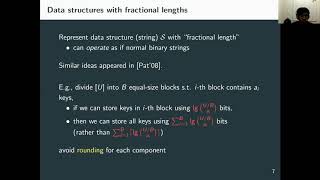
Nearly Optimal Static Las Vegas Succinct Dictionary
Explore advanced data structures for efficient dictionary operations, focusing on succinct representations and optimizing space usage for various input types.
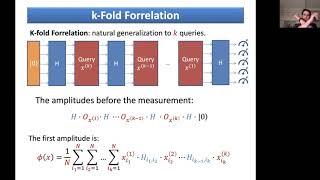
Towards Optimal Separations between Quantum and Randomized Query Complexities
Explore the intriguing gap between quantum and randomized query complexities, delving into cutting-edge research on optimal separations and their implications for computational theory.
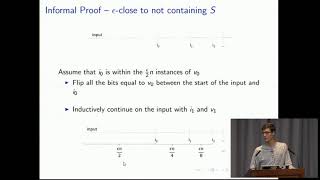
Sublinear Time Property Testers - Algorithms for Efficient Function Analysis
Explore sublinear time property testers for efficient algorithm design. Learn about relaxed decision problems, fast testers, and applications in graph theory and string processing.
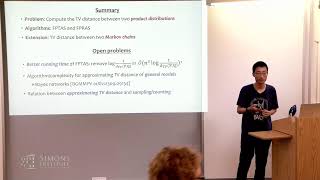
Approximating the TV Distance Between Two Product Distributions
Explore techniques for approximating total variation distance between high-dimensional product distributions, including randomized coupling and deterministic sparsification methods.
Randomized Algorithms for Rounding and Rank Compression in the Tensor Train Format
Explore randomized algorithms for efficient tensor-train rounding, enhancing performance in quantum systems and condensed matter physics applications with significant computational speedups.
Algorithms Approaching the Threshold for Semirandom Planted Clique
Explore advanced algorithms for semirandom planted clique problems with Princeton researcher Pravesh Kothari, discussing computational and statistical challenges in learning and optimization.
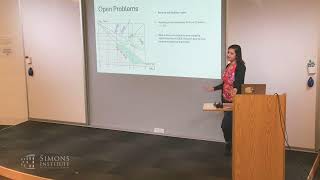
Sublinear Time Algorithms for Estimating Edit Distance
Explore efficient methods for approximating edit distance between strings, focusing on sublinear time algorithms and their applications in computational biology and text processing.
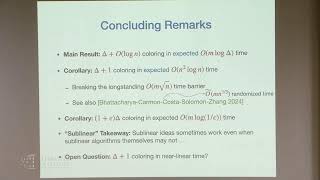
Sublinear Insights: A Faster Classical Algorithm for Edge Coloring
Explores a novel randomized algorithm for near-linear time graph edge coloring, improving on decades-old methods. Discusses implications for Vizing's theorem and dense graph coloring efficiency.
Shaving Logs by Weighing Coins - Extroverted Sublinear Algorithms
Explore innovative sublinear algorithms for efficient data analysis, focusing on log-shaving techniques and coin-weighing problems in computational complexity.