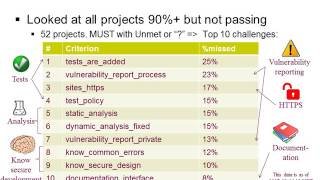
CII Best Practices Badge Program - One Year Later
Explores the CII Best Practices Badge program for open source software, discussing its impact, challenges, and future developments in improving security and quality standards.
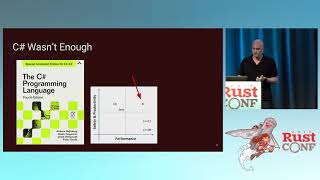
Safe Systems Software and the Future of Computing - Closing Keynote
Explore the future of safe systems programming and its impact on operating systems, drawing insights from Microsoft's innovative projects and addressing technical and cultural challenges.
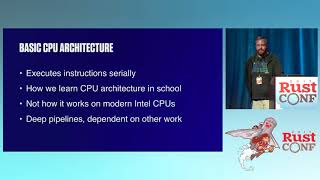
Improving Rust Performance Through Profiling and Benchmarking
Explore techniques for optimizing Rust applications through profiling and benchmarking, with insights from real-world production experience and industry tool comparisons.

Shipping a Solid Rust Crate - Best Practices and Promotion
Learn best practices for creating and releasing high-quality Rust crates, including automated testing, documentation, examples, and strategies to increase visibility and adoption in the Rust community.
Emergent Load Testing - Rules for Organized Chaos
Explore emergent load testing techniques to simulate real-world chaos in production systems. Learn to create adaptive scripts that autonomously evolve based on runtime feedback for more robust application testing.
Serverless WebAssembly - Scaling from 0 to 10k in 10 Seconds
Explore WebAssembly's potential for serverless computing, enabling rapid scaling from 0 to 10,000 instances in seconds. Learn about load testing, best practices, and Fermyon Cloud's innovative approach.
Even More Board Farm Goodness - Update on REST API for Automated Testing
Explore advancements in the REST API for automated testing in board farms, enhancing efficiency and capabilities for embedded systems development.
Going Beyond Metadata - Adopting Static Analysis in Dependency Tools
Explore the importance of static analysis in dependency tools for enhanced software security and reliability beyond traditional metadata approaches.

API Testing Without Writing Test Cases and Mocks
Learn efficient API testing techniques using shadow testing, eliminating the need for manual test case writing and mocking. Explore innovative approaches to streamline your testing process.

Scaling the Test Coverage of OpenAPI Generator for 30+ Programming Languages
Explore strategies for scaling test coverage across multiple programming languages in OpenAPI Generator, addressing challenges and offering practical solutions for contributors.
Solve Flake Tests in Open Source Projects
Discover strategies to address and resolve flaky tests in open-source projects, enhancing software reliability and development efficiency.
Fuzzing the Linux Kernel - Mentorship Session
Explore advanced techniques for identifying vulnerabilities in the Linux kernel through fuzzing, enhancing system security and stability.

Testing Principles - Avoiding the Big Ball of Mud in Quality Engineering
Explore Quality Engineering approaches, focusing on appropriate testing methods and strategies to avoid overwhelming complexity in software development.
The Importance of Continuous Regression for Hardware and Software Development
Innovative continuous testing techniques for hardware and software development, focusing on performance improvement, quality assurance, and efficient open-source collaboration in data center products.
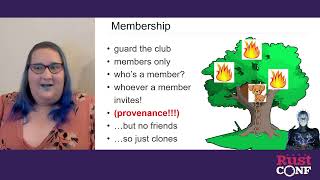
What If We Pretended Unsafe Code Was Nice, and Then It Was? - RustConf 2022
Explore Rust's Strict Provenance APIs for safer and more efficient unsafe code. Learn how pretending unsafe code is nice can lead to better documentation, libraries, and tools.
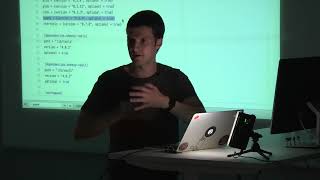
Share Secrets Safely: Introduction to Secure Team GPG Usage - Rust Cologne
Learn about 'Share Secrets Safely', a tool for secure GPG usage in teams, featuring journey-level testing and efficient secret management without disk storage.
Benchmarking and Optimization of Rust Libraries
Explore benchmarking and optimization strategies for Rust libraries, focusing on consistent evaluation and performance enhancement techniques for the growing ecosystem.
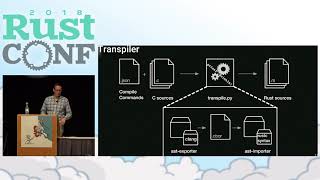
C2Rust: Migrating Legacy Code to Rust - RustConf 2018
Explore tools for migrating C/C++ to Rust: transpiler for equivalent code, dynamic analysis for computation checks, and refactoring tool for idiomatic Rust. Automate steps and detect discrepancies during migration.
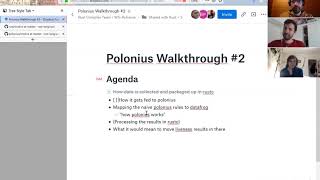
Polonius and Rustc Code Walkthrough
Explore rustc and Polonius codebases, understanding their connection and key components like IntroFax, compute regions, and liveness computation in this comprehensive walkthrough.
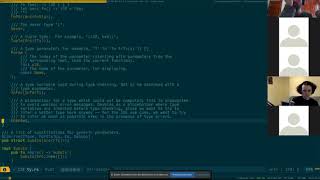
Rust-Analyzer Type-Checker Overview
Explore the inner workings of rust-analyzer's type checker and potential integrations with chalk for RLS 2.0 in this technical deep dive.
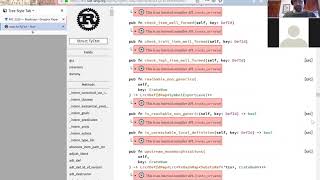
Implementing RFC #2229: Disjoint Field Capture Plan - Rust Strategy and Roadmap
Explore the implementation strategy for RFC #2229 in Rust, covering refactorings, independent tasks, and a roadmap for disjoint field capture.