angr: Binary Analysis Framework - Demonstration and Analysis
Explore angr, a powerful binary analysis framework, through demos and source code analysis. Learn its capabilities for reverse engineering and vulnerability detection.
CaSym: Cache Aware Symbolic Execution for Side Channel Detection and Mitigation
Explores cache-aware symbolic execution for detecting and mitigating side-channel vulnerabilities, offering novel abstract cache models and guidance for effective countermeasures.
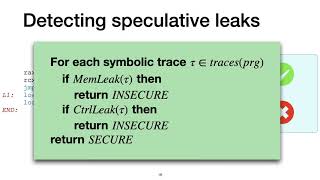
SPECTECTOR - Principled Detection of Speculative Information Flows
Principled detection of speculative information flows in computer systems, focusing on security against Spectre-like attacks through speculative non-interference and symbolic execution techniques.
TriggerScope - Towards Detecting Logic Bombs in Android Applications
Explore techniques for detecting logic bombs in Android apps using symbolic execution and path predicate analysis. Learn about TriggerScope, a tool for identifying time-, location-, and SMS-related triggers in mobile applications.
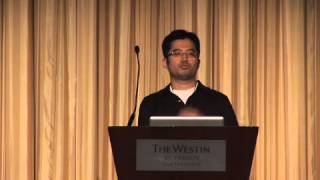
Unleashing Mayhem on Binary Code
Explore automated exploit generation for binary programs using hybrid symbolic execution and index-based memory modeling. Learn techniques to find and demonstrate exploitable vulnerabilities efficiently.
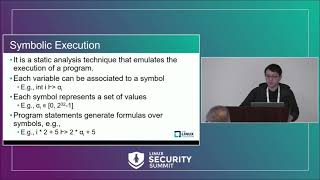
Triaging Kernel Out-of-Bounds Write Vulnerabilities
Explore techniques for triaging kernel out-of-bounds write vulnerabilities, including symbolic execution, capability summarization, and exploitability evaluation.
Quantitative Robustness for Vulnerability Assessment
Explore quantitative robust reachability for measuring bug triggering difficulty in software security. Learn about QRSE and functional E-MAJSAT for improved vulnerability assessment.
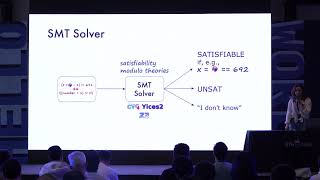
Practical Symbolic Execution for EVM - ETHTaipei 2023
Dive into symbolic execution techniques for Ethereum Virtual Machine (EVM), exploring practical applications and implementation strategies for smart contract analysis.
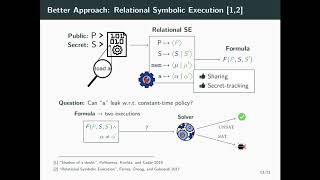
Efficient Relational Symbolic Execution for Constant-Time at Binary-Level
Efficient binary-level verification tool for constant-time programming, providing bug-finding and bounded-verification through relational symbolic execution and optimizations for information flow analysis.
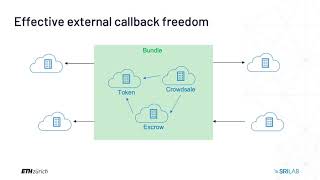
VerX: Safety Verification of Smart Contracts
Explore automated safety verification for smart contracts using VerX, covering specification challenges, verification techniques, and practical applications in blockchain security.
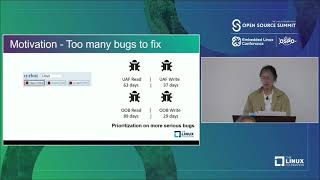
SyzScope: Revealing High-Risk Security Impacts of Fuzzer-Exposed Bugs
Explore SyzScope, a tool revealing high-risk security impacts of fuzzer-exposed bugs. Learn about its workflow, fuzzing techniques, and symbolic execution for effective vulnerability assessment.
Can a Programming Language Reason About Systems?
Exploring Fault: A new programming language for modeling and reasoning about diverse systems, from technical to organizational, with programmer-friendly syntax and logic-based problem-solving capabilities.
PLSE Seminar Series - Willem Visser, "An Analytical Perspective on Mutations and Coverage"
Explores symbolic execution and model counting for analyzing mutations and coverage in software testing, discussing reachability, mutation operators, oracle precision, and probabilistic approaches.
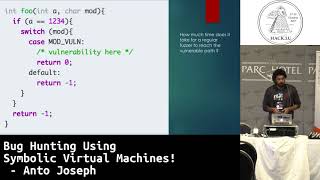
Bug Hunting Using Symbolic Virtual Machines - Hack.lu 2017
Explore symbolic execution for vulnerability discovery and reverse engineering. Learn KLEE symbolic virtual machine basics to solve complex challenges in software security.
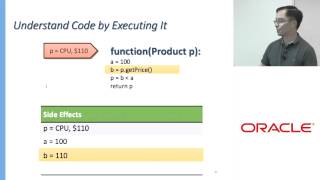
LINQ-style Queries in Java with Jinq - JVM Language Summit 2015
Explore LINQ-style queries in Java with Jinq, covering embedding database DSLs, lazy evaluation, query generation, and symbolic code execution for efficient database operations.

Formally Verifying Optimizations with Block Simulations
Explore formal verification of compiler optimizations using block simulations. Learn about enhancing CompCert with efficient, verified validators for advanced optimizations like LCM and SR.
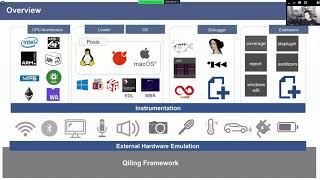
When Qiling Framework Meets Symbolic Execution
Exploring Qiling Framework's new symbolic execution capabilities for advanced binary analysis across architectures, with demonstrations and insights into its development and applications.
Logic Against Sneak Obfuscated Malware
Explore SMT solvers for binary analysis and code deobfuscation in IT security. Learn practical applications, limitations, and solutions for enhancing malware analysis capabilities.
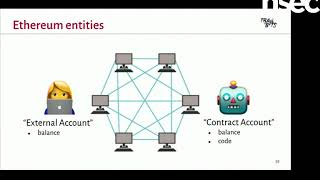
Binary Analysis, Meet the Blockchain
Explore symbolic execution for Ethereum smart contract analysis, addressing technical challenges and introducing Manticore, an open-source tool for enhancing contract security audits.
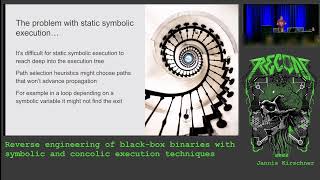
Reverse Engineering of Black Box Binaries with Symbolic and Concolic Execution Technique
Explore symbolic and concolic execution techniques to simplify reverse engineering of complex binaries. Learn to use the angr framework for efficient crackme solving and deobfuscation.
Under the Hood of Wslink Multilayered Virtual Machine
Análisis detallado de la máquina virtual multicapa Wslink, explorando técnicas de ofuscación avanzadas y presentando un enfoque semiautomático para desobfuscar el malware de forma eficiente.