Isoprenoids, Rubber, and Tuning Polymer Properties - Freshman Organic Chemistry II
Explore isoprenoids, rubber vulcanization, and polymer properties. Learn about biosynthesis, statistical mechanics, and free-radical polymerization in this comprehensive organic chemistry lecture.

Epoxide Opening, Dipolar Cycloaddition, and Ozonolysis in Organic Chemistry
Explore advanced organic chemistry concepts including epoxide opening, ozonolysis, and cycloaddition reactions. Gain insights into reaction mechanisms, regiospecificity, and orbital interactions in complex organic transformations.
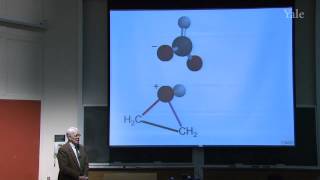
Addition to Form Three-Membered Rings - Carbenoids and Epoxidation
Explore three-membered ring formation through carbenoids and epoxidation. Learn mechanisms, stereochemistry, and practical applications in organic chemistry.
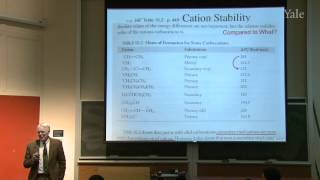
Carbocations and the Mechanism of Electrophilic Addition to Alkenes and Alkynes - Lecture 11
Explore carbocation stability, electrophilic addition mechanisms, and alkene/alkyne reactivity. Gain insights into organic reaction principles and their applications in chemistry.
Cation Intermediates and Alkene Reactions - Formation, Addition, and Stability
Explore cation intermediates, alkene reactions, and isomer stability. Learn about SN1 and E1 mechanisms, electrophilic addition, and using the NIST Webbook for thermochemical data analysis.
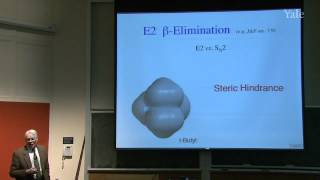
Pentavalent Carbon and Competing Reaction Mechanisms - E2, SN1, E1
Explore organic chemistry mechanisms: E2, SN1, E1 reactions. Analyze stereochemistry, kinetic isotope effects, and carbocation intermediates. Learn strategies for substitution in organic synthesis.
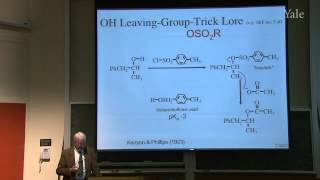
Organic Chemistry II - Nucleophiles, Leaving Groups, and SN2 Reactions - Lecture 8
Explore nucleophiles, leaving groups, and SN2 reactions in organic chemistry. Learn about bridgehead substitution, converting poor leaving groups, and applications in PET scanning and medical imaging.
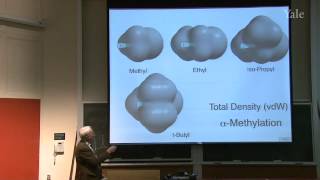
Nucleophilic Substitution Mechanisms: Stereochemistry, Kinetics, and Structural Influences
Explore nucleophilic substitution mechanisms through stereochemistry, kinetics, and structural influences. Gain insights into experimental tools for determining reaction pathways in organic chemistry.
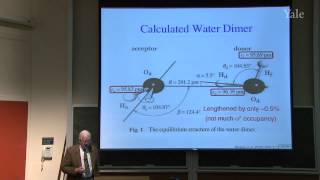
Solvation, Hydrogen-Bonding, and Ionophores in Organic Chemistry - Lecture 5
Explore solvation, hydrogen bonding, and ionophores in organic chemistry. Learn about non-bonded interactions, electrostatics, and their impact on chemical properties and reactions in solution.

Bioimaging - X-Ray and CT Imaging Techniques - Lecture 20
Explore electromagnetic spectrum, X-ray imaging, and CT scans in biomedical engineering. Learn about their principles, applications, advantages, and safety considerations in medical diagnostics.

Tissue Engineering Applications in Biomedical Engineering - Lecture 23
Explores tissue engineering applications in healing, regeneration, organ replacement, and drug delivery, featuring Yale research on hydrogel scaffolds, spinal cord repair, and blood vessel growth control.
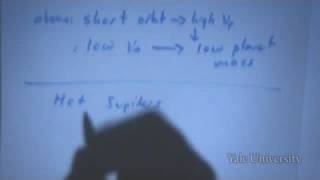
Planetary Transits and Hot Jupiters in Astrophysics - Lecture 5
Explore astrophysics controversies, from Pluto's demotion to hot Jupiter discoveries. Learn how scientific understanding evolves, the impact of cultural factors, and techniques for studying exoplanets.

Why Are People Different? Understanding Personality and Intelligence - Lecture 13
Explore theories on personality and intelligence differences, including measurement methods, genetic and environmental influences, and their impact on individual and group variations.

Foundations of Psychology - This Is Your Brain
Explore the relationship between mind and body, examining dualism vs. materialism, and delve into basic neurophysiology and brain structure in this engaging psychology lecture.
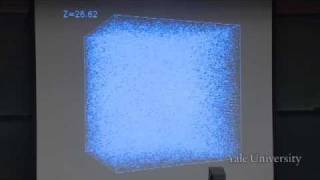
The Cosmic Microwave Background and Dark Energy - Lecture 23
Explore the Cosmic Microwave Background, dark energy, and large-scale clustering in this lecture on astrophysics frontiers, featuring evidence from supernovae and computer simulations of universe evolution.

Hubble's Law, the Big Bang, and Measuring Cosmic Distances
Explore cosmology's history, Hubble's Law, and methods for measuring celestial distances and brightness. Learn about redshift, parallax, standard candles, and magnitude scales in this astrophysics lecture.
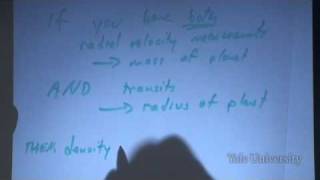
Microlensing, Astrometry and Other Methods for Exoplanet Detection - Lecture 6
Explore planetary detection methods like transits and migration, understanding their impact on our view of solar systems and potential exoplanet discoveries.

Tests of Relativity - Frontiers in Astrophysics
Explore velocity, mass, and time in special relativity. Delve into post-Newtonian approximations, Lorentz transformations, and the possibility of faster-than-light travel using real-world examples.

Frontiers and Controversies in Astrophysics - Introduction to Exoplanets, Black Holes, and Cosmology
Explore exoplanets, black holes, and cosmology in this astrophysics lecture. Learn about planetary orbits and the historical progression of astronomical understanding from Ptolemy to Newton.
Stellar Mass Black Holes and Post-Newtonian Gravitational Effects - Lecture 13
Explore post-Newtonian gravitational effects: perihelion precession, light deflection, gravitational redshift, and gravitational waves. Understand their implications for astrophysics and Einstein's theories.
Introduction to Black Holes - Frontiers in Astrophysics
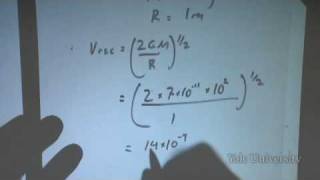
Explore black holes, relativity, and stellar evolution in this lecture. Learn about escape velocity, Schwarzschild radius, and the physics behind neutron stars and black hole formation.