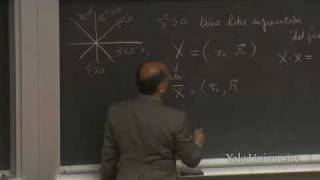
Introduction to the Four-Vector in Special Relativity - Lecture 14
Explore the four-vector concept in physics, unifying space-time coordinates and energy-momentum, with emphasis on Lorentz transformations and the invariant space-time interval.
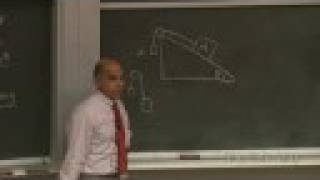
Newton's Laws and Inclined Planes - Lecture 4
Explore Newton's laws applied to friction, inclined planes, pulleys, and circular motion. Gain practical insights into physics principles through real-world examples like roller coasters and planetary orbits.
Simple Harmonic Motion and Introduction to Waves - Lecture 18
Explore harmonic motion and wave behavior through problem-solving and derivations. Learn about oscillations, driving forces, resonance, and different types of waves in this physics lecture.
Fluid Dynamics, Statics, and Bernoulli's Equation - Lecture 20
Explore fluid dynamics, statics, and Bernoulli's equation through key concepts like pressure, density, and Archimedes' Principle. Learn practical applications and problem-solving techniques in physics.

Simple Harmonic Motion - Fundamentals of Physics
Exploración detallada del movimiento armónico simple, incluyendo ejemplos físicos, conceptos clave y tipos de oscilaciones. Análisis matemático y resolución de problemas para comprender este fenómeno fundamental de la física.
The Boltzmann Constant and First Law of Thermodynamics - Lecture 22
Explore thermodynamics, heat generation, and measurement. Learn about the Boltzmann Constant, microscopic temperature, and the First Law of Thermodynamics. Gain insights into molecular mechanics and quasi-static processes.

The Taylor Series, Complex Numbers, and Simple Harmonic Motion - Lecture 16
Explore advanced mathematical concepts including Taylor series, complex numbers, and simple harmonic motion in this comprehensive lecture from Yale University's physics course.

The Second Law of Thermodynamics and Carnot's Engine - Lecture 23
Explore the Second Law of Thermodynamics, entropy, and Carnot's engine. Learn about irreversibility, heat engine efficiency limits, and how entropy arises from macroscopic considerations in thermodynamics.

Lorentz Transformation in Special Relativity - Lecture 13
Detailed analysis of Lorentz transformations, exploring relativity of length, time, and simultaneity. Covers key concepts like time dilation, twin paradox, and length contraction in physics.

Introduction to Thermodynamics - Lecture 21
Comprehensive introduction to thermodynamics, covering temperature, heat transfer, and thermal properties. Explores key concepts like absolute zero, specific heat, and phase changes through detailed explanations and examples.

Fundamentals of Physics - Waves and Wave Properties - Lecture 19
Explore wave properties, superposition, and interference in physics. Learn about frequency, energy, Doppler effect, and applications to musical instruments in this comprehensive lecture.

Newton's Laws of Motion - Fundamentals of Physics
Explore Newton's Laws of Motion: inertia, force and acceleration relationships, and action-reaction principles. Gain insights into fundamental physics concepts and their real-world applications.

Introduction to Newtonian Mechanics - Lecture 1
Comprehensive introduction to Newtonian mechanics, covering kinematics, dynamics, and calculus applications in physics. Explores motion concepts and equation derivations for a solid foundation in classical mechanics.

Kepler's Laws and Planetary Motion - Fundamentals of Physics
Explore planetary motion and gravitational interactions through Kepler's laws, deriving orbital mechanics and energy conservation principles in this comprehensive physics lecture.
Dynamics of Multiple-Body Systems and Conservation of Momentum - Lecture 8
Explore multi-body dynamics, center of mass, conservation of momentum, and collisions in this physics lecture. Gain insights into rocket equations and practical applications of fundamental principles.
Rotations and Dynamics of Rigid Bodies - Part I
Explore fundamental concepts of rotational dynamics in rigid bodies, including angular velocity, momentum, torque, and inertia. Gain insights into the Parallel Axis Theorem and practical applications.
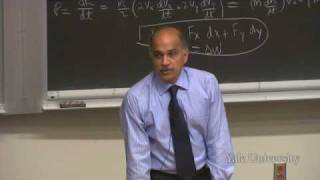
Law of Conservation of Energy in Higher Dimensions - Fundamentals of Physics
Explore conservation of energy in higher dimensions, covering calculus concepts, work in 2D, conservative forces, and applications to gravitational potential energy.
Torque and Static Equilibrium in Physics - Lecture 11
Explore static equilibrium and rigid body dynamics through practical examples like seesaws, rods, and gyroscopes. Gain insights into torque, angular velocity, and 3D mechanics in physics.
Work-Energy Theorem and Law of Conservation of Energy - Lecture 5
Explore work-energy theorem and energy conservation, covering key concepts, applications, and effects of friction. Includes calculus review and practical examples.

Vectors in Multiple Dimensions - Fundamentals of Physics
Explore vector motion in multiple dimensions, covering properties, transformations, velocity vectors, and applications to circular and projectile motion. Gain a solid foundation in vector physics.

Introduction to Relativity - Lecture 1
Explore the foundations of relativity, from historical context to key concepts like Galilean and Lorentz transformations, Maxwell's theory, and the postulates of relativity in this comprehensive lecture.