
Renal Physiology: Nephron Function and Homeostasis - Lecture 17
Explore nephron anatomy, concentration gradients, molecular transport processes, and homeostasis regulation in renal physiology. Learn to measure glomerular filtration rate using inulin.

Global Warming and Climate Change in the Holocene - Lecture 28
Explore climate fluctuations from the Medieval Warm Period to modern global warming, examining natural and anthropogenic factors shaping Earth's temperature and environment over time.
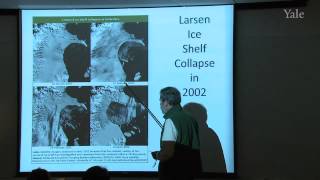
Ice in the Climate System - Types and Formation
Explore five types of ice in the climate system: sea ice, ice sheets, ice shelves, icebergs, and mountain glaciers. Learn about their formation, characteristics, and roles in Earth's environment.

Seasons and Climate - Factors Affecting Earth's Climate Systems
Explore factors influencing Earth's climate: latitude, terrain, continentality, and seasonality. Learn about precipitation patterns, ocean currents, biomes, and the impact of Earth's rotation on climate variations.
Clouds and Precipitation - Cloud Formation and Precipitation Mechanisms
Explore cloud formation, precipitation mechanisms, and detection methods through experiments and real-world applications. Gain insights into atmospheric processes and their environmental impact.
Horizontal Transport in Atmospheric Mixing - Lecture 8
Explore atmospheric pollutant mixing through confined, unconfined, and wind-influenced scenarios. Learn about diffusion, wind effects, and temperature changes with altitude in this comprehensive lecture.
Hydrostatic Balance in Atmosphere and Ocean - Lecture 7
Explore hydrostatic balance in the atmosphere and ocean, including calculations, experiments, and real-world applications of the hydrostatic law.
Greenhouse Effect and Earth's Energy Balance - Lecture 6
Explore Earth's energy balance, black body radiation, and the greenhouse effect. Learn about planetary energy budgets and the role of greenhouse gases in atmospheric dynamics.
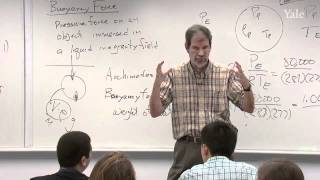
The Perfect Gas Law - Atmospheric Pressure, Density, and Temperature
Explore the Perfect Gas Law's impact on atmospheric dynamics, including buoyancy, pressure variations, and gas behavior, with applications to weather patterns and environmental phenomena.
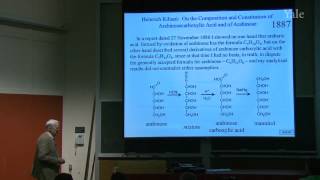
Proving the Configuration of Glucose and Synthesizing Cyclobutadiene - Lecture 37
Explore glucose structure, configuration proof, and synthesis of unnatural products. Delve into historical developments and modern spectroscopic techniques in organic chemistry.
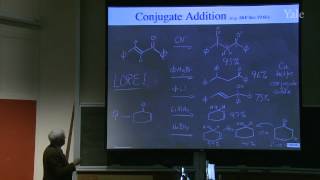
Alpha-Reactivity and Condensation Reactions in Organic Chemistry - Lecture 36
Explore key organic chemistry reactions: alkylation, aldol condensation, Robinson annulation, and Claisen condensation. Learn about their mechanisms, applications in synthesis, and relevance to biochemistry.
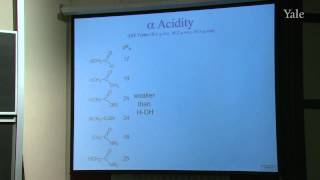
Acyl Insertions and Alpha-Reactivity in Organic Chemistry - Lecture 35
Explore acyl insertions, α-carbon reactivity, and rearrangements in organic chemistry. Learn about nucleophilic attacks, enolates, and mechanisms behind H/D exchange, racemization, halogenation, and alkylation.
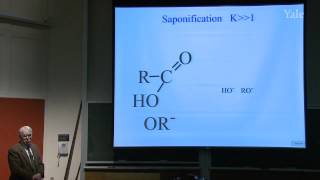
Acids and Acid Derivatives - Reactions and Spectroscopy
Explore reactions of carboxylic acids, IR spectroscopy of acid derivatives, interconversion mechanisms, selective reductions, and specialized reactions like decarboxylation and Baeyer-Villiger oxidation.
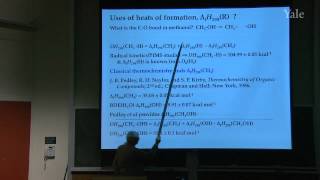
Measuring Bond Energies in Organic Chemistry
Prof. Ellison explores advanced techniques for measuring bond energies in polyatomic molecules, combining spectroscopy, mass spectrometry, and thermochemistry to provide insights into chemical bonding and resonance.
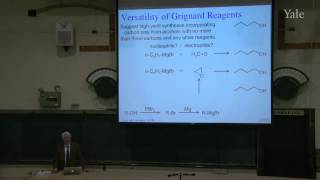
Periodate Cleavage, Retrosynthesis, and Green Chemistry in Organic Chemistry
Explore organic chemistry concepts including periodate cleavage, retrosynthesis, and green chemistry. Learn about alcohol synthesis, Grignard reagents, and Wittig olefination in this comprehensive lecture.
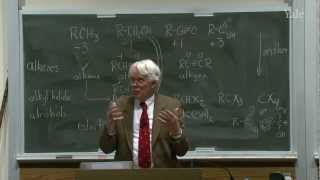
Oxidation States and Mechanisms in Organic Chemistry - Lecture 30
Explore oxidation states, spectroscopy, and reaction mechanisms in organic chemistry. Learn about carbon oxidation states and alcohol oxidation processes through practical examples and exam questions.
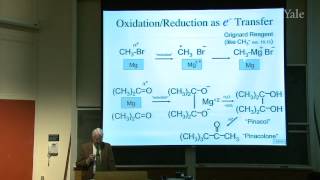
Imines, Enamines, Oxidation and Reduction in Organic Chemistry - Lecture 29
Explore imines in chemistry and biology, their role in amino acid synthesis, enamine reactions, and the concepts of oxidation and reduction in organic chemistry.
Aromatic Substitution in Synthesis: Friedel-Crafts Reactions and Benzylic Chemistry
Explore Friedel-Crafts reactions, synthetic strategies for substituted benzenes, nucleophilic aromatic substitution, and benzylic reactivity. Gain insights into the historical development of organic chemistry through key discoveries.
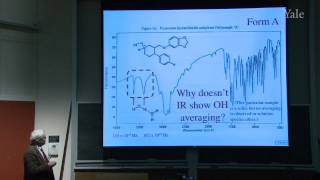
C-13 and 2D NMR - Electrophilic Aromatic Substitution - Lecture 25
Explore advanced NMR techniques and electrophilic aromatic substitution. Learn about proton decoupling, 2D NMR applications, and substituent effects in organic chemistry reactions.
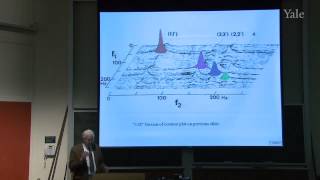
Higher-Order Effects, Dynamics, and the NMR Time Scale - Lecture 24
Explore advanced NMR concepts: higher-order effects, dynamics, and time scales. Learn about hybridization, spin-spin splitting, and spectral prediction for complex molecular structures.
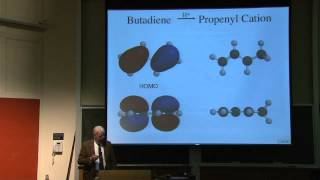
Alkynes and Conjugation in Allylic Systems and Dienes - Lecture 17
Explore alkynes, conjugation in allylic systems, and dienes. Learn about isomerization, stability, and reactivity of these organic compounds through various chemical reactions and principles.