Illumination Engineering
Explore the science of light, from vision and photometry to various lamp types and lighting applications, covering interior, sports, and road illumination.
Illumination Engineering
Explore the science of light, from vision and photometry to various lamp types and lighting applications, enhancing your understanding of illumination systems and design.

Select-Special Topics in Atomic Physics
Explore advanced atomic physics topics, including quantum mechanics, relativistic effects, and spectroscopy. Gain insights into hydrogen atom symmetry, angular momentum, and atomic probes.
Special - Select Topics in Atomic Physics
Explore quantum mechanics, symmetry, angular momentum, and relativistic effects in atomic physics. Delve into Hartree-Fock formalism, atomic probes, and spectroscopy techniques.
Physics - Nonequilibrium Statistical Mechanics
Explore advanced concepts in nonequilibrium statistical mechanics, including Langevin models, linear response theory, Fokker-Planck equations, and critical phenomena, with practical applications and quizzes.
Topics in Nonlinear Dynamics
Explore nonlinear dynamics through critical points, Hamiltonian systems, bifurcations, limit cycles, discrete-time dynamics, and stochastic processes. Gain insights into complex system behaviors and analysis techniques.
Topics in Nonlinear Dynamics
This is a basic course in classical mechanics at the senior undergraduate/ master's level. It covers the standard topics in this subject, including the Lagrangian and Hamiltonian formalisms. It also places the subject in the broader context of classical…

Geotechnical Earthquake Engineering
Comprehensive exploration of earthquake engineering principles, covering seismology, ground motion, wave propagation, soil dynamics, hazard analysis, and seismic design of geotechnical structures.
Foundation of Computational Fluid Dynamics
Comprehensive exploration of computational fluid dynamics fundamentals, covering essential concepts and techniques over 8 weeks through structured modules and practical applications.
Semiconductor Devices and Circuits
Explore quantum mechanics, semiconductor physics, and electronic devices. From wave-particle duality to charge transport and continuity equations, gain a comprehensive understanding of semiconductor fundamentals.
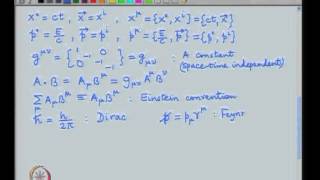
Relativistic Quantum Mechanics
You will learn Dirac and Klein-Gordon equations, Lorentz and Poincare groups, Fundamental processes of Quantum Electrodynamics. This course is taught by Professor Apoorva D Patel from IISc Bangalore
Relativistic Quantum Mechanics
This course covers topics on relativistic quantum mechanics: Dirac and Klein-Gordon equations, Lorentz and Poincare groups, Fundamental processes of Quantum Electrodynamics.
Gas Dynamics
This course discusses topics in gas dynamics. Review of fundamentals: concepts from fluid mechanics, basic thermodynamic relations. Compressible flow: the concept of waves in a fluid, mach waves, compression waves, expansion waves.
Engineering Thermodynamics
The main emphasis in this course is placed on the precise and logical presentation of the basic concepts and principles, which are essential for a better understanding of engineering thermodynamics.
Applied Thermodynamics for Engineers
Comprehensive exploration of thermodynamic principles, cycles, and applications in engineering, covering power generation, refrigeration, and combustion processes.
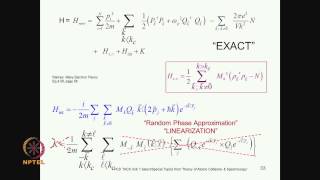
Special - Select Topics in the Theory of Atomic Collisions
Explore quantum collision theory, many-body problems, and advanced scattering concepts. Covers perturbation methods, Feynman diagrams, resonances, and applications in atomic physics.
Chemistry I - Introduction to Quantum Chemistry and Molecular Spectroscopy
Explore quantum chemistry and molecular spectroscopy, covering topics from Bohr's atom to polyatomic vibrations, with a focus on mathematical foundations and practical applications.
Thermodynamics & Kinetics
Comprehensive exploration of chemical thermodynamics and kinetics, covering laws, equilibrium, electrochemistry, and reaction dynamics. Ideal for deepening understanding of fundamental chemical principles.
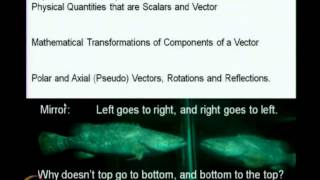
Special - Select Topics in Classical Mechanics
Explore advanced topics in classical mechanics, from equations of motion to chaotic systems. Gain deep insights into oscillators, relativity, fluid dynamics, and electrodynamics.
Special Topics in Classical Mechanics
Comprehensive exploration of advanced classical mechanics topics, including equations of motion, oscillations, relativity, electrodynamics, and chaotic systems.
Quantum Mechanics I
This course is a first-level course in the Dirac’s bra(ket) notation which will set the foundation to take up advanced level courses