
Engineering Chemistry 1
Learn about Engineering chemistry starting with Introduction to Chemistry & Quantum Chemical Methods and explore Oppenheimer Approximation, etc. in this course.

One-Dimensional Wave Functions in Quantum Chemistry - Lecture 8
Explore wave functions, their relationship to kinetic energy and probability density, and how they apply to various potentials. Learn about the isotope effect on bond properties in organic chemistry.

Quantum Mechanics and Applications
Explore quantum mechanics fundamentals, including wave-particle duality, Schrödinger equation, and applications in atomic physics. Develop problem-solving skills for quantum systems.

Introductory Quantum Chemistry
Explore quantum chemistry fundamentals, from wave-particle duality to molecular orbitals. Master key concepts, equations, and theories through comprehensive lectures and practical applications.
Quantum Chemistry of Atoms and Molecules
The course introduces students to quantum Chemistry. The syllabus is as follows. Black body radiation. Failure of classical mechanics. Marsden experiment and Rutherford theory. Hydrogen atom spectrum. Bohr Sommerfeld theory. etc.
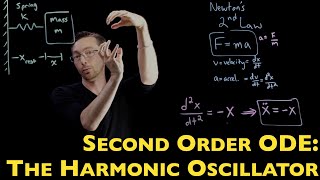
Second-Order Ordinary Differential Equations - Solving the Harmonic Oscillator Four Ways
Explore four methods to solve second-order ODEs for harmonic oscillators: guessing, Taylor series, alternative guessing, and matrix systems. Gain practical problem-solving skills in differential equations.
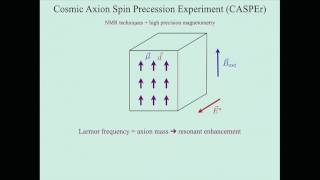
New Experimental Directions for Fundamental Physics II - Peter Graham
Explore cutting-edge experimental approaches in fundamental physics, focusing on innovative techniques and their potential to advance our understanding of particle physics beyond the LHC.

The Finite Part of Infinity by Joseph Samuel
Explore the paradoxical equation 1+2+3...=-1/12, its mathematical interpretation, and its impact on physics, including the Casimir effect, with insights from differential geometry and topology.
How Uncertainty Clarifies Observables from Amplitudes - Nathan Moynihan
Explores how uncertainty principles in quantum mechanics clarify the relationship between observable quantities and scattering amplitudes, with applications to gravitational wave detection and quantum field theory.

Second Order Harmonic Oscillator, Characteristic Equation, Ode45 in MATLAB
Explore second-order harmonic oscillators, characteristic equations, and ode45 in MATLAB through practical examples and hands-on coding for engineering mathematics applications.
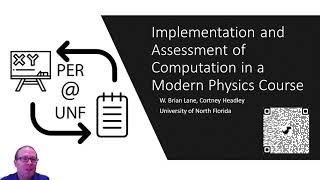
Implementation and Assessment of Computation in Modern Physics Teaching
Explore innovative computational methods for teaching modern physics, focusing on dynamic visualizations and hands-on investigations to enhance student understanding of complex quantum concepts.
Cosmology - Lecture 2: Path Integrals and Harmonic Oscillators
Explore advanced cosmology concepts including path integrals, harmonic oscillation, wave functions, and boundary conditions in this in-depth lecture by renowned physicist Nima Arkani-Hamed.
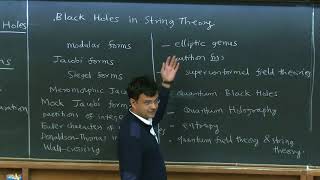
Quantum Fields, Strings, and Black Holes: A Primer for Non Experts, Part I - Atish Dabholkar
Explore quantum black holes, string theory, and their connections to number theory and geometry. Gain insights into fundamental physics concepts, suitable for mathematicians and physics students.

Understanding Prisms Through Springs - Optics Puzzles Part 3
Explore the physics behind prisms and light refraction, delving into oscillating charges, wave interactions, and harmonic oscillators to understand how the index of refraction arises and varies with color.
Harmonic Oscillator Potential in Quantum Mechanics - Lecture 8
Explore quantum behavior of harmonic oscillators through computer animations. Visualize spring force in the quantum world and learn to build coherent states using VPython.
Wave Function Evolver for 2D Harmonic Oscillator - Episode 7
Explore a working wave function evolver for a Gaussian wave in a 2-D harmonic oscillator potential, with debugging and tweaks demonstrated in VPython.

Everything is a Spring - Understanding Quantum Field Theory
Explore how quantum field theory models the universe as infinite oscillating springs, explaining particle behavior, interactions, and the fundamental nature of matter and energy.
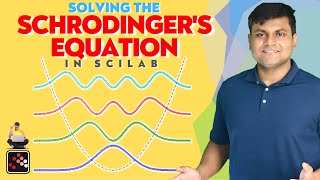
Numerically Solving the Schrodinger Equation in Scilab - Harmonic Oscillator and Infinite Square Well
Learn to numerically solve the Schrödinger equation using Scilab, covering finite difference methods and applications to harmonic oscillator and infinite square well potentials.
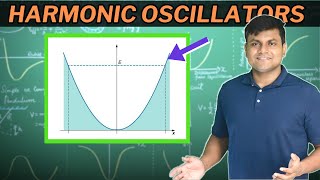
Harmonic Oscillators in Physics - Potential Energy Analysis and Solutions
Explore harmonic oscillators through potential energy analysis, understanding their solutions and applications in various physical systems, from pendulums to quantum mechanics.
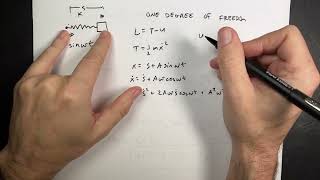
Review of Lagrangian Mechanics with Examples - Projectile Motion and Driven Spring Oscillation
Explore Lagrangian mechanics through projectile motion and driven spring oscillation examples, including numerical calculations and Python implementation.
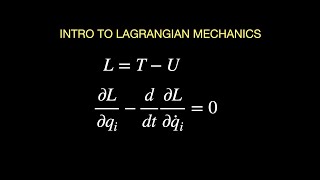
Introduction to Lagrangian Mechanics - Comparison with Newtonian Mechanics
Explore Lagrangian mechanics, comparing it to Newtonian physics. Learn to solve pendulum problems using both approaches and discover advanced applications like double pendulums.