Numerical Relativity as a Tool for Studying the Early Universe
Explore numerical relativity's role in studying the early universe, covering gravitational waves, dark matter, and plasma turbulence through advanced simulations and computational methods.
SpECTRE: A Relativistic Astrophysics Code
Explore SpECTRE, a cutting-edge relativistic astrophysics code, and its applications in computational relativity and gravitation research.
Introduction to Theory and Numerics of Partial Differential Equations - Lecture 1
Explore fundamental concepts and numerical techniques for solving partial differential equations, essential for modeling complex physical phenomena in gravitational-wave astronomy and astrophysics.
Introduction to Theory and Numerics of Partial Differential Equations - Lecture 4
Explore advanced concepts in partial differential equations, focusing on theory and numerical methods for solving complex mathematical problems in physics and engineering.
High Resolution Shock Capturing Scheme for Non-Relativistic Hydrodynamics - Lecture 2
Explore advanced numerical techniques for modeling shock waves in non-relativistic fluid dynamics, enhancing understanding of complex hydrodynamic phenomena in astrophysical simulations.
Numerical Relativity for Next-Generation Gravitational-Wave Observatories - Geoffrey Lovelace
Exploring numerical relativity for advanced gravitational-wave detection, covering Einstein's equations, wave formulations, and modeling challenges for next-generation observatories and detectors.
Post Processing and Mock Observations - Shane Davis, Philipp Moesta
Explore post-processing techniques and mock observations for binary systems, focusing on circumbinary gas evolution, observational signatures, and numerical modeling advancements.
Physics and Astrophysics of Gamma-Ray Bursts by Frédéric Daigne
Explore the physics and astrophysics of gamma-ray bursts in this advanced lecture, covering key concepts and latest research in high-energy astrophysical phenomena.
Numerical Relativity - Mathematical Formulation by Harald Pfeiffer
Explore mathematical formulation of numerical relativity, focusing on simulating binary black hole coalescence, gravitational waves, and advanced computational techniques in astrophysics.
Realistic Binary Neutron Stars Collisions Simulations - Challenges and Opportunities
Explore challenges and opportunities in simulating binary neutron star collisions, focusing on realistic models, electromagnetic counterparts, and remnant properties using open-source codes and parametrized equations of state.
Numerical Relativity and the Next Generation of Gravitational Wave Detections
Explore numerical relativity's role in gravitational wave astronomy, its impact on understanding gravity, and future challenges as detectors improve. Insights into computational and data hurdles in this evolving field.
Introduction to Modelling Gravitational Waves from Compact Binaries
Explore gravitational wave modeling techniques for compact binary systems, covering inspiral, merger, and ringdown phases. Learn about semi-analytic models crucial for detection and analysis.
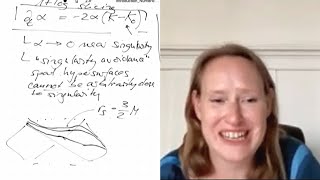
Helvi Witek - Introduction to Numerical Relativity, Part 2 - IPAM at UCLA
Explore advanced concepts in numerical relativity, including 3+1 spacetime decomposition, Einstein's equations, and stable simulation techniques for gravitational wave research.
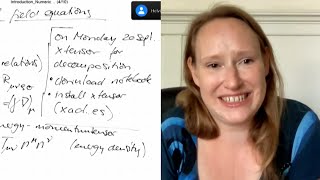
Helvi Witek - Introduction to Numerical Relativity, Part 1 of 2 - IPAM at UCLA
Explore the foundations of numerical relativity, including spacetime decomposition, Einstein's equations, and coordinate choices for stable simulations in gravitational wave astronomy.
Modern Numerical Methods in Computational Relativity - Lecture 5
Explore advanced numerical techniques in computational relativity, focusing on simulating black hole mergers and other high-energy astrophysical phenomena for gravitational-wave astronomy.
Modern Numerical Methods in Computational Relativity - Lecture 2
Explore advanced numerical techniques for solving Einstein's equations in computational relativity, focusing on applications in gravitational-wave astronomy and astrophysical simulations.
Modern Numerical Methods in Computational Relativity - Lecture 3
Explore advanced numerical techniques for solving Einstein's equations in computational relativity, focusing on modeling gravitational waves from merging black holes and neutron stars.

Modern Numerical Methods in Computational Relativity - Lecture 1
Explore modern numerical methods for solving Einstein's equations in computational relativity, essential for modeling gravitational waves from black hole and neutron star mergers.
Numerical Relativity: Mathematical Formulation - Lecture 4
Explore mathematical foundations of Numerical Relativity, essential for modeling gravitational waves from black hole mergers and other high-energy astrophysical phenomena.
Numerical Relativity: Mathematical Formulation - Lecture 3
Explore mathematical foundations of Numerical Relativity, essential for modeling gravitational waves from black hole mergers and other high-energy astrophysical phenomena.
Introduction to Numerical Relativistic Hydrodynamics - Lecture 5
Explore advanced concepts in numerical relativistic hydrodynamics, focusing on computational techniques for modeling high-energy astrophysical phenomena and gravitational wave sources.