Driving Performance for the Tools of Utility
Explore utility-scale quantum computing tools, focusing on performance, reliability, and advanced error mitigation for long-running jobs and system parallelism.
Two Sigma: Push Computing Research Boundaries with Google Cloud
Explore TwoSigma's AI/ML platform integrating Ray, Spark, and Dask on Google Kubernetes Engine. Learn about architecture, capabilities, and on-demand GPU access for investment strategy testing.
Power and Energy Consumption of HPC Systems
Explore power and energy consumption in HPC systems, learn about tuning for energy efficiency, and understand computing center restrictions for energy-saving measures.

QEMU Live Migration Device State Transfer Parallelization via Multifd Channels
Parallelize QEMU live migration device state transfer using multifd channels to improve performance and reduce downtime for VMs with large device states.
Innovative Gen AI Applications: Beyond Text - MLOps Mini Summit 5
Explore innovative Gen AI applications beyond text, focusing on molecule discovery and call center optimization. Learn about chemical language models, RAG use cases, and efficient pipeline architectures.
Rapids Machine Learning Training and Feature Engineering in GPU with CuML and CuDF
Accelerate ML training and feature engineering using GPU-powered CuML and CuDF libraries for enhanced performance and efficiency.
Lessons Learned Developing Performance-Portable QMCPACK
Explore strategies for developing performance-portable scientific applications, focusing on QMCPACK's redesign for GPU and CPU compatibility in materials property prediction.
Exascale Computing Project Successes and Lessons Learned
Explore ECP successes and lessons learned, focusing on integration, as presented by Lori Diachin, project director, to the Industry and Agency Council upon completion of technical work.
Exascale Computing Project Applications: Lessons Learned
Explore key insights and lessons learned from Exascale Computing Project applications development with Erik Draeger, deputy director of Application Development.
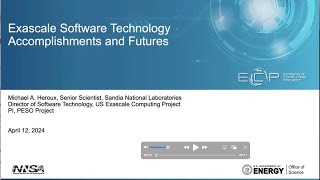
Exascale Computing Project's Software Technology Accomplishments and Futures - Lecture
Explore Exascale Computing Project's software technology achievements and future directions with Mike Heroux, senior scientist at Sandia National Laboratories.
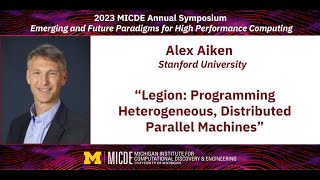
Legion: Programming Heterogeneous, Distributed Parallel Machines
Explore hierarchical data organization and computation in parallel programming, focusing on Legion's design for complex machine architectures.
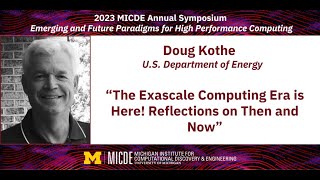
The Exascale Computing Era - Reflections on Progress and Challenges
Explore the dawn of exascale computing, focusing on the Frontier system, its applications, and the challenges overcome in developing exascale-capable software and technologies.
Programming Novel AI Accelerators for Scientific Computing - Part 2 - Tutorial 5
Explore advanced techniques for programming AI accelerators in scientific computing, focusing on optimization and performance enhancement.
LLMs on Polaris - Tutorial 5
Explore large language model deployment on Polaris supercomputer, focusing on efficient scaling and performance optimization techniques.
Programming Novel AI Accelerators for Scientific Computing - Part 1 - Tutorial 5
Explore programming techniques for AI accelerators in scientific computing, focusing on novel approaches and optimization strategies.
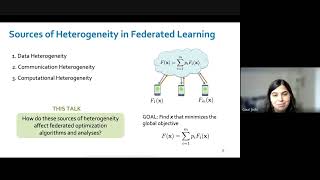
Heterogeneity-Aware Algorithms for Federated Optimization
Explore heterogeneity-aware algorithms for federated optimization, addressing data, communication, and computational challenges in distributed learning environments.
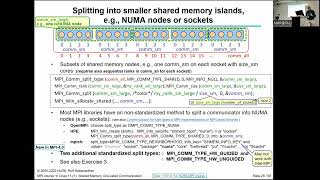
New Features in MPI 4.0
Explore new features in MPI 4.0, including large-count routines, persistent collectives, and the Sessions Model. Learn about hardware-based communicator splitting and improvements in error handling.
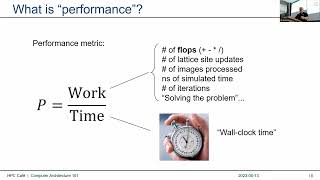
Computer Architecture 101 for Scientists and Its Impact on Cluster Jobs
Explore core concepts of parallel computer architecture and their impact on cluster job performance. Gain insights to optimize resource allocation and improve efficiency in supercomputing tasks.
LLVM in HPC: Enabling Performance Portability, Interoperability, and Novel Features - Part 2
Explore recent LLVM efforts for HPC: portable CUDA, debugging at scale, GPU execution of legacy codes, automatic differentiation, ML in compilers, and static information impact.
Processing Very Large Image Volumes with the Adaptive Particle Representation
Explore advanced techniques for processing massive image datasets using adaptive particle representation, enabling efficient visualization and analysis of terabyte-scale biomedical data.
Bridging Domain Science and HPC with Julia
Explore Julia's potential in HPC, combining scientific ecosystem with high performance. Gain insights on its strengths, limitations, and notable international projects from an experienced user.