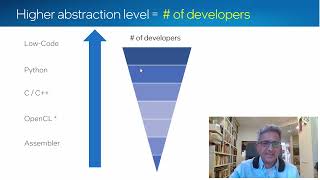
C++ for Multi-Accelerator, Multi-Vendor Systems - Meeting C++ 2022
Explore SYCL for C++ development on multi-accelerator systems. Learn basics, see demos, and discover how companies and institutions leverage this open-source, cross-device solution.
C++ Standard Parallelism - Portable Parallel Programming Across Platforms
Explore C++ Standard Parallelism: write portable parallel code for diverse hardware platforms. Learn about common algorithms, custom algorithm creation, and task graph composition.
Breaking Enigma with the Power of Modern C++
Explore Enigma machine encryption cracking using modern C++ and multicore CPUs. Learn historical context and benchmark performance of contemporary cryptanalysis techniques.
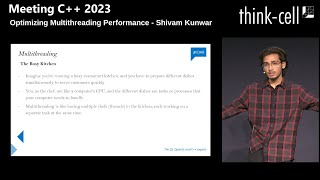
Optimizing Multithreading Performance - False Sharing and Hardware Destructive Interference
Explore false sharing and hardware destructive interference to optimize multithreaded performance. Learn strategies to mitigate cache-related bottlenecks and improve efficiency in C++ applications.
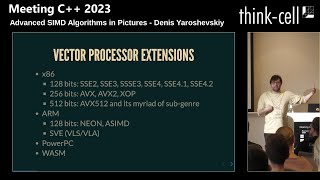
Advanced SIMD Algorithms in Pictures
Explore non-trivial SIMD algorithms like strcmp, set_intersect, and sort through visual explanations. Demystify vectorized algorithms for those with basic CS knowledge.
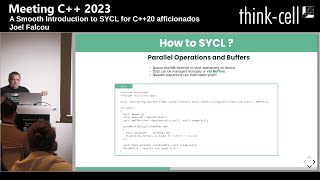
A Smooth Introduction to SYCL for C++20 Aficionados
Explore SYCL for cross-platform accelerator programming in C++20. Learn integration techniques, key features, and real-world applications in high-energy physics.
CUDA and the Wolfram Language: Latest Developments and Future Directions
Explore CUDA integration in Wolfram Language, covering latest developments and future directions for massively parallel GPU computation.
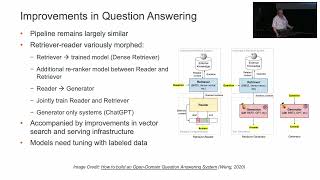
A Cheap Trick for Semantic Question Answering for GPU-Challenged Systems
Explore a cost-effective approach to semantic question answering using LLMs during indexing, combining text and vector matching for efficient search without GPU requirements.
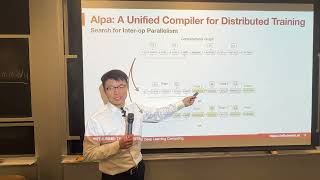
Distributed Training: Techniques and Strategies - Part II - Lecture 18
Explore advanced distributed training techniques for machine learning, focusing on efficiency and scalability in large-scale AI systems.
Distributed Training for Efficient Machine Learning - Part II - Lecture 18
Explore advanced distributed training techniques for machine learning, focusing on efficiency and scalability in large-scale systems.
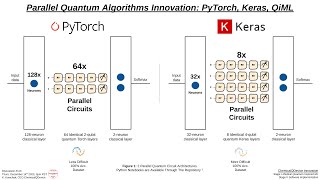
Parallel Quantum Algorithms Innovation: PyTorch, Keras, and QiML
Explore parallel quantum algorithms for machine learning using PyTorch and Keras. Enhance model accuracy and efficiency by incorporating quantum layers in neural networks.
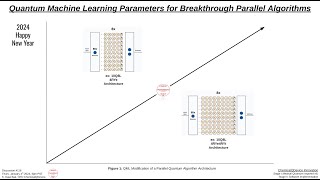
Quantum Machine Learning Parameters for Breakthrough Parallel Algorithms
Explore breakthrough parallel quantum algorithms for machine learning, improving performance and efficiency. Learn key benefits and optimal parameter settings for quantum-classical hybrid models.
Parallel Algorithms for Local Problems in Sparse Graphs
Explore efficient parallel algorithms for locally checkable problems in sparse graphs, focusing on techniques beyond graph sparsification for improved performance in sublinear regimes.

Molly.jl - Molecular Dynamics in Julia
Explore Molly.jl for molecular dynamics simulations in Julia. Learn about its features, advantages, and applications in research, including differentiable molecular simulation and force field improvement.
CPU and GPU Performance of the Batched Code - QMCPACK Workshop 2023
Explore CPU and GPU performance optimization techniques for batched code in quantum Monte Carlo simulations with QMCPACK.
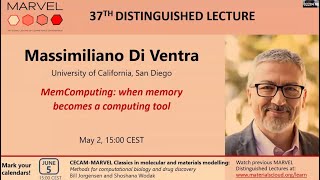
MemComputing: When Memory Becomes a Computing Tool - Lecture 37
Explore MemComputing, a revolutionary approach where memory acts as a computing tool, presented by Prof. Massimiliano Di Ventra from UC San Diego.
Why Do We Need a Compiler Architecture for Heterogeneous Computing
Explore compiler architecture for heterogeneous computing, addressing complex tasks and large data volumes. Learn about seamless integration between diverse computing units and platforms.
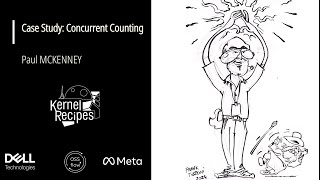
Case Study: Concurrent Counting - Kernel Recipes 2024
Explore fundamental concurrency issues through scalable counting on multicore systems, covering design, coding, and validation challenges.
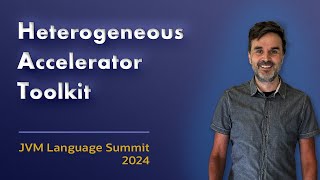
Heterogeneous Accelerator Toolkit (HAT) Update - Project Babylon and GPU Acceleration in Java
Explore updates on Java's Heterogeneous Accelerator Toolkit (HAT) project, focusing on GPU acceleration, programming models, and integration with Babylon and Panama FFM. Includes demos and future plans.
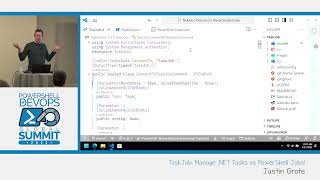
TaskJob: Manage .NET Tasks as PowerShell Jobs - PowerShell Summit 2023
Discover how to manage .NET Tasks as PowerShell Jobs with TaskJob, enhancing your scripting capabilities and workflow efficiency.

Kokkos: Getting Lucky By Design - Performance Portability and API Design Principles
Explore Kokkos programming model's design principles for performance portability across diverse HPC platforms. Learn how API design and community development contribute to widespread adoption.