Playing With Fire - Pyro SOP Solver, Houdini Tutorial
Learn top tips for Houdini 18's Pyro SOP solver, covering setup, simulation, shaping, and rendering techniques for creating realistic fire effects in 3D VFX.
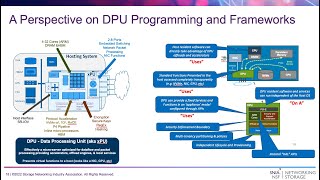
Programming Frameworks for xPU, GPU, and Computational Storage - A Comprehensive Overview
Explore programming frameworks for GPUs, xPUs, and computational storage devices, covering CUDA, SYCL, DOCA, and emerging standards for accelerated processing and host offload capabilities.

Rusticl OpenCL Implementation Status Update 2023
Discover the latest developments and implementations in Rusticl, exploring project updates and future outlook for this OpenCL implementation in Rust.
Scala Goes Native
Explore Scala's expansion beyond JVM with a new ahead-of-time compiler and lightweight managed runtime, opening doors to native development and enhanced performance.
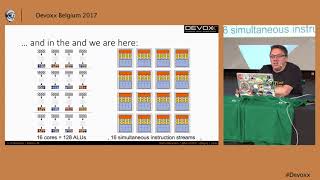
Java on the GPU - Where Are We Now?
Explore GPU utilization in Java, covering OpenGL, CUDA, and OpenCL for massive computations. Learn advantages and drawbacks of GPU computing in desktop and cloud environments.
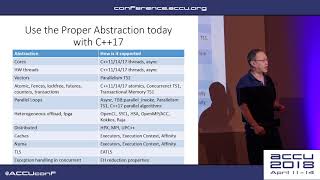
Heterogeneous Programming in C++ Today
Explore the evolving landscape of heterogeneous parallelism in C++, including standards, specifications, and future applications in IoT, self-driving cars, and machine learning.

But Mummy I Don't Want to Use CUDA - Open Source GPU Compute
Explore alternatives to CUDA for GPU computing, focusing on open-source options like OpenCL, SPIR-V, and SYCL. Discuss challenges and potential solutions for a vendor-neutral Linux compute stack.
Tensorflow on Open Source GPUs
Explore efforts to enable TensorFlow on open-source GPUs using SYCL, LLVM, and OpenCL. Learn about challenges and progress in deploying AI/ML frameworks without proprietary NVIDIA CUDA stack.
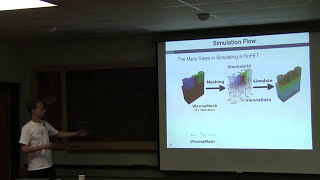
A Discussion of Selected Vienna-Libraries for Computational Science
Explore Vienna-Libraries for computational science: ViennaCL, ViennaGrid, ViennaData, ViennaMath, and ViennaFEM. Learn how C++ can better meet scientific computing needs.
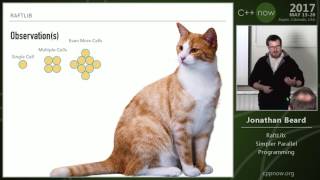
RaftLib - Simpler Parallel Programming
Explore RaftLib, a C++ library simplifying parallel programming for heterogeneous multicore processors. Learn to write efficient code for complex hardware without extensive low-level knowledge.
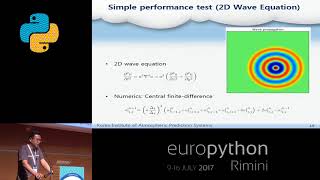
GPU Acceleration of a Global Atmospheric Model Using Python Based Multi-Platform
Explore GPU acceleration for global atmospheric models using PyMIP, a Python module integrating C, Fortran, CUDA, and OpenCL. Learn about performance improvements and multi-platform compatibility for weather forecasting and climate prediction.
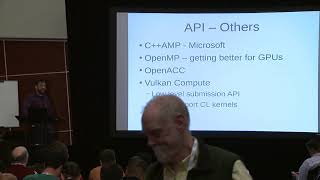
Open Source GPU Compute Stack - Not Dancing the CUDA Dance
Exploring open-source alternatives to CUDA for GPU compute acceleration, discussing potential for a vendor-neutral reference stack using SYCL/OpenCL/Vulkan and Mesa.

cuCatch: A Debugging Tool for Efficiently Catching Memory Safety Violations in CUDA Applications
Explore cuCatch, an innovative debugging tool for CUDA applications that efficiently detects memory safety violations with low performance overhead and high error detection coverage.
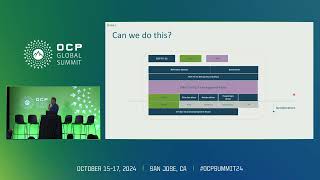
Interfaces in Near Data Computing - Simplifying SNIA API for Compute Storage Devices
Explore the FTI API's simplified approach to compute storage devices, focusing on SNIA API integration and practical applications in video encoding scenarios.
Descend: A Safe GPU Systems Programming Language
Explore Descend, a safe GPU programming language enforcing memory management through type systems. Learn about its holistic model, extended Borrow checking, and competitive performance against CUDA.
News from the Embedded Graphics Space
Explore the evolving embedded GPU landscape, including new standards, hardware changes, and software ecosystem demands, with insights on Linux support and driver comparisons.
Code Reflection in Action - Translating Java to SPIR-V
Explore Java-to-SPIR-V translation using Babylon's code reflection API for GPU execution. Learn about parallel compute workloads and graphics libraries implementation.
Exascale Computing: From Shared Memory to GPU Architecture
Explore exascale computing, HPC architectures, and GPU programming with Dr. Meifeng Lin from Brookhaven National Laboratory.

Flora: Creating Realistic 3D Plants with Houdini - GPU-Accelerated Plant Modeling
Discover how Flora, a new Houdini-based toolset, revolutionizes 3D plant creation by combining generative systems with intuitive controls, GPU acceleration, and seamless Unreal Engine integration.