
NVIDIA GPU Computing - A Journey from PC Gaming to Deep Learning
Explore NVIDIA GPU's evolution from gaming to deep learning, covering key architectures and applications in supercomputing, data centers, and autonomous vehicles.

Synthetic Data Generation and Fine-tuning for OpenAI GPT-4 or Llama 3
Dive into an extensive tutorial on synthetic data generation and fine-tuning techniques for large language models like OpenAI GPT-4o and Llama 3. Learn how to create synthetic questions and answers, implement chain of thought reasoning, and augment data…
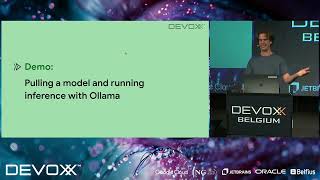
Running Open Large Language Models in Production with Ollama and Serverless GPUs
Explore the deployment of open large language models in production environments using Ollama and serverless GPUs. Learn why companies are increasingly interested in running open models like Gemma and Llama, which offer full control over deployment, model…
Sustainable Development of Stencil-based HPC Applications - JuliaCon 2024
Explore sustainable HPC application development using Julia packages for stencil-based computations, achieving scalable performance and portability across diverse hardware architectures.
NeuroTree - A Differentiable Tree Operator for Tabular Data
Explore NeuroTree, a differentiable tree operator for tabular data, addressing traditional tree limitations through simultaneous node learning and built-in ensemble techniques.

Training Llama 2 in Julia - Scaling Large Language Models
Explore scaling techniques for training large neural networks like Llama2 using Julia, including multi-GPU parallelization and fine-tuning methods for efficient model adaptation.
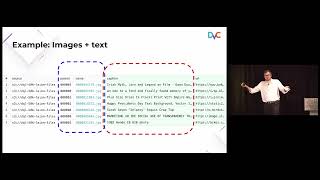
Data Versioning in Generative AI: A Pathway to Cost-Effective ML
Explore data versioning strategies for Generative AI, focusing on managing large-scale unstructured data and optimizing resource usage in model scoring and API interactions.
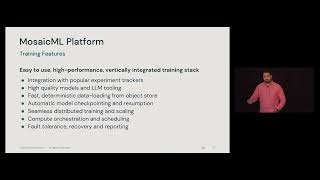
Training LLMs: Lessons from the Trenches
Discover key insights and challenges in training large language models across hundreds of GPUs, from data handling to resource management.
From Idea to Production: AI Infrastructure for Scaling LLM Applications
Explore strategies for scaling LLM applications from beta to production, addressing challenges and building adaptable AI infrastructure for evolving models and workflows.
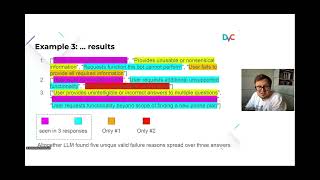
Data Versioning in Generative AI - A Pathway to Cost-effective Machine Learning
Explore data versioning strategies for generative AI, focusing on cost-effective techniques to minimize processing time and API calls while enhancing collaboration and efficient versioning of annotations and embeddings.
Scale and Accelerate Distributed Model Training in Kubernetes Clusters
Orchestrate and accelerate distributed deep learning workloads across multiple GPUs and nodes using Kubernetes, Kubeflow PytorchJob, RDMA, RoCE, and SRIOV for near-linear performance scaling.
MLOps is Just HPC in Disguise - A Real-World, No-Nonsense Guide to Upgrading Your Workflow
Upgrade your ML workflow with efficient tools and techniques for automating tasks, managing resources, and streamlining production deployment in this practical guide to MLOps.
Critical Use of MLOps in Finance Using Cloud-Managed ML Services That Scale
Leverage MLOps to improve quality and consistency of machine learning solutions in finance. Accelerate model experimentation, deployment, and tracking using cloud-managed services for efficient scaling.
WarpDrive: Orders of Magnitude Faster Multi-Agent Deep Reinforcement Learning on a GPU
Accelerate multi-agent deep reinforcement learning with WarpDrive, an open-source framework enabling end-to-end GPU execution. Explore features like automatic GPU tuning and distributed training for improved efficiency and scalability.
Faster Model Serving with Ray and Anyscale - Ray Summit 2024
Explore Ray Serve's capabilities for distributed model serving and deployment, focusing on Anyscale's solutions for large-scale AI models and the challenges of building AI applications in the era of generative AI.
OpenCV DNN
Learn to deploy neural networks for object detection, depth estimation, and point cloud creation using OpenCV DNN module with Python and C++. Explore GPU acceleration and custom YOLOv5 models.

Pytorch Tutorial
Learn PyTorch fundamentals, from installation to advanced applications. Master tensors, backpropagation, and deep learning techniques for real-world data science projects.

Julia for High-Performance Computing - JuliaCon 2022
Explore Julia's capabilities for high-performance computing through expert talks on scalability, GPU support, MPI integration, and real-world applications in scientific and engineering domains.
Distributed TensorFlow Training - Google I/O 2018
Learn to scale TensorFlow training across multiple GPUs and machines efficiently. Explore distribution strategies, performance optimization techniques, and practical implementation using Google Cloud.
The Evolution of Multi-GPU Inference in vLLM
Dive into advanced parallelism strategies for distributed LLM inference, exploring tensor, pipeline, and expert parallelism techniques through vLLM's architecture and optimization approaches.
SeismicWaves.jl - Wave Simulation Package for Full Waveform Inversion on Multi-xPUs
Discover how SeismicWaves.jl enables efficient wave equation solving through finite-difference methods, offering high-performance computing capabilities for both small-scale prototyping and large-scale simulations.