Advanced Database Systems - Spring 2019
Comprehensive exploration of advanced database systems, covering in-memory databases, concurrency control, indexing, storage models, query processing, and optimization techniques for modern DBMS architectures.
Advanced Database Systems - Spring 2018
Explore advanced database systems, covering in-memory databases, query optimization, concurrency control, indexing, storage models, logging, and parallel execution techniques for high-performance data management.
CUDA Tutorials
Learn to program NVIDIA GPUs with CUDA, covering basics, kernels, memory, parallel algorithms, shared memory, and the Thrust library for efficient GPU computing.
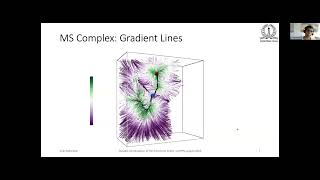
Scalable Computation of the Extremum Graph
Explore scalable computation of extremum graphs, a simplified topological descriptor for scalar functions, with applications in visualization and shape analysis. Learn efficient parallel algorithms for large datasets.
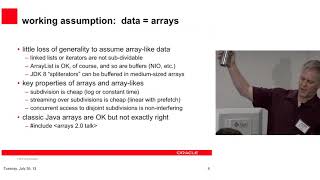
Data Parallel Programming - Concepts and Challenges in Java
Explore data parallel computing techniques, array operations, and Java VM virtualization. Learn about multi-threading challenges, data partitioning strategies, and GPU thread concepts.
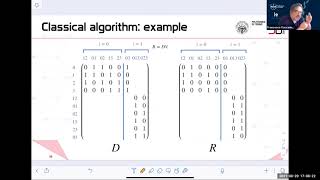
Parallel Decomposition of Persistence Modules Through Interval Bases
Exploring parallel decomposition of persistence modules using interval bases, with applications in Topological Data Analysis and connections to the Hodge Laplacian.
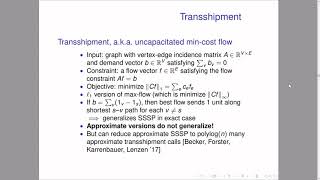
Faster Parallel Algorithm for Approximate Shortest Path
Explore advanced techniques for optimizing parallel algorithms to compute approximate shortest paths, focusing on transshipment, Sherman's framework, and oblivious routing.
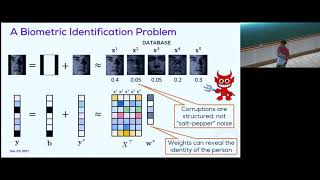
Robust Regression by Purushottam Kar
Explore robust regression techniques for learning and estimation in algorithms and optimization, focusing on practical applications and theoretical foundations.
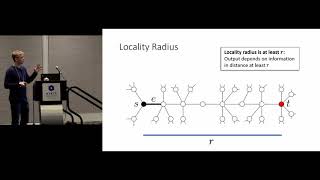
Conditional Hardness Results for Massively Parallel Computation from Distributed Lower Bounds
Explore conditional hardness results in massively parallel computation, derived from distributed lower bounds. Gain insights into theoretical computer science and parallel algorithms.
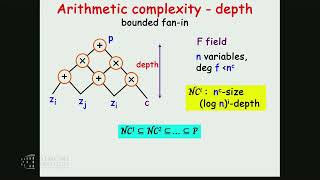
Faster Parallel Algorithms for Basic Linear Algebra Problems
Explore advanced parallel algorithms for fundamental linear algebra, enhancing computational efficiency in mathematical problem-solving.
Conditional Hardness for Massively Parallel Computing Via Distributed Lower Bounds
Explore conditional hardness in massively parallel computing through distributed lower bounds, examining theoretical challenges and algorithmic implications for sublinear algorithms.
C++ Parallel Programming Models
Explore C++'s parallel programming models: unstructured, task-based, and data parallel. Learn key facilities, use cases, and recent features for efficient parallel programming in modern C++.
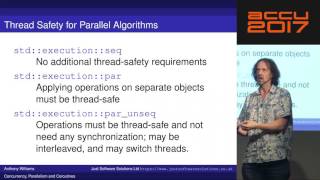
Concurrency, Parallelism and Coroutines
Explore C++17's parallel algorithms, concurrency, and coroutines. Learn how these features interrelate and can be leveraged for efficient, parallel programming in modern C++ applications.
Scaling with C++11
Techniques for building hyperscalable software: design principles, multithreading patterns, memory management, and asynchronous I/O in C++11 for maximizing parallel execution and reducing inter-thread dependencies.
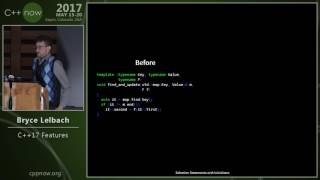
C++17 Features
Comprehensive overview of C++17 features, covering major language and library changes. Explores structured bindings, if constexpr, lambdas, inline variables, and new standard library components like filesystem and parallel algorithms.
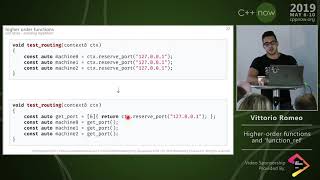
Higher-Order Functions and Function Ref
Explore higher-order functions in C++, their practical applications, and the proposed `function_ref` abstraction for C++20, enhancing code flexibility and performance.
Concurrency in C++ - A Programmer’s Overview - Part 1 of 2
Comprehensive overview of C++ concurrency features from C++11 to C++20, focusing on performance optimization with live benchmarks and practical insights for efficient concurrent programming.
Concurrency in C++ - A Programmer’s Overview - Part 2 of 2
Explore advanced C++ concurrency features, including memory models, thread-safety, primitives, parallel algorithms, and C++20 coroutines. Gain insights for maximum performance through live benchmarks and practical examples.
C++ Standard Parallelism
Explore C++ Standard Parallelism: portable, efficient parallel programming for all platforms. Learn about common algorithms, tools for custom algorithms, and task graph composition.

Forward Progress Guarantees in C++
Explore forward progress guarantees in C++, their importance for synchronization, and areas where the C++ specification needs clarity. Gain insights into concurrent programming and parallel algorithms.

Writing a Parallel and Distributed Tool for Backing Up a Multi Terabyte Data
Learn to create a parallel and distributed backup tool for handling multi-terabyte datasets, exploring efficient strategies for large-scale data management and protection.