Back to the Future
Exploring advanced C++ abstractions for multi-core and parallel computing, focusing on a heterogeneous, extensible future implementation that outperforms existing models like OpenMP and MPI.
Boost.Compute - A Library for GPU - Parallel Computing
Explore Boost.Compute, a high-level API for GPU/parallel computing. Learn to write efficient C++ applications for GPUs, FPGAs, and multi-core CPUs using this portable, STL-like library.
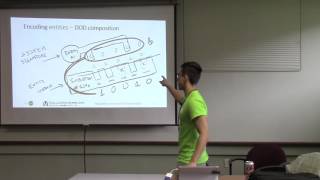
Implementation of a Multithreaded Compile-Time ECS in C++14
Explore efficient game architecture using C++14 metaprogramming to create a compile-time, multithreaded entity-component system, focusing on reusability, parallelism, and intuitive syntax.
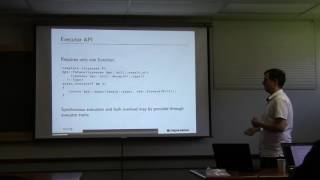
HPX and GPU Parallelized STL
Exploring GPU parallelization in HPX's STL implementation using C++AMP and SYCL standards. Discusses integration challenges, performance optimization, and the potential for simplified GPU programming in C++ applications.
C++ Performance in Practice - Align, Vectorise, Cache, Jump!
Explore hardware-driven C++ performance optimization techniques including memory alignment, SIMD, cache-friendliness, and branch prediction with code examples and benchmarks.
C++17 Features
Comprehensive overview of C++17 features, covering major language and library changes. Explores structured bindings, if constexpr, lambdas, inline variables, and new standard library components like filesystem and parallel algorithms.
Composite Arithmetic Types Are Greater Than the Sum of Their Parts
Explore advanced C++ arithmetic types using modern language features. Learn to build custom numeric types with improved safety, speed, and usability through compositional approaches and low-cost abstractions.

Rust - Hack Without Fear
Explore Rust's ownership concept, memory safety, and parallelism advantages. Learn how Rust combines low-level control with high-level programming, ensuring thread safety and efficient abstractions.

RaftLib - Simpler Parallel Programming
Explore RaftLib, a C++ library simplifying parallel programming for heterogeneous multicore processors. Learn to write efficient code for complex hardware without extensive low-level knowledge.
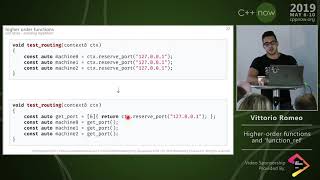
Higher-Order Functions and Function Ref
Explore higher-order functions in C++, their practical applications, and the proposed `function_ref` abstraction for C++20, enhancing code flexibility and performance.
Adventures in SIMD-Thinking
Explore SIMD capabilities in modern hardware, focusing on SSE, AVX, and AVX-512 instruction sets. Learn to leverage C++ for improved performance in real-world computing problems through vertical thinking.
Taskflow - A Heterogeneous Task Graph Programming System with Control Flow
Explore heterogeneous task graph programming with control flow using Taskflow, a C++ system for efficient parallel and GPU-accelerated computing with high productivity.
Concurrency in C++ - A Programmer’s Overview - Part 1 of 2
Comprehensive overview of C++ concurrency features from C++11 to C++20, focusing on performance optimization with live benchmarks and practical insights for efficient concurrent programming.
Concurrency in C++ - A Programmer’s Overview - Part 2 of 2
Explore advanced C++ concurrency features, including memory models, thread-safety, primitives, parallel algorithms, and C++20 coroutines. Gain insights for maximum performance through live benchmarks and practical examples.
C++ Standard Parallelism
Explore C++ Standard Parallelism: portable, efficient parallel programming for all platforms. Learn about common algorithms, tools for custom algorithms, and task graph composition.
Introduction to C++ Coroutines Through a Thread Scheduling Demonstration
Explore C++20 coroutines for efficient CPU-GPU multitasking, improving performance in heterogeneous workloads. Learn fundamental components and design a lightweight programming model with scheduling algorithm.

Forward Progress Guarantees in C++
Explore forward progress guarantees in C++, their importance for synchronization, and areas where the C++ specification needs clarity. Gain insights into concurrent programming and parallel algorithms.
Pipeflow - C++ Task-Parallel Pipeline Scheduling Framework
Explore Pipeflow, a C++ task-parallel pipeline framework for efficient scheduling. Learn design, implementation, and real-world applications to enhance your parallel programming skills.
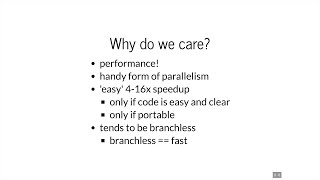
SIMD Libraries in C++
Explore SIMD libraries in C++, including std::simd for C++26. Learn about application-level libraries, developer libraries, and design trade-offs for exploiting SIMD in modern C++ development.
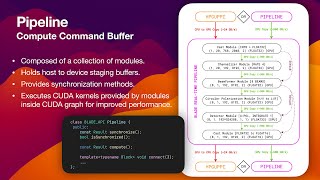
BLADE - The Allen Telescope Array CUDA-Accelerated Real-Time DSP Library
Explore GPU-accelerated real-time DSP for radio astronomy, focusing on BLADE software's innovative techniques for processing massive data streams from the Allen Telescope Array.
Python Concurrency - From Beginner to Pro
Comprehensive guide to Python concurrency, covering processes, threads, modules, race conditions, and the GIL. Includes coding examples and activities to build a multithreaded and multiprocessing web server.