MELF - Multivariant Executables for a Heterogeneous World
Explore MELF: a novel approach for including multiple function variants in a single binary, enabling runtime switching for optimized performance across heterogeneous systems.
Towards Iterative Relational Algebra on the GPU
Explores GPU-based iterative relational algebra for high-performance data analytics, presenting a novel hash-join implementation with optimizations for memory access and deduplication, outperforming existing solutions.
MSRL - Distributed Reinforcement Learning with Dataflow Fragments
Explores MSRL, a distributed reinforcement learning system using fragmented dataflow graphs for flexible execution on GPU clusters, offering improved performance and adaptability.
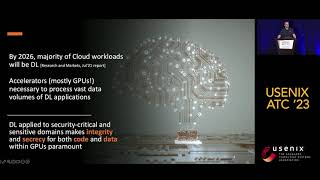
SAGE - Software-based Attestation for GPU Execution
Explore SAGE, a software-based attestation mechanism for secure GPU execution, offering code integrity, computation integrity, and data protection without hardware support.
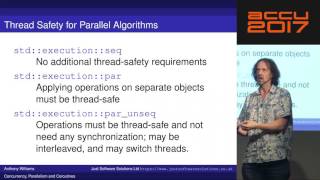
Concurrency, Parallelism and Coroutines
Explore C++17's parallel algorithms, concurrency, and coroutines. Learn how these features interrelate and can be leveraged for efficient, parallel programming in modern C++ applications.
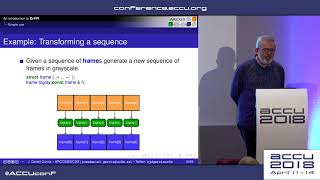
Parallel Design Patterns and Stream Parallelism
Explore parallel design patterns and stream parallelism using GrPPI, an experimental library for expressing parallelism through patterns, with focus on composability and multiple back-end support.
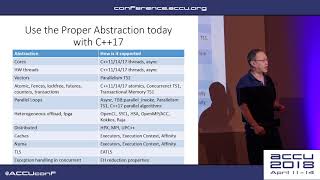
Heterogeneous Programming in C++ Today
Explore the evolving landscape of heterogeneous parallelism in C++, including standards, specifications, and future applications in IoT, self-driving cars, and machine learning.

The Cell as a Computer - Turing Complete and Massively Parallel
Explore biological computing: cells as Turing-complete devices, biocomputers, and parallels between cellular processes and computer components. Gain insights into nature's 4-billion-year-old computing paradigm.
Khronos Sycl Language Framework for C++ Accelerators - Take Advantage of All the MIPS
Explore SYCL, a C++ framework for heterogeneous computing, enabling efficient use of various accelerators. Learn its features, applications, and advantages for high-performance computing and AI/ML development.
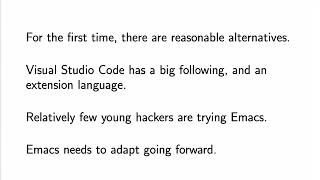
Emacs - The Editor for the Next Forty Years
Exploring Emacs' future: modernizing with Rust, enhancing HTML rendering, integrating developer tools, and expanding functionality while preserving its essence as a powerful, extensible editor.

But Mummy I Don't Want to Use CUDA - Open Source GPU Compute
Explore alternatives to CUDA for GPU computing, focusing on open-source options like OpenCL, SPIR-V, and SYCL. Discuss challenges and potential solutions for a vendor-neutral Linux compute stack.
Tensorflow on Open Source GPUs
Explore efforts to enable TensorFlow on open-source GPUs using SYCL, LLVM, and OpenCL. Learn about challenges and progress in deploying AI/ML frameworks without proprietary NVIDIA CUDA stack.
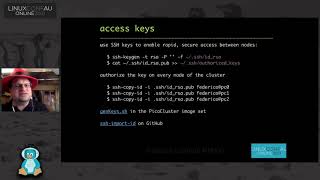
Building Raspberry PI Supercomputers
Learn to build and manage Raspberry Pi supercomputers, from cluster setup to parallel computing. Explore software integration, node configuration, and practical applications using MPI for numerical workloads.
CPU-Friendly Code
Explore CPU architecture, cache locality, branch prediction, and OS concepts to optimize code performance and efficiency beyond Big-O notation.
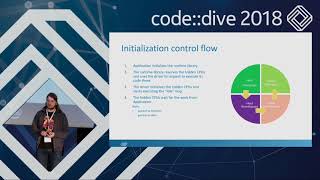
Reducing OS Noise Using Offload Driver
Explore techniques to reduce OS noise and improve performance in multi-core processors using offload drivers, with a focus on Intel® Xeon Phi™ Processors.
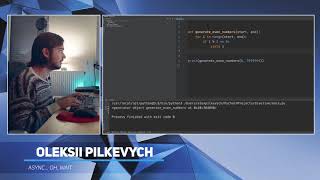
Async - Oh, Wait
Explore common pitfalls and challenges in asynchronous Python programming, with insights on improving code efficiency and avoiding mistakes for developers new to asyncio.
HPX - A C++11 Parallel Runtime System
Explore HPX, a C++11 parallel runtime system offering an alternative to MPI for computational science applications, featuring lightweight user-threads and Active Global Address Space.
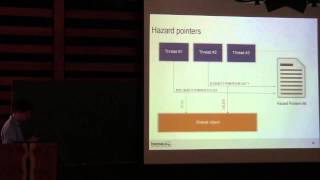
Scaling with C++11
Techniques for building hyperscalable software: design principles, multithreading patterns, memory management, and asynchronous I/O in C++11 for maximizing parallel execution and reducing inter-thread dependencies.
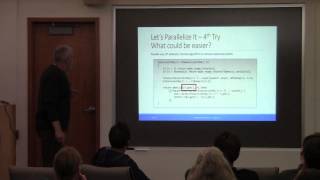
HPX - A C++ Runtime System for Parallel and Distributed Computing
Explore HPX, a C++ runtime system for parallel and distributed computing. Learn about its innovative approach to multi-core processing, asynchronous task execution, and scalable addressing for high-performance applications.
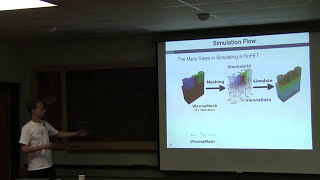
A Discussion of Selected Vienna-Libraries for Computational Science
Explore Vienna-Libraries for computational science: ViennaCL, ViennaGrid, ViennaData, ViennaMath, and ViennaFEM. Learn how C++ can better meet scientific computing needs.

Multi-Threading with C++11 and Boost
Explore C++11 and Boost for multi-threading through practical examples, including thread-safe queues, parallel tasks, and task interruption. Learn about threads, mutexes, and condition variables.