
Simplifying Numeric Expressions with Powers - Basic Math Practice Problem
Simplify a complex numeric expression using order of operations and PEMDAS. Master essential problem-solving skills for basic math calculations involving exponents and division.

Fast, Elegant, Set-oriented Numerical Analysis Using GAIO.jl
Explore GAIO.jl for fast, elegant set-oriented numerical analysis in Julia. Learn to compute attractors, leverage multiple dispatch, and utilize GPU acceleration for enhanced performance.
Projector Monte Carlo and Exact Diagonalization with Rimu.jl
Explore quantum many-body physics with Rimu.jl: implement projector Monte Carlo, perform exact diagonalization, and extend models using Julia's speed and flexibility.

Learning Mathematics for Those Who Struggle
Discover strategies to overcome math challenges and improve your skills. Learn effective approaches to tackle mathematical concepts with confidence.
Good, Fast, Cheap - How to Do Data Science with Missing Data
Explore strategies for handling missing data in data science projects, including visualization, identification, and practical implementation techniques for effective workflow integration.
Machine Learning on Dynamic Graphs - Temporal Graph Networks
Explore Temporal Graph Networks for dynamic graph analysis, unlocking insights in evolving systems like social networks and financial transactions.
Polygenic Prediction Across Populations - Ancestry, Genetic Architecture, and Methodological Considerations
Explore polygenic prediction across populations, examining ancestry, genetic architecture, and methodological considerations for improved understanding of complex trait genetics.
Deep End-to-end Causal Inference and Introduction to Causal Discovery
Explore deep end-to-end causal inference and discover its applications in data-driven decision-making across various domains. Learn about causal discovery, inference, and the Microsoft causal AI suite.
Medical and Population Genetics Primer: All of Us Research Program - Part 2
Explore advanced concepts in medical and population genetics, focusing on complex trait analysis, human genetic variation, and cutting-edge sequencing methods.
Large-Scale Differentiable Causal Discovery of Factor Graphs - Lecture and Primer
Explore large-scale causal discovery using factor directed acyclic graphs and differentiable optimization. Learn about causal representation learning for genetic perturbations and combinatorial extrapolation.
Data Thinning to Avoid Double Dipping in Statistical Analysis - Lecture 1
Explore data thinning techniques to prevent double dipping in statistical analysis, with applications in single-cell RNA sequencing and unsupervised learning problems.
Causal Representation Learning Through Multi-Modal Data Integration
Explore causal representation learning techniques for integrating multi-modal data in this workshop by Caroline Uhler from MIT and Broad Institute.
Medical and Population Genetics Primer: All of Us Research Program - Part 1
Explore the basics of medical and population genetics, covering human genetic variation, genotyping, and DNA sequencing methods in this informative primer series.
Contrastive Models for Case-Control Changes in Sequencing - Models, Inference and Algorithms
Explore contrastive latent variable models for analyzing differential expression in sequencing data, enhancing case-control comparisons in transcriptomics with novel approaches to capture condition-specific variations.
GRN-Guided Simulation of Single-Cell RNA-Seq and Primer on Causal GANs
Explore GRouNdGAN for simulating single-cell RNA-seq data and learn about CausalGANs for gene regulatory network analysis and in-silico perturbation experiments.
Modeling Rare Variation and Calculating Genetic Constraint - MPG Primer 2023
Explore genetic constraint calculation and rare variation modeling techniques for understanding human population genetics and disease mechanisms.
MPG Primer: suSIEx - Medical and Population Genetics 2023
Explore suSIEx, a cutting-edge method for analyzing genetic data in medical and population genetics. Learn its principles, applications, and potential impact on understanding complex traits and diseases.
Inferring Causal Cell Types Driving Human Disease and Complex Traits - MPG Primer 2023
Explore causal cell types in human diseases through GWAS and functional genomics integration. Learn about colocalization, TWAS, and TCSC for identifying disease-critical genes and tissues.
MPG Primer: STACI - 2023
Explore STACI, a novel method for analyzing single-cell data to uncover cell type-specific genetic effects on gene expression and disease risk.
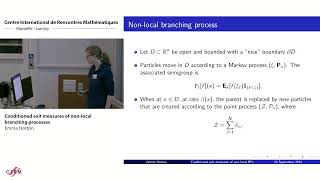
Conditioned Exit Measures of Non-Local Branching Processes
Explore conditioned exit measures of non-local branching processes in this mathematical conference talk by Emma Horton at CIRM.

Accessibility Percolation for the Rough Mount Fuji Model
Explore accessibility percolation in the rough Mount Fuji model through a mathematical conference talk by Matt Roberts at CIRM.