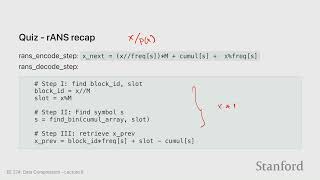
Stanford EE274: Data Compression - Beyond IID Distributions: Conditional Entropy - Lecture 8
Explore conditional entropy and advanced data compression techniques beyond IID distributions in this Stanford lecture, enhancing understanding of complex information theory concepts.

Convex Optimization I - Lecture 3
Explore advanced convex optimization techniques with Stanford's Stephen Boyd. Dive deep into mathematical concepts and practical applications in this comprehensive lecture series.
Convex Optimization I - Lecture 2
Explore advanced convex optimization techniques with Stanford's Stephen Boyd. Dive deep into mathematical concepts and practical applications in electrical engineering and beyond.

Convex Optimization I - Lecture 1
Explore fundamental concepts of convex optimization with Stanford's Stephen Boyd. Gain insights into this powerful mathematical technique for solving complex problems efficiently.
Convex Optimization I - Lecture 12
Explore advanced convex optimization techniques with Stanford's Stephen Boyd. Delve into complex mathematical concepts and their practical applications in engineering and data science.

Convex Optimization I - Lecture 11
Explore advanced convex optimization techniques with Stanford's Professor Stephen Boyd, focusing on practical applications and theoretical foundations in electrical engineering.
Underactuated Robotics - Spring 2009
This course discusses nonlinear dynamics and control of underactuated mechanical systems, with an emphasis on machine learning methods.

Mathematics of Big Data and Machine Learning, IAP 2020
Explore artificial intelligence and machine learning with a focus on data handling challenges, covering topics from associative arrays to bio sequence cross-correlation and Kronecker graphs.
Engineering Mathematics: Linear Algebra and ODEs, Fall 2014
Explore linear algebra and ODEs, covering numerical solutions for equation systems. Learn first and second-order equations with renowned instructor Gilbert Strang.

Imaginary Numbers Are Real
Explore the fascinating world of imaginary numbers, from their historical origins to complex functions and Riemann surfaces, in this comprehensive mathematical journey.

Efficient Markets Hypothesis and Its Limitations - Financial Markets Lecture 7
Explore the Efficient Markets Hypothesis, its implications for stock prices, and critiques of the theory through empirical evidence and alternative models of market behavior.

Technology and Invention in Finance - Financial Markets
Explore financial technology's societal impact, from limited liability corporations to inflation indexation and swap contracts, emphasizing the evolution and importance of financial inventions in managing risks.

Risk and Financial Crises - Probability Theory in Financial Markets
Explore probability theory in financial crises context, covering expected value, variance, covariance, and regression analysis. Learn about risk decomposition and the limitations of normal distribution assumptions in finance.

Bass Patterns in Blues and Rock - Lecture 8
Explore bass patterns and chord progressions in popular and classical music, learning to identify harmonic structures across genres from Mozart to Justin Timberlake.

Sonata-Allegro Form in Mozart and Beethoven - Lecture 9
Explore musical forms from pop to classical, focusing on ternary and sonata-allegro structures. Analyze examples from 'N Sync, Mozart, and Beethoven to understand harmonic relationships and compositional techniques.

Population Growth - Density Effects and Mathematical Models
Explore factors influencing population growth, including density effects, predators, and resources. Learn mathematical models and real-world examples to understand population dynamics and ecological interactions.
Evolutionary Game Theory: Fighting and Contests - Lecture 33
Explore how game theory applies to evolution and behavior, analyzing encounters between organisms as mathematical games to infer fitness payoffs and strategy proportions in populations.

Durkheim and Social Facts - Foundations of Modern Social Thought
Explore Durkheim's sociological methodology, examining social facts, collective representations, and the challenges of objectively studying society's values and sentiments.
The Universal Principle of Risk Management - Pooling and Hedging Risks
Explore probability theory, statistics, and financial analysis methods essential for risk management and understanding the time value of money in financial markets.

Portfolio Diversification and Supporting Financial Institutions - CAPM Model
Explore portfolio diversification, efficient frontiers, and the Capital Asset Pricing Model to maximize returns and manage risk in financial markets.

Making It Work for Real People - The Democratization of Finance
Explore financial risk management tools, social insurance programs, and ethical considerations in finance, with insights on inequality, government policies, and career guidance for young professionals.