Drying Colloidal Systems
Explore the physics of drying colloidal systems and their non-equilibrium processes in this graduate-level lecture by Laurence Ramos.
A Microscopic, Experiment-Based View of the Yielding Transition - Part II
Explore microscopic perspectives on yielding transitions through experimental insights, advancing understanding in non-equilibrium physics and biology.
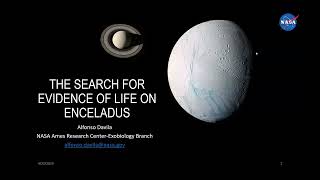
The Search for Evidence of Life on Enceladus
Explore Saturn's moon Enceladus, its subsurface ocean, and the potential for life. Learn about strategies to search for evidence of life in the plume ejected from this fascinating astrobiology target.
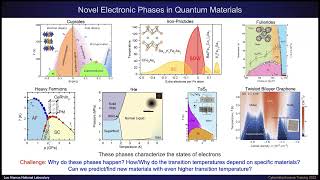
Recent Advances in Density Functional Theory for Complex Correlated Materials
Explore recent advances in density functional theory for complex correlated materials, presented by Dr. Christopher Lane of Los Alamos National Lab.
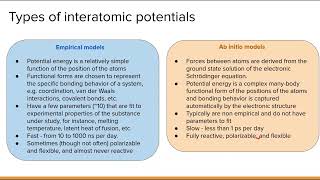
Crystallization Machine Learning - Theory and Simulation Techniques
Explore machine learning applications in crystallization, from molecular dynamics to enhanced sampling techniques for rare events and homogeneous nucleation.
QCD Spectroscopy 2023 - Part 1 of 2
Explore quantum chromodynamics spectroscopy, delving into the study of hadron properties and interactions through advanced theoretical and computational methods.
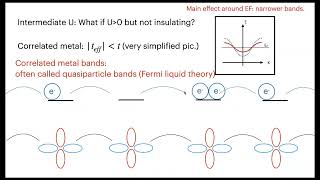
Concepts in the Computational Study of Correlated Electron Materials
Explore computational methods for studying correlated electron materials, focusing on advanced concepts and techniques in materials science and chemistry.
Facilitating Electronic Structure Computations on GPU-based Exascale Platforms
Explore GPU-based electronic structure computations for exascale platforms using PROGRESS and BML libraries. Learn implementation strategies, performance optimization, and scaling techniques.
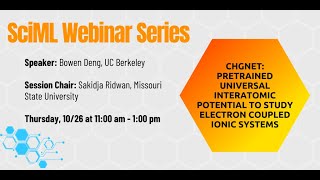
CHGNet: A Pre-trained Universal Interatomic Potential for Electron-Coupled Ionic Systems
Explore CHGNet, a graph-neural-network-based machine-learning potential for modeling universal potential energy surfaces in large-scale simulations with complex electron interactions.
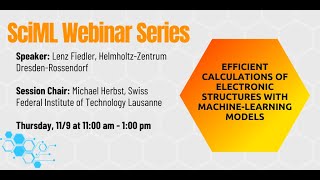
Efficient Calculations of Electronic Structures with Machine-Learning Models
Explore machine learning models for efficient electronic structure calculations in materials discovery and drug design, focusing on density functional theory and the Materials Learning Algorithms library.
Unraveling Opinion Dynamics - Insights from Network Science and the Ising Model
Explore opinion dynamics using network science and the Ising model. Discover how network topologies influence opinion formation and evolution across diverse structures, with insights from statistical physics simulations.
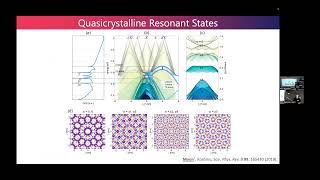
Quasicrystalline Resonant States and Nonlinear Landau Fan Diagram in van der Waals Superlattices
Explore quasicrystalline resonant states and nonlinear Landau fan diagrams in van der Waals superlattices, examining unique electron behaviors in incommensurate configurations and moiré potentials.
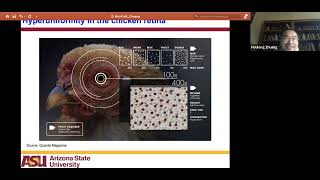
Disordered Hyperuniformity in Two-Dimensional Materials
Explore disordered hyperuniformity in 2D materials, its impact on electronic structures, and role of topological defects in preserving hyperuniformity in amorphous materials.
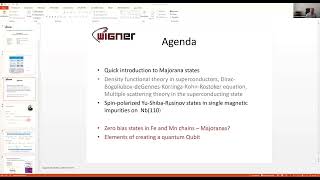
Electronic Structure in the Superconducting State from First Principles
Explore first-principles theory of inhomogeneous superconductivity, focusing on magnetic atom chains on superconductor surfaces and the identification of Majorana Zero Modes in topological systems.
Diffusion Models
Explore advanced concepts in diffusion models, including theory, applications, and recent developments in probabilistic AI.
Geometric Probabilistic Models - Tutorial 4
Explore geometric probabilistic models for data-efficient, uncertainty-aware decision-making in applications like drug design and robotics. Learn theory and implementation of Gaussian processes and related techniques.
Accelerating Drug Discovery with Generative AI
Discover how generative AI accelerates drug discovery through advanced machine learning techniques and innovative computational approaches in pharmaceutical research.
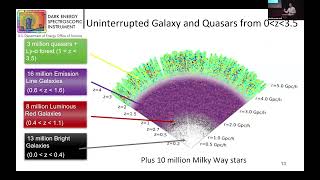
Cosmology from the First Year DESI BAO Measurements
Explore groundbreaking findings from DESI's first-year measurements of baryon acoustic oscillations, examining implications for dark energy, neutrino mass, and the Hubble Constant tension.

How to Find Group, Block and Period in the Periodic Table
Master the fundamentals of periodic table navigation through practical examples covering s, p, d, and f blocks. Learn to identify group numbers, periods, and blocks using diverse elements like Calcium and Copper.
The Frontiers of Modeling Atoms with AI
Explore cutting-edge AI applications in atomic modeling, focusing on drug discovery and climate change solutions, with insights into machine learning potentials and renewable fuel synthesis catalysts.
Artificial Intelligence for Protein Modeling - DNA, RNA and Ion Docking Explained
Discover how AlphaFold3 revolutionizes structural biology through AI-powered protein modeling, enabling accurate predictions of 3D molecular structures, DNA/RNA interactions, and protein-protein binding mechanisms.