Spectroscopy in the Zeeman Sublevels of Rb Using Electromagnetically Induced
Explore electromagnetically induced spectroscopy in Rb Zeeman sublevels. Gain insights into precision measurements and quantum metrology applications in atomic physics.

The Four Quantum Numbers
Comprehensive exploration of the four quantum numbers, their significance in electron configuration, and related concepts in general chemistry for various standardized exams.

Introduction to Geology
Explore Earth's physical processes, from plate tectonics to rock formation. Learn about volcanoes, earthquakes, and geological phenomena shaping our planet's surface and interior.

Identifying Functional Groups - Study With Us
Comprehensive guide to identifying and understanding functional groups in organic chemistry, with practice problems and expert explanations to enhance learning and retention.

Modeling the Phase Behavior of Nanoparticle Superlattices - Mario Tagliazucchi
Explore nanoparticle superlattice phase behavior modeling using molecular theory. Gain insights into hierarchical assembly, structural complexity, and quantum function at the mesoscale.
Fundamental & Applied Aspects of Laser Diodes Based on Colloidal Quantum Dots - Victor Klimov
Explores fundamental principles and practical applications of laser diodes using colloidal quantum dots, focusing on recent developments and future prospects in nanoparticle assembly and quantum technology.

Next Steps in Patchy Particle Assembly Engineering - Sharon Glotzer
Exploring advancements in nanoparticle assembly engineering, focusing on patchy particles and their potential for creating complex, functional materials with unique structural properties.

Electron Videography of Nanoparticles in and Out of Equilibrium - Qian Chen
Explore electron videography techniques for studying nanoparticle behavior in equilibrium and non-equilibrium states, offering insights into their dynamic properties and assembly processes.
Estimate Transport Coefficients From Short Equilibrium Molecular-Dynamic Simulation
Discover optimal methods for estimating transport coefficients in molecular dynamics simulations, enhancing efficiency and accuracy in quantum mechanics research.
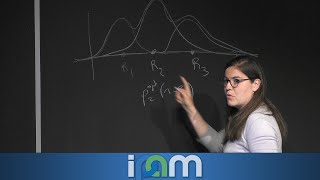
Multi-Center Decomposition of Molecular Densities: A Mathematical Perspective
Explore mathematical perspectives on molecular density partitioning, focusing on Iterative Stockholder Atom methods. Learn about new schemes, convergence results, and applications in quantum mechanics.
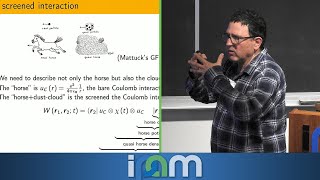
Stochastic Vector Methods for Extended Systems - IPAM at UCLA
Explore stochastic vector approaches for electronic structure in condensed matter systems, reducing complexity and enhancing efficiency in computational quantum mechanics.
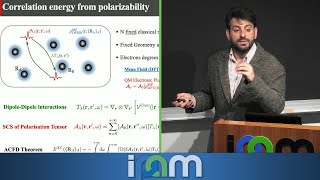
Second-Quantization of Many-Body Dispersion Formalism - Modeling of Million Atom Systems
Explore second-quantization of many-body dispersion formalism for modeling large-scale systems, enhancing computational efficiency and enabling analysis of interactions with surrounding environments.
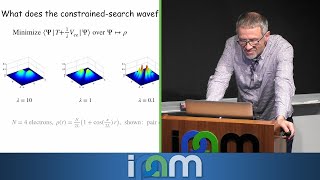
Fast Algorithm for the Strong-Interaction Limit of Density Functional Theory
Explore a novel algorithm for computing the strong-interaction limit in density functional theory, enhancing accuracy in modeling strongly correlated systems and overcoming computational challenges.
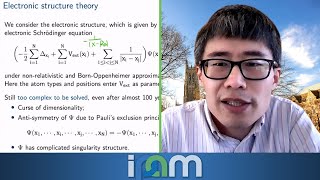
Mathematical Models of Electronic Structure - IPAM at UCLA
Explore mathematical models of electronic structure, focusing on quantum mechanics applications in materials science and chemistry, presented by Duke University expert Jianfeng Lu.
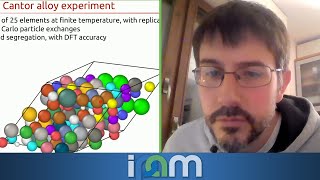
Machine Learning for Atomic-Scale Modeling - Potentials and Beyond - IPAM at UCLA
Explore machine learning techniques for atomic-scale modeling, addressing challenges in chemical diversity and integrating functional properties beyond interatomic potentials for advanced materials simulation.
Catalysis - Automated Multiscale Modeling and Active Exploration of Chemical Space
Revolutionizing catalysis through automated multiscale modeling and active exploration of chemical space, accelerating material discovery and optimizing processes from first principles to reactor scale.
High-Dimension Perspective on Extracting & Encoding Information in Chemical Systems
Explore high-dimensional data extraction and encoding in complex chemical systems, focusing on exascale computing opportunities, multiscale correlations, and challenges in feature selection and interpretability.
From Electrons to the Simulation of Materials - IPAM at UCLA
Explore computational workflows for predicting complex materials properties, from phase diagrams to nanostructures, using density functional theory and machine learning potentials.
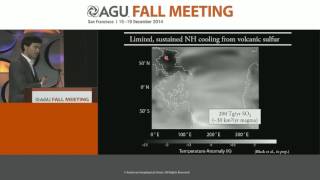
Trouble Upstairs: Reconstructing Permian-Triassic Climate during Siberian Traps Magmatism
Explore the impact of Siberian Traps magmatism on Permian-Triassic climate, examining its effects on atmospheric chemistry, ocean circulation, and potential extinction mechanisms.

Hydrothermal Fluids, Nebular Vapors and Silicate Melts Through Mineral Analysis
Explore mineral thermochemistry's insights into geological processes, from hydrothermal fluids in Ag-Pb-Zn ores to primordial solar nebula condensation and fassaitic pyroxenes in Ca-Al-rich inclusions.

Tracking the Reorientation of Terrestrial Planets - True Polar Wander
Explore how major geological events can cause True Polar Wander on terrestrial planets, affecting their orientation and geological history over time.