
Physics of Life by Vijaykumar Krishnamurthy
Explore the physics of living systems, focusing on soft condensed matter and emergent self-organization in cells and tissues. Gain insights into the fascinating intersection of physics and biology.
Entropy in Self-Assembly - Lecture 1
Explore entropy's role in self-assembly, from hard sphere systems to DNA-coated colloids. Learn about phase transitions, depletion forces, and shape-dependent interactions in soft matter physics.
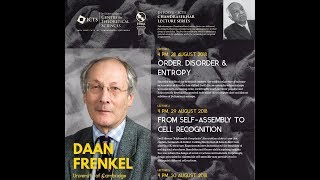
Order, Disorder and Entropy - Lecture 1
Explore entropy's evolving concept, from disorder measure to complex systems driver. Gain insights on self-assembly, cell recognition, and phoretic transport in nanoscale phenomena.
Flat Bands in Twisted Bilayer Transition Metal Dichalcogenides by Manish Jain
Explore flat bands in twisted bilayer transition metal dichalcogenides, focusing on Moire patterns, electronic structure, and localization effects in various twist angles and stacking configurations.
Active Processes in Cells and Tissues - Phase Separation in Active Systems - Lecture 2
Explore phase separation in active cellular systems, focusing on droplet physics, centrosome dynamics, and RNA-protein assemblies. Learn how these processes drive cellular organization and morphogenesis.
Cargo Transport in Vivo - How Is Transport Regulated? by Steven P. Gross
Explores regulation of intracellular cargo transport, focusing on motor proteins kinesin and dynein. Discusses global and semi-global regulation, adaptation mechanisms, and implications for cellular processes like lipid transfer and nuclear migration.
Soft and Biological Matter - Introduction to States and Structures in Living Systems - Lecture 1
Explore the intersection of biology and physics, covering topics from molecular evolution to ecology. Learn about physical constraints, evolutionary outcomes, and mathematical models in living systems.
Pattern Formation in Biology - Lecture 4
Explore hydrodynamic theories in biology, focusing on pattern formation in active fluids and the actomyosin cortex. Learn about conservation laws, chemical reactions, and force balance in biological systems.
Chemical Reaction Networks - Lecture 1
Explore stochastic chemical reaction networks, their examples, definitions, and the deficiency zero theorem in this comprehensive lecture on statistical physics of complex systems.
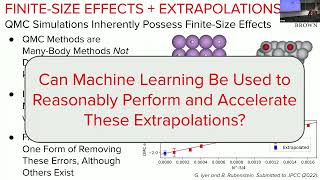
Extending the Reach of Quantum Monte Carlo Methods via Machine Learning
Explore how machine learning enhances quantum Monte Carlo methods for electronic structure modeling, improving force calculations and scaling to larger systems in molecular simulations.
Quantum Time Correlation Functions in an Open-Chain Path Integral Distribution
Explore quantum time correlation functions using open-chain path integrals, offering a new perspective on semiclassical approximations in computational chemistry with potential applications in rate theory and spectroscopy.
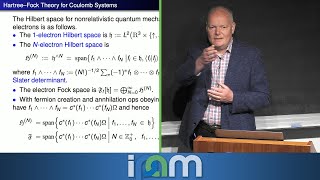
The Hartree-Fock Approximation and Its Generalizations - IPAM at UCLA
Explore Hartree-Fock approximation in quantum mechanics, covering accuracy, variational principles, generalizations, and symmetries. Gain insights into advanced theoretical concepts and applications.
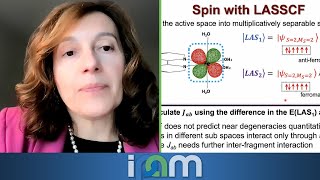
Localized-Wave-Function Methods in Quantum Chemistry and Their Extension to Quantum Computers
Explore localized wave-function methods in quantum chemistry, their applications to large systems, and potential extensions to quantum computing algorithms for improved efficiency and accuracy.
Post-DFT Green's Function Embedding - IPAM at UCLA
Explore post-DFT Green's function embedding for correlated solids, focusing on self-energy embedding theory (SEET) and its applications in molecular systems and periodic solids.
A Physical-Chemical Motivation Behind Quantum Embedding Theories - IPAM at UCLA
Explore quantum embedding theories, their physical motivations, and applications in many-electron problems. Learn about Green's function embedding and other approaches for accurate, controlled approximations.
Randomized Methods for Quantum Many-Body Problems - A Mathematical Primer
Explore randomized methods for quantum many-body problems, focusing on Monte Carlo techniques to approximate ground and excited states in large systems. Learn about VMC and FCIQMC algorithms.
Physically Inspired Machine Learning for Excited States - IPAM at UCLA
Explore machine learning applications in photochemistry, focusing on excited state predictions and light-matter interactions. Discover innovative techniques for overcoming data limitations and enabling accurate photodynamics simulations.
High Accuracy Wavefunctions Using Deep-Learning-Based Variational Monte Carlo
Explore deep learning-based variational Monte Carlo for high-accuracy wavefunctions in computational chemistry, featuring novel architecture and improved methods for ground state energy calculations.
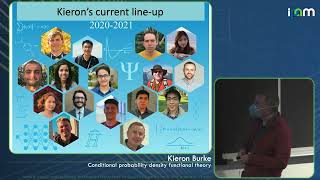
Conditional Probability Density Functional Theory - IPAM at UCLA
Explore conditional probability density functional theory for electronic structure calculations, addressing challenges in DFT and offering insights into ground-state correlations and warm dense matter simulations.
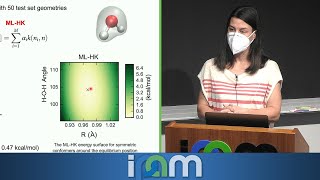
Molecular Electron Densities via Machine Learning - IPAM at UCLA
Explore machine learning techniques for predicting molecular electron densities and energies, with applications in quantum mechanics and molecular dynamics simulations.
Auxiliary-Field Methods for Quantum Materials - IPAM at UCLA
Overview of auxiliary-field quantum Monte Carlo methods for simulating quantum materials, discussing recent advances in ab initio calculations, including correlated sampling and structural optimization.