Sound Dynamic Deadlock Prediction in Linear Time
Explore a novel approach to dynamic deadlock prediction in concurrent systems, introducing sync-preserving deadlocks and efficient algorithms for sound, linear-time detection.
Compiling Probabilistic Programs for Variable Elimination with Information Flow
Explore a novel approach to variable elimination and marginal inference in probabilistic programming, featuring bounded recursion and discrete distributions, with compiler-based optimization techniques.
Concurrent Immediate Reference Counting
Explore a novel approach to memory management in concurrent programming, combining SMR algorithms with reference counting for efficient and safe automatic memory reclamation in unmanaged languages.

Parametric Subtyping for Structural Parametric Polymorphism
Explore parametric subtyping for structural parametric polymorphism. Learn about a decidable fragment of structural subtyping that generalizes rigid subtyping, with a proven saturation-based decision procedure.

Toward Probabilistic Coarse-to-Fine Program Synthesis
Explore probabilistic coarse-to-fine program synthesis, a novel approach using iterative refinement of stochastic programs to efficiently search and generate programs matching specifications.

The Complex(ity) Landscape of Checking Infinite Descent
Explore the complexity of checking Infinite Descent in cyclic proof systems, examining various criteria and their parameterized time complexities to improve automatic verification techniques.

Efficient CHAD - Optimizing Combinatory Homomorphic Automatic Differentiation
Optimizar el algoritmo CHAD para diferenciación automática en modo reverso, logrando la complejidad computacional esperada mediante técnicas funcionales y paralelismo.

ReLU Hull Approximation - Fast and Precise Convex Hull Over-Approximation for Neural Network Verification
Explore a fast, precise approach to over-approximating ReLU function convex hulls in neural network verification, improving efficiency and precision for large-scale networks.
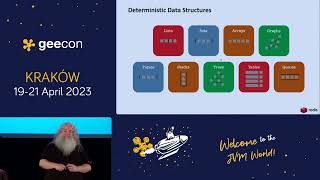
Understanding Probabilistic Data Structures with UFO Sightings
Explore probabilistic data structures through UFO sightings analysis. Learn about Bloom Filters, MinHash, and Top-K, and their applications in processing large datasets efficiently.

Fear Not the Unknown: Go Functional Programming
Explore functional programming concepts and overcome fears of the unknown in this engaging talk on modern coding paradigms.
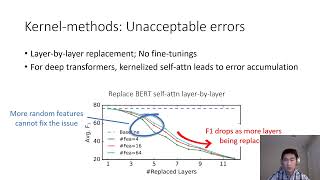
The NLP Task Effectiveness of Long-Range Transformers
Explore the effectiveness of long-range Transformer variants on NLP tasks, comparing their performance and analyzing attention behaviors to uncover strengths and limitations.
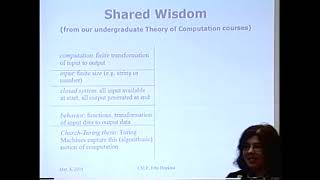
Conjectures, Results, and Myths in Interactive Computation - 2005 Lecture
Explore interactive computation paradigms, challenging traditional algorithmic models. Gain insights into Persistent Turing Machines and their implications for computational expressiveness and software engineering.

Is It Time to Put Your Pet Kubernetes Down?
Explore the potential drawbacks of Kubernetes and consider alternative solutions for managing containerized applications in modern DevOps environments.

Greedy Method in Design and Analysis of Algorithms - Lecture 1
Master the Greedy Method in algorithm design through practical examples. Enhance problem-solving skills and optimize solutions for efficient computational processes.
Subgroup Tests and Tailored Non-local Games - Lecture on Interactive Proof Systems
Explore advanced concepts in interactive proof systems, refuting the Aldous-Lyons conjecture through subgroup tests and tailored non-local games.
Think Parallel - Changing Mindsets for Parallel Programming in C++
Explore parallelism in C++ through four algorithms, uncovering key principles and implementation strategies to shift your mindset towards parallel thinking in modern programming.
Extroverted Sublinear Algorithms
Explore extroverted sublinear algorithms with Google Brain researcher Ilya Mironov, delving into innovative computational techniques for efficient data processing and analysis.
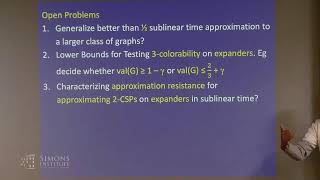
Sublinear Time Algorithms for Max-Cut Approximation on Expander Graphs
Explore random walks on graphs to achieve better-than-1/2 approximation for max-cut on expanding and clusterable graphs, using sublinear time algorithms.
Linear and Sublinear Algorithms for Graphlet Sampling
Explore efficient algorithms for graphlet sampling, including linear and sublinear preprocessing techniques, with applications to semi-streaming and MPC settings.
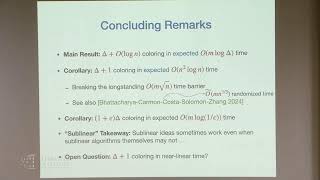
Sublinear Insights: A Faster Classical Algorithm for Edge Coloring
Explores a novel randomized algorithm for near-linear time graph edge coloring, improving on decades-old methods. Discusses implications for Vizing's theorem and dense graph coloring efficiency.
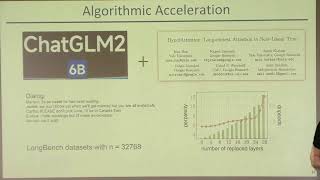
Long-context Attention in Near-Linear Time
Explores HyperAttention, an innovative approach to tackle computational challenges in long-context LLMs, offering significant speed improvements while maintaining performance across various datasets.