Identity Check Problem for Shallow Quantum Circuits
Explore an efficient classical algorithm for checking quantum circuit identity, focusing on shallow geometrically local circuits and their distance approximation to identity channels.
3D-Local Noisy Shallow Quantum Circuits - A Colossal Advantage Against Classical Computing
Explore groundbreaking research demonstrating quantum computing superiority using 3D-local noisy circuits, showcasing unprecedented advantages over classical computing in fault-tolerant quantum systems.
Parity vs. AC0 with Simple Quantum Preprocessing
Delve into quantum computation theory exploring the limitations of QNC0 and AC0 circuits in computing parity functions, with insights into decision tree complexity and nonlocal channels.
A Shortcut to a Near-Optimal Quantum Linear System Solver
Discover a simplified approach to quantum linear system solving that achieves near-optimal performance through kernel reflection, offering improved efficiency for practical applications in quantum computing.

Quantum Advantage from One-Way Functions
Delve into quantum advantage theory through one-way functions, exploring inefficient-verifier proofs of quantumness and their construction from classical bit commitments in cryptography.
Oracle Separation of QMA and QCMA with Bounded Adaptivity
Delve into quantum complexity theory through an exploration of oracle separation between QMA and QCMA, focusing on bounded adaptivity in oracle queries and the novel concept of slipperiness.
Understanding Cryptographic Hardness in a Quantum World
Explore cutting-edge research on cryptographic security challenges and theoretical frameworks in quantum computing, focusing on hardness assumptions and their implications for future systems.
Quantum PCPs: On Adaptivity, Multiple Provers and Reductions to Local Hamiltonians
Delve into advanced quantum PCP theory, exploring adaptivity, multiple unentangled provers, and their connections to local Hamiltonians through rigorous mathematical frameworks and complexity theory analysis.
Constant-Depth Circuits for Uniformly Controlled Gates and Boolean Functions
Explore constant-depth quantum circuits using Fan-Out and Global Tunable gates, focusing on implementations for Uniformly Controlled Gates and quantum memory applications.
Quantum Complexity of Testing Signed Graph Clusterability
Explore quantum algorithms for testing signed graph clusterability, featuring a novel approach with O(N^1/3) query complexity and proven advantages over classical methods.
Two Prover Perfect Zero Knowledge for MIP* - Theory of Quantum Computation
Delve into advanced quantum computing theory exploring perfect zero-knowledge protocols in MIP* systems, focusing on two-prover implementations and boolean constraint systems for quantum computation.
An Improved Quantum Max Cut Approximation via Maximum Matching
Discover groundbreaking improvements in Quantum Max Cut approximation through maximum matching techniques, achieving a 0.595 approximation ratio using simplified 2-qubit state outputs.
Computational Quantum Secret Sharing
Discover groundbreaking advances in quantum secret sharing schemes, exploring computational security approaches that achieve efficient distribution and reconstruction of quantum states with reduced share sizes.
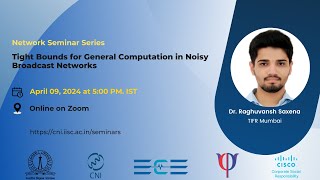
Tight Bounds for General Computation in Noisy Broadcast Networks
Delve into the mathematical analysis of noise-resilient protocols in broadcast networks, exploring tight bounds for general computation and innovative simulation schemes with Dr. Saxena.
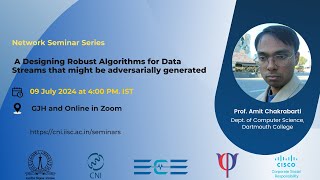
Designing Robust Algorithms for Data Streams with Adversarial Generation
Explore advanced techniques for designing robust streaming algorithms that maintain accuracy even under adversarial data manipulation, focusing on Missing Item Finding and graph coloring challenges.
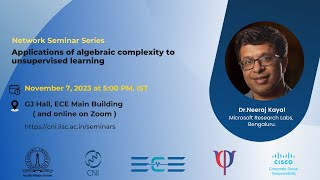
Applications of Algebraic Complexity to Unsupervised Learning
Delve into advanced algebraic complexity theory and its applications in unsupervised learning algorithms, exploring computational hardness of multivariate polynomials and efficient learning techniques.
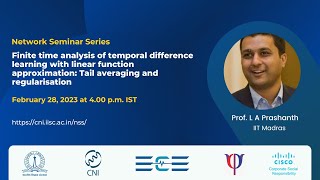
Finite Time Analysis of Temporal Difference Learning with Linear Function Approximation: Tail Averaging and Regularization
Delve into advanced temporal difference learning analysis, exploring tail-averaging techniques and regularization methods for improved convergence rates in reinforcement learning applications.
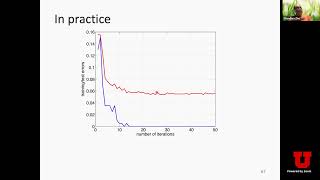
Machine Learning Fundamentals - Lecture 10
Dive into advanced machine learning concepts and techniques through comprehensive coverage of key algorithms, theoretical foundations, and practical applications in data science.
Machine Learning Fundamentals - Lecture 1
Dive into foundational machine learning concepts, algorithms, and theoretical frameworks in this comprehensive first lecture of advanced data science studies.
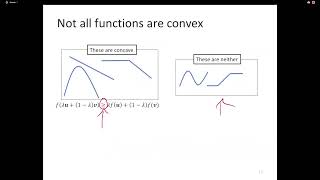
Stochastic Gradient Descent for Support Vector Machines - Lecture 22
Dive into stochastic gradient descent algorithms and their application in optimizing Support Vector Machines through practical implementation techniques and mathematical foundations.
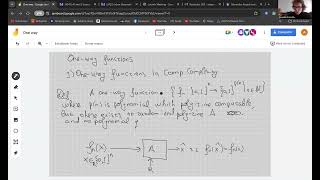
One-Way Computable Transformations - The Barmalias-Zhang Example
Dive into the mathematical exploration of one-way computable transformations through the Barmalias-Zhang example, examining its significance in computational complexity theory.