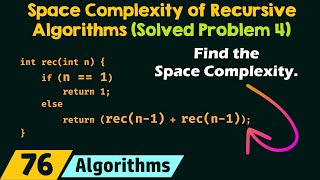
Space Complexity of Recursive Algorithms - Problem 4
Master the calculation of space complexity in recursive algorithms through a detailed solved example demonstrating key analytical techniques and practical applications.
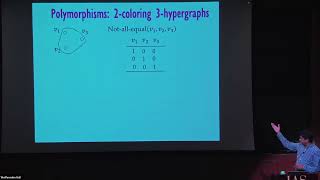
When and How are Promise Constraint Satisfaction Problems Efficiently Solvable
Delve into the mathematical foundations of Constraint Satisfaction Problems (CSP), exploring algorithmic efficiency, polymorphisms, and promise CSP applications in graph coloring and discrepancy minimization.
Mathematical Problems in Machine Learning - Part 1 of 4
Dive into mathematical probability fundamentals for machine learning through Stanford expert Andrea Montanari's comprehensive exploration of key theoretical concepts and applications.
Efficient Community Search Based on Relaxed k-truss Index
Explore advanced techniques for efficient community search in networks using relaxed k-truss indexing methods and graph-based algorithms for optimized data analysis.
Mathematical Problems in Machine Learning - Lecture 3
Delve into advanced mathematical probability concepts and their applications in machine learning through Stanford expert Andrea Montanari's comprehensive theoretical exploration.
Mathematical Problems in Machine Learning - Lecture 2
Delve into mathematical probability fundamentals and their applications in machine learning through advanced theoretical concepts and problem-solving approaches from Stanford expertise.
Mathematical Problems in Machine Learning - Lecture 4
Delve into advanced mathematical probability concepts applied to machine learning through Stanford expert Andrea Montanari's comprehensive theoretical exploration and analysis.
Differences Between Divide and Conquer and Dynamic Programming in Algorithm Design
Understand key distinctions between Divide & Conquer and Dynamic Programming approaches in algorithm design, exploring their unique problem-solving methodologies and implementation strategies.

Introduction to Hashing in Data Structures - Hash Functions, Hash Tables, Hash Keys, and Hash Values
Master the fundamentals of hashing in data structures, including hash functions, tables, keys, and values. Learn efficient data storage and retrieval techniques for optimized programming solutions.
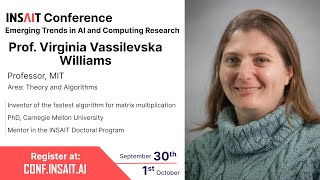
Fine-Grained Algorithms and Complexity - An Overview of Exact Running Times
Explore the emerging theory of fine-grained reductions in algorithmic complexity, examining modern approaches to determining optimal computational problem-solving speeds beyond traditional NP-hardness.

The Three Tales of Correct Network Operations
Explore network routing algorithms through verification, synthesis, and reconfiguration, examining operational challenges and solutions for more reliable network management.

Simulating Quantum Computation - Classical Data Requirements and Efficiency
Explore the classical simulation methods for quantum computation through probability functions, examining data requirements and computational efficiency in magic state implementations.
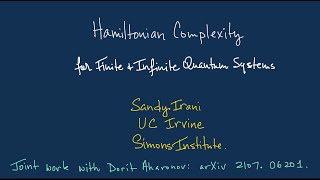
Computational Complexity of Quantum Systems - From Theory to Ground State Analysis
Delve into quantum systems' computational complexity, exploring ground states, quantum computing challenges, and algorithmic approaches for simulating quantum phenomena.
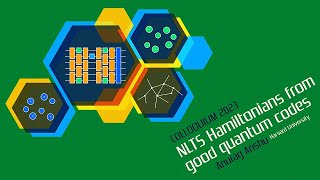
NLTS Hamiltonians from Good Quantum Codes - Understanding Low-Energy States and Circuit Complexity
Delve into the complexity of NLTS conjecture, quantum LDPC codes, and their connection to local Hamiltonians, exploring circuit lower bounds and many-body entanglement principles.
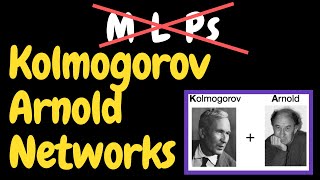
Kolmogorov-Arnold Networks: Understanding KAN Architecture and Comparison with MLPs
Dive into Kolmogorov-Arnold Networks (KAN), a groundbreaking alternative to Multi-Layer Perceptrons, exploring its architecture, implementation, and potential advantages in neural network development.
Quantum Complexity Theory Meets TFNP - Product Quantum Satisfiability on Qudits
Delve into advanced quantum complexity theory, exploring the intersection of Total Function NP and Quantum Satisfiability through innovative frameworks and theoretical breakthroughs in qudit systems.
Quantum 2-SAT on Low Dimensional Systems is QMA_1-Complete
Delve into groundbreaking research exploring quantum satisfiability problems, examining complexity transitions in low-dimensional quantum systems and their computational implications for quantum information theory.
Classical Verification of Quantum Learning
Explore the verification framework enabling classical clients to reliably delegate learning tasks to quantum servers, focusing on parity learning and Fourier-sparse functions with mixture-of-superpositions examples.
New Approaches to Complexity via Quantum Graphs
Explore groundbreaking research on quantum graph complexity theory, examining clique problems and quantum channels while comparing complexity classes QMA(2), QMA, MA, and NP.
Provable Advantage in Quantum PAC Learning
Discover groundbreaking research on quantum PAC learning, exploring provable advantages over classical methods with square root improvements in sample complexity and theoretical quantum information science.
Guidable Local Hamiltonian Problems with Implications to Heuristic Ansatz State Preparation and Quantum PCP
Delve into advanced quantum computing theory exploring Guidable Local Hamiltonian problems, their complexity-theoretic implications, and connections to quantum PCP conjecture and state preparation methods.