Recursive State Machine Guided Graph Folding for Context-Free Language Reachability
Explore an innovative approach to improve CFL-reachability scalability through graph folding, reducing input size and enhancing performance in program analysis applications like alias and value-flow analysis.
The One Pass (OP) Compactor - An Intellectual Abstract
Explore a novel compaction algorithm that reduces heap fragmentation with a single pass, improving efficiency in memory management and garbage collection.
A Better Approximation for Interleaved Dyck Reachability
Explore a novel approach to interleaved Dyck reachability, offering improved precision for context- and field-sensitive static analyses through refined CFLs and on-demand application.

Higher-Order Property-Directed Reachability
Explore higher-order extension of PDR for automated verification of complex systems. Learn about HoPDR's formalization, implementation, and effectiveness in program safety verification.
Octagons Revisited - Elegant Proofs and Simplified Algorithms
Explore simplified algorithms for Octagon domain closure, featuring elegant proofs, efficient computations, and improved abstract transformers for affine assignments in program analysis.
Efficient Matching of Regular Expressions with Lookaround Assertions
Explore efficient matching of regular expressions with lookaround assertions, including formal semantics, simplification properties, and a new O(m·n) algorithm using oracle-NFAs for improved performance.
Coarser Equivalences for Causal Concurrency
Explore relaxations of trace equivalence in concurrent programs, focusing on grain equivalence for efficient causal concurrency analysis while maintaining algorithmic advantages.
Probabilistic Programming with Stochastic Probabilities
Explore a novel approach to probabilistic programming languages using stochastic probability estimation, enabling unrestricted stochastic control flow and programmable inference with custom proposals.
Proving and Disproving Equivalence of Functional Programming Assignments
Explore an automated approach for verifying programming assignments using equivalence checking, functional induction, and clustering algorithms. Learn how to prove correctness and provide counterexamples efficiently.
Zero-Overhead Parallel Scans for Multi-Core CPUs - ARRAY 2024
Explore efficient parallel scans for multi-core CPUs, achieving zero overhead and improved single-threaded performance in array languages.
Sketching Algorithms: Making Sense of Big Data in a Single Stroke
Explore sketching algorithms for efficient big data processing, covering concepts, design principles, and practical applications using open-source tools like Apache DataSketches.
Applications of K-mers in Computational Genomics - CGSI 2024
Explore applications of k-mers in computational genomics, focusing on efficient data structures and algorithms for large-scale sequence analysis and comparison.
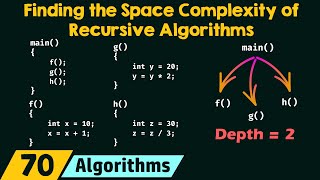
Finding the Space Complexity of Recursive Algorithms
Learn to analyze space complexity of recursive algorithms, focusing on function calls, activation records, and practical applications in algorithm design.
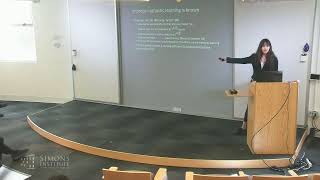
Agnostic Proper Learning of Monotone Functions: Beyond the Black-Box Correction Barrier
Explore efficient algorithms for agnostic, proper learning of monotone Boolean functions, overcoming previous limitations and achieving near-optimal runtime complexity.
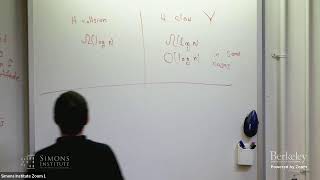
On the Instance Optimality of Detecting Collisions and Subgraphs
Explore instance optimality in detecting collisions and subgraphs, examining how structural knowledge impacts algorithm efficiency for various detection tasks in functions and graphs.
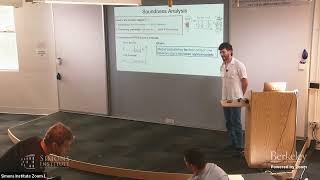
Local Algorithms: Principles and Applications
Explore insights from Tal Herman's presentation at the Workshop on Local Algorithms, delving into cutting-edge research in computer science and mathematics.
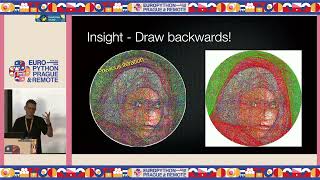
Reverse Engineering Art: Creating Photorealistic String Paintings with Python
Discover how to reverse engineer a string art algorithm using Python, covering greedy algorithms, image processing, and performance optimization.
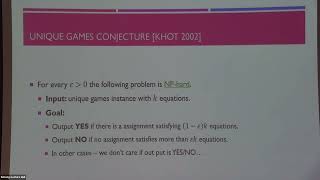
How Efficiently Can We Solve Unique Games? - Lecture
Explore the computational complexity of Unique Games and their efficient solutions in this insightful talk by Yotam Dikstein.
Weaving Algorithms: The Threads That Bind the Python and Textile Communities
Explore fascinating connections between programming and fiber arts, uncovering shared origins, terminology, and cultural aspects that link Python and textile communities.
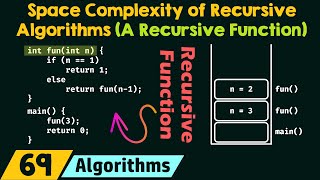
Space Complexity of Recursive Algorithms - A Recursive Function
Explore space complexity in recursive algorithms, focusing on direct and indirect recursion, and the role of call stacks in recursive functions.

La-La-Lambda Calculus: A Functional Musical Journey
Explore lambda calculus through a musical journey, discovering its power to represent programs as pure functions and its role in functional programming.