SYK III: Entanglement, Non-equilibrium Dynamics and Thermalization - Lecture 3
Explore entanglement, non-equilibrium dynamics, and thermalization in quantum systems. Delve into advanced concepts of quantum information theory and their applications in many-body physics.
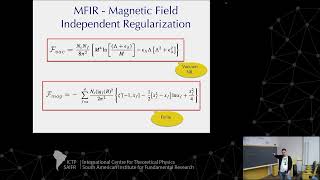
Issues Related to Regularizing Thermo and Magnetic Contributions within Nonrenormalizable Theories
Explore regularization challenges in thermo and magnetic contributions for nonrenormalizable theories in strongly interacting matter.
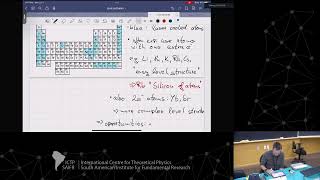
Quantum Information Processing and Simulation with Rydberg Atom Arrays - Class 1
Explore quantum information processing and simulation using Rydberg atom arrays in this advanced physics lecture, part of a series on non-equilibrium quantum systems.
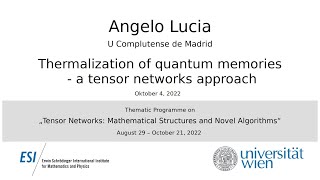
Thermalization of Quantum Memories - A Tensor Networks Approach
Explore thermalization of quantum memories using tensor networks, focusing on 2D Kitaev's quantum double models and their Gibbs state representation as PEPS.
Tensor Network Methods and Large Deviations in Stochastic Dynamics
Explore tensor network methods for studying fluctuations in stochastic systems, covering long-time statistics, rare event sampling, finite-time extensions, and symmetry protected topological phases in dynamical LDs.
Artificial Chemical Intelligence: AI for Chemistry and Chemistry for AI
Explore the integration of AI with chemistry, focusing on trustworthy frameworks for molecular discovery. Learn about innovative approaches to predict mechanisms and overcome challenges in computational chemistry.

Physics in the Dark - Searching for Missing Matter
Leading physicists explore the mystery of dark matter, discussing its role in the universe, detection methods, and alternative theories, challenging our fundamental understanding of physics and cosmology.

Solving the Puzzle of Black Holes
Explore black hole research puzzles and recent breakthroughs with Harvard physicist Andrew Strominger. Delve into Einstein's theories, quantum mechanics, and string theory to unravel the mysteries of these cosmic enigmas.
Machine Learning and the Real Space Renormalization Group
Explore the intersection of machine learning and renormalization group theory, focusing on real-space applications and information theory perspectives in physics.
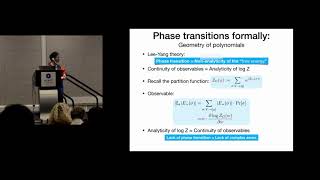
A Deterministic Algorithm for Counting Colorings with 2Δ Colors
Explore a deterministic algorithm for counting colorings, delving into phase transitions, partition functions, and entropy conditions in graph theory.
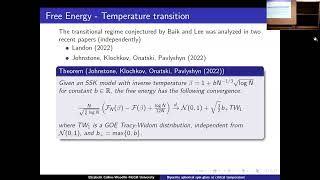
Bipartite Spherical Spin Glass at Critical Temperature - With a Random Matrix Detour
Explore the intricacies of bipartite spherical spin glass at critical temperature, including insights from random matrix theory in this advanced probability seminar.
Table Partitioning 101
Learn table partitioning in SQL Server: advantages, disadvantages, implementation, and best practices for improved database management and performance optimization.
Statistical Mechanics of Consciousness - Maximization of Information Content of Neuronal Networks Is Associated With Conscious Awareness
Explore statistical mechanics approach to consciousness, examining brain network complexity and information processing optimization in conscious vs. unconscious states.
Temperature Dependence of Fermi Level
Explore the temperature-dependent behavior of the Fermi level in semiconductors, understanding its impact on electronic properties and device performance.
Phonon Heat Capacity and Its Contribution to Solids' Thermal Properties - Lecture 53
Explore thermal properties of phonons and their contribution to heat capacity in solids. Gain insights into fundamental concepts of solid-state physics.
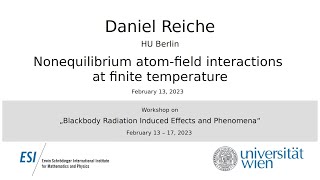
Nonequilibrium Atom-Field Interactions at Finite Temperature
Explore nonequilibrium interactions between atoms and material-modified thermal vacuum, examining deviations from blackbody radiation near surfaces and discussing emergence of blackbody-radiation-induced effects.
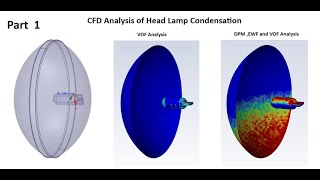
CFD Analysis of Head Lamp Condensation - VOF Approach
Explore condensation in headlamps using VOF evaporation-condensation approach in CFD analysis. Learn advanced techniques for automotive lighting design.
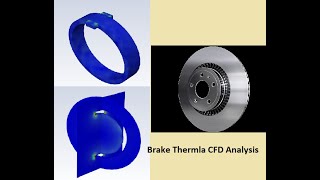
Brake Thermal Pad Sliding Mesh CFD Analysis - CHT Analysis
Explore advanced CFD techniques for brake thermal pad analysis, including sliding mesh and conjugate heat transfer methods.

ME3256 - Modules 2 and Case Study Start
Explore modules_02 and begin a case study in ME3256, focusing on practical applications and problem-solving techniques in mechanical engineering.
Physical Limits to Cognition - How I Learned to Stop Worrying and Love Black Hole Thermodynamics
Explore the intersection of information theory, cognitive science, and black hole thermodynamics to understand fundamental limits of physically-embodied computational systems and cognitive processes.

Entropy, Enthalpy, and Gibbs Free Energy - Chemistry Spontaneity Formulas
Master essential chemistry concepts of entropy, enthalpy, and Gibbs free energy through clear formula explanations and practical examples for understanding reaction spontaneity.