Negativity and Mutual Information After a Quench - Exact Link From Space-Time Duality
Explores the connection between negativity and mutual information in quantum systems after a quench, using space-time duality to derive exact results in integrable models.
Learning Entanglement in Quantum Simulation - Peter Zoller
Exploración de entrelazamiento cuántico en simulaciones, destacando avances recientes y aplicaciones en física de la materia condensada, teoría de cuerdas y sistemas cuánticos ruidosos de escala intermedia.
A Phase Transition in Linear Cross-Entropy Benchmarking
Explores phase transition in linear cross-entropy benchmarking for quantum circuits, analyzing noise robustness and fidelity approximation across different architectures and gate properties.
Quantum Algorithms for Approximating Partition Functions
Explore advanced quantum algorithms for approximating partition functions, focusing on computational techniques and applications in statistical physics and machine learning.
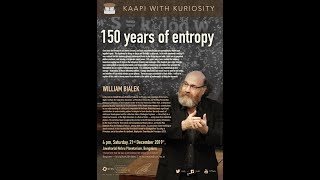
150 Years of Entropy by William Bialek
Explore the concept of entropy across physics, information theory, and technology with Princeton's William Bialek. Discover how this fundamental idea shapes our understanding of the universe and modern innovations.
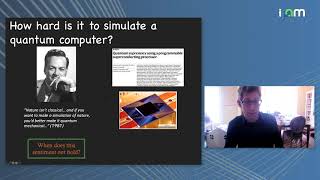
Phase Transitions in the Complexity of Simulating Random Shallow Quantum Circuits
Explores phase transitions in simulating random shallow quantum circuits, discussing computational complexity, tensor network contraction, and mapping 2D circuits to 1D processes with implications for quantum computing.
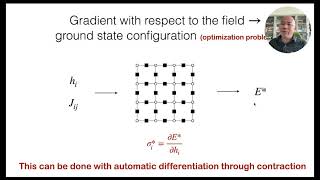
Tropical Tensor Networks
Unified tensor network approach for spin glasses using tropical algebra, enabling ground state energy computation, optimal configuration identification, and solution counting. Combines graphical models and quantum circuit simulation.
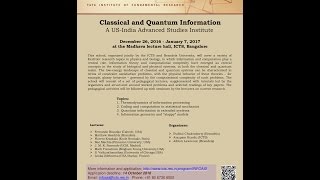
From Information Theory to Learning via Statistical Physics - Introduction
Explore connections between information theory, statistical physics, and learning. Delve into classical statistics, high-dimensional problems, and Bayesian approaches, with applications in signal processing and regression.
Non-Unitary Dynamics - Dissipative to Monitored - Vedika Khemani
Explore non-unitary dynamics in quantum systems, from dissipative to monitored, covering analytical approaches, entanglement scaling, and spacetime duality in quantum circuits and many-body physics.
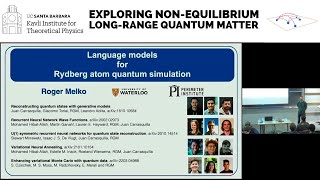
Language Models for Rydberg Atom Quantum Simulation - Roger Melko
Explore language models for Rydberg atom quantum simulation in this talk by Roger Melko, bridging quantum physics and machine learning for novel insights into long-range quantum matter.
Coulomb Universality - Leo Radzihovsky
Explore Coulomb universality in quantum many-body systems with long-range interactions. Discover novel phases and out-of-equilibrium phenomena in this cutting-edge physics lecture.
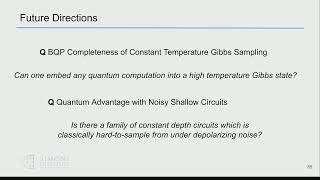
Quantum Computational Advantage With Constant-Temperature Gibbs Sampling
Explore quantum computational advantage through constant-temperature Gibbs sampling, examining thermalization processes and their implications for quantum systems and classical algorithms.
Machine Learning Gradients in Molecular Simulations
Explore ML gradients in molecular simulations, including surrogate functions, active learning, and differentiable programming for enhanced scientific modeling and optimization.
From Entropy to Artistry: Thermodynamics and Generative AI
Explore connections between diffusion models and physics, focusing on non-equilibrium thermodynamics and its applications in image/video generation and climate modeling.
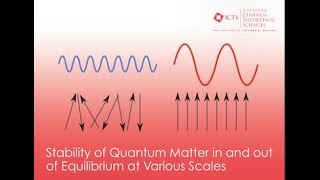
Solvable Entanglement Dynamics in Quantum Circuits with Generalized Dual Unitarity
Explores solvable entanglement dynamics in quantum circuits using generalized dual unitarity, advancing understanding of quantum matter stability and non-equilibrium physics.
Quantum Information Phases in Space-time: Measurement-induced Entanglement and Dynamics
Explore quantum information phases in space-time, focusing on measurement-induced entanglement and related phenomena. Gain insights into cutting-edge research in quantum many-body systems and their stability.
QED with Cooperative Atom Arrays and Applications - Susanne Yelin
Explore quantum electrodynamics with cooperative atom arrays, focusing on applications and recent advancements in quantum many-body systems with long-range interactions.
Design of Integrable Long-Range Quantum Devices - Angela Foerster
Explore the design of integrable long-range quantum devices in this talk by Angela Foerster, covering novel phases and out-of-equilibrium phenomena in quantum many-body systems with long-range interactions.
Non-Equilibrium Dynamics and Nanofriction in Ion Coulomb Crystals - Tanja Mehlstaubler
Explore non-equilibrium dynamics and nanofriction in ion Coulomb crystals through quantum simulation, bridging diverse research perspectives on long-range quantum matter phenomena.
How Did Life Arise from Increasing Entropy?
Explores how life and evolution align with increasing entropy, discussing energy dissipation, complexity formation, and the potential physics behind life's origins in the universe.

The Startling Reason Entropy and Time Only Go One Way
Explore the fascinating connection between entropy, probability, and the unidirectional flow of time. Discover why natural phenomena tend towards lower energy states and how this relates to the universe's increasing disorder.