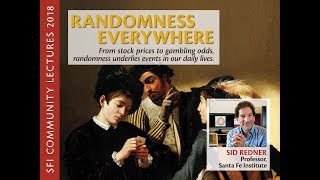
Randomness Everywhere - Understanding Random Walk Models and Their Applications
Explore the fascinating world of randomness with physicist Sid Redner. Discover how random walk models explain everyday phenomena, from stock prices to gambling, and their applications in various fields.
Fluctuations and Order in Randomly Evolving Environments
Explore non-equilibrium systems where giant fluctuations coexist with long-range order, examining particle behavior, interface properties, and applications in various scientific domains.
Death and Resurrection of the Zeroth Principle
Explore the intriguing concept of the Zeroth Principle, its demise, and potential revival in this thought-provoking lecture from the Santa Fe Institute.
Vignettes of Data-Driven Approaches to the MT-Kinesin Active Fluid
Explore data-driven approaches to MT-Kinesin active fluid dynamics in this conference talk by Aparna Baskaran, delving into collective phenomena and energy-consuming components in active matter systems.
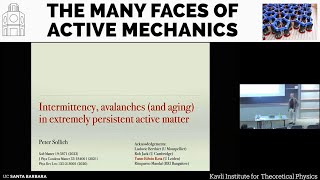
Intermittency, Avalanches and Aging in Extremely Persistent Active Matter
Delve into intermittency, avalanches, and aging phenomena in extremely persistent active matter. Explore collective behaviors emerging from energy-consuming components in active solids and their implications across diverse systems.
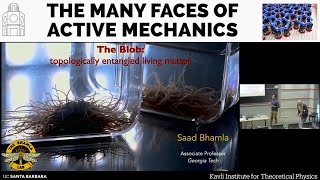
The Blob: Topologically Entangled Living Matter
Dive into the fascinating world of active matter and explore the behavior of 'The Blob' - a unique form of topologically entangled living matter. Gain insights from Saad Bhamla's research at Georgia Tech.
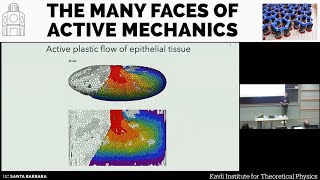
Active Plastic Flow of Epithelial Tissue
Explore active plastic flow in epithelial tissue through Fridtjof Brauns' conference talk, delving into collective phenomena and energy-consuming components in active matter systems.
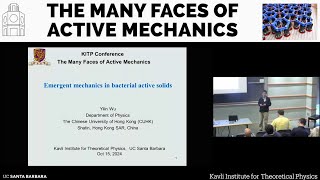
Emergent Mechanics in Bacterial Active Solids
Dive into emergent mechanics of bacterial active solids. Explore collective phenomena in energy-consuming systems, from spontaneous flow to flocking, and their relevance to diverse biological and engineered materials.
Lightning Talks - Active Mechanics Poster Presentations
Explore cutting-edge research in active mechanics through lightning talks by poster presenters at the Kavli Institute's conference on active solids and collective phenomena in energy-consuming systems.
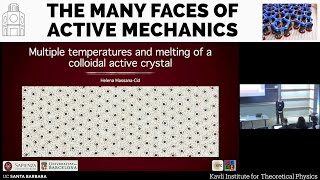
Multiple Temperatures and Melting of a Colloidal Active Crystal
Explore the melting dynamics of colloidal active crystals and multiple temperature effects in this conference talk by Helena Massana Cid, delving into cutting-edge research in active matter physics.
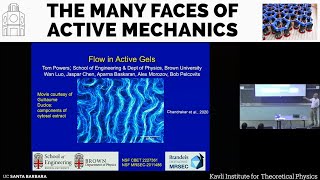
Flow in Active Gels
Dive into the dynamics of active gels with Thomas Powers, exploring flow phenomena in energy-consuming systems and their applications in diverse fields from biology to engineered materials.
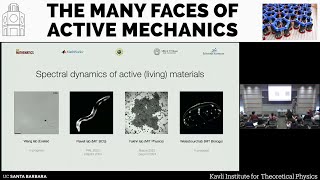
Spectral Dynamics of Active and Living Materials
Dive into the spectral dynamics of active materials with MIT's Jorn Dunkel, exploring collective phenomena in energy-consuming systems and their applications in diverse fields.
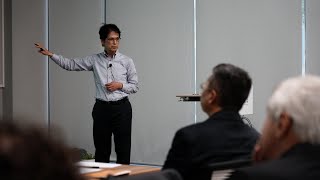
Probability Inspired by Non-equilibrium Statistical Physics
Explore probability theory through non-equilibrium statistical physics with insights from renowned mathematician Tadahisa Funaki's research on interacting systems and stochastic PDEs.
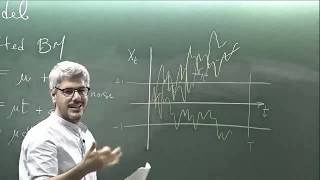
Dynamical Phase Transitions in Markov Processes by Hugo Touchette
Explore dynamical phase transitions in Markov processes, contrasting with equilibrium transitions and examining a Brownian motion model showcasing localization-delocalization phenomena.
From Newton to Boltzmann - Fluctuations and Large Deviations in Hard Sphere Gas Dynamics
Explore macroscopic fluctuations in hard sphere gases, including deviations from the Boltzmann equation, central limit theorem, and large deviation bounds in the Boltzmann-Grad limit.
Survival Probability and Record Statistics for Random Walks
Explore survival probability and record statistics for random walks, including correlated models and applications to active particles, with insights on universality and extreme value statistics.
An Optical Lattice with Sound - Benjamin Lev
Explore quantum simulators and non-equilibrium many-body physics in optical lattices using sound. Discover novel phases of matter, universality classes, and connections between diverse fields of physics.
Motility-Regulation and Self-Organization in Active Matter by Julien Tailleur
Explore self-organization principles in active matter systems, from bacterial colonies to colloids. Learn about motility regulation, quorum sensing, and pattern formation in non-equilibrium physics.
Generalized Hydrodynamics of the Hyperbolic Calogero-Moser Model by Herbert Spohn
Explores generalized hydrodynamics of the hyperbolic Calogero-Moser model, covering 1D classical fluids, conservation laws, scattering shifts, and hydrodynamic equations. Includes discussion on Toda fluids and rational models.
Fully Quantum Scalable Approaches to Driven-Dissipative Lattice Models - Marzena Szymanska
Explores quantum approaches to driven-dissipative lattice models, discussing non-equilibrium many-body physics and universal aspects in diverse fields like AMO, condensed matter, and high-energy physics.
Adiabatic Flows and Many-Body Dark States in a Non-Integrable Ising Model - Anatoli Polkovnikov
Explores adiabatic flows and many-body dark states in non-integrable Ising models, discussing novel aspects of non-equilibrium many-body physics and their implications for quantum simulators.