Advanced Metallurgical Thermodynamics
In this course, you will learn, First, second and third laws of thermodynamics, Maxwell's relations, Clausius-Clapeyron equation, Equilibrium Concepts, Thermodynamics of Phase Transformations etc.
Thermodynamics - Classical to Statistical
Comprehensive exploration of thermodynamics, from classical concepts to statistical mechanics, covering fundamental principles, applications, and advanced problem-solving techniques.
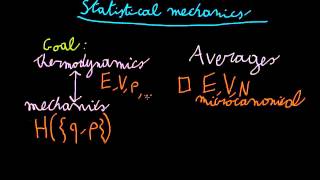
Statistical Mechanics
Explore fundamental concepts of statistical mechanics, including thermodynamic potentials, entropy, free energy, ergodic hypothesis, and microcanonical ensemble.
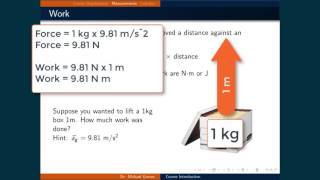
Physical Chemistry - Thermodynamics, Statics, and Kinetics
Comprehensive physical chemistry lectures covering thermodynamics, kinetics, and equilibrium. Explore gas laws, energy concepts, phase diagrams, reaction rates, and advanced topics in chemical systems.

Physical Chemistry
Comprehensive exploration of physical chemistry principles, covering thermodynamics, quantum mechanics, and chemical kinetics. Ideal for students seeking in-depth understanding of chemical systems and their behavior.
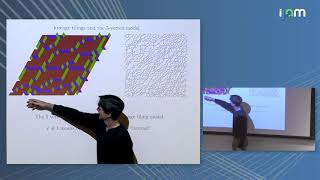
On the 5-Vertex Model
Exploration of the 5-vertex model, a generalization of lozenge tiling, discussing free energy, surface tension, and probabilities. Insights into asymptotic algebraic combinatorics and lattice path models.
Metamaterials and Topological Mechanics - Lecture 2
Explores classical elasticity, free energy, and stress in metamaterials. Covers isotropic materials, Lame coefficients, and uniaxial crystals. Discusses forces and stresses in topological mechanical systems.
Generalized Hydrodynamics of the Hyperbolic Calogero-Moser Model by Herbert Spohn
Explores generalized hydrodynamics of the hyperbolic Calogero-Moser model, covering 1D classical fluids, conservation laws, scattering shifts, and hydrodynamic equations. Includes discussion on Toda fluids and rational models.
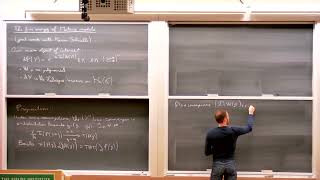
The Free Energy of Matrix Models and Application to the Microstates Free Entropy
Explore matrix models' free energy and its application to microstates free entropy in this advanced mathematical talk by Felix Parraud from KTH Royal Institute of Technology.
Resurgence in Integrable Field Theories - Part 2
Explore resurgent properties of integrable field theories, focusing on UV-free theories with mass gaps and 1/N expansions. Analyze free energy with chemical potentials using Bethe ansatz and large N methods.
Resurgence in Integrable Field Theories - Lecture 1
Explore resurgent properties of integrable field theories, focusing on UV-free theories with mass gaps and 1/N expansions. Analyze free energy with chemical potentials using Bethe ansatz and large N methods.
Systems with Coulomb Interactions: Mean-Field Limits and Statistical Mechanics - Lecture 4
Explore large particle systems with Coulomb repulsion, examining mean-field dynamics and statistical mechanics using modulated energy approaches and free energy expansions.
Systems with Coulomb Interactions: Mean-Field Limits and Statistical Mechanics - Lecture 3
Explore large particle systems with Coulomb repulsion, covering mean-field dynamics and statistical mechanics using modulated energy and free energy expansion approaches.
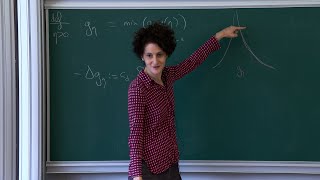
Systems with Coulomb Interactions: Mean-Field Limits and Statistical Mechanics - Lecture 2
Explore Coulomb-type repulsion in large particle systems, covering mean-field dynamics and statistical mechanics with focus on free energy expansion and fluctuations.
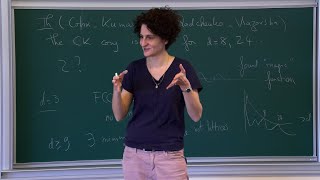
Systems with Coulomb Interactions: Mean-Field Limits and Statistical Mechanics - Lecture 1
Explore large particle systems with Coulomb repulsion, examining mean-field dynamics and statistical mechanics using modulated energy approaches and free energy expansions.
New Initial Approximation in Loop Vertex Expansion for Quartic Matrix Models
Explore advanced techniques in Loop Vertex Expansion for QFT models, focusing on analytic continuation of free energy in quartic matrix models beyond standard cardioid domains.
Resurgence in Integrable Field Theories - Lecture 3
Explore resurgent properties of integrable field theories, focusing on UV-free theories with mass gaps and 1/N expansions. Analyze free energy with chemical potential using Bethe ansatz and large N methods.
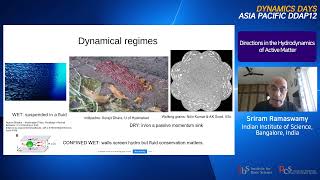
Directions in the Hydrodynamics of Active Matter
Explore the collective properties of active systems, focusing on inertia, chirality, and non-reciprocality in self-driven materials that defy equilibrium rules.

EMF of a Cell and Free Energy Change of a Reaction
Learn to calculate cell EMF, free energy, entropy change, and heat of reaction through practical numerical problems and theoretical concepts.
Improved Product-state Approximation Algorithms for Quantum Local Hamiltonians
Delve into advanced algorithms for approximating ground state energy and free energy in quantum local Hamiltonians, exploring new techniques for dense systems and sparse graphs with fixed minor exclusions.
The Nucleosome as the Hydrogen Atom of Epigenetics
Explore nucleosome structural transitions and their energy scales, drawing parallels with hydrogen atom energy levels. Examine pH effects on nucleosome stability and biological implications.