Investing in Code Reviews for Better Research Software
Explore code review benefits for scientific software: improved quality, teamwork, and knowledge transfer. Learn approaches to facilitate effective reviews.
Writing Clean Scientific Software
Learn strategies for writing readable, reusable, and maintainable scientific code. Master techniques for creating concise functions, restructuring complex code, and effective commenting.
Infrastructure for High-Fidelity Testing in HPC Facilities
Explore infrastructure and tools for high-fidelity testing in HPC environments, focusing on hardening software for DOE's Exascale Computing Project and future applications.
Secure Software Programming Practices and Development for Scientific Software
Explore secure software development practices to mitigate malicious attacks and protect scientific software integrity, authentication, and sustainability.
Socially Responsible Software Development - Teaching Software Design Systematically
Explore socially responsible software development and its importance in education. Learn strategies for creating curricula that emphasize software as a message to future developers.

Design is Testability - Understanding Software Testing Through Design Principles
Explore software design's impact on testability, linking design concepts to testing strategies for effective automated testing in continuous integration systems.
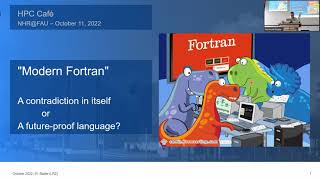
Modern Fortran - A Contradiction or Future-Proof Language?
Explore modern Fortran's evolution, focusing on program design, parallelism, and interoperability. Discover how this 65-year-old language remains relevant for scientific simulations.
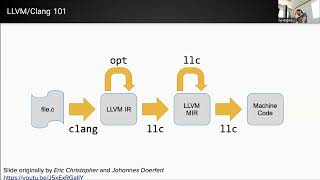
LLVM in HPC - Enabling Performance Portability, Interoperability, and Novel Features - Part 1
Explore LLVM's impact on HPC, covering portable CUDA, debugging at scale, GPU execution of legacy code, and ML in compilers. Learn about efforts to enhance performance, tooling, and development in HPC.
Conflict Resolution for Open Source Teams
Develop conflict resolution skills for open source teams. Learn strategies to address various conflict types, analyze real-world examples, and foster team prosperity.
Game Programming: C++ Visual Code Profiling - Lecture 20
Explore C++ game programming profiling techniques, including Singletons, event-based, statistical, and instrumentation profilers. Learn to implement a Profiler class and use macros for efficient code timing and analysis.
Video Game AI Course Project Specification - Lecture 2
Explore AI techniques for video games, covering movement, search, planning, decision-making, and procedural content generation. Implement a bot for a retail game using C++ and SFML.
COMP4300 - Game Programming - SFML and ImGui Tutorial - Lecture 4a
Explore SFML and ImGui for game development, covering rendering, animation, and user interfaces in C++. Learn to create functional games using ECS architecture.
C++ Visual Code Profiling for Game Programming - Lecture 20
Learn C++ Visual Code profiling techniques for game programming, focusing on performance optimization and efficient code analysis.
Recipes for Reducing Allocations by C++ Containers - C++ on Sea 2022
Explore techniques to minimize allocations in C++ containers, including vector reservations, container choices, constructors, scope promotion, view types, and PMR allocators. Gain insights with benchmarks and diagnostics.
Contractual Disappointment in C++ - Ensuring Robust Software Development
Explore effective strategies for robust C++ software development, focusing on contracts and interfaces to enhance usability, efficiency, and reliability in program operation.
AI-Assisted Software Engineering - Endnote
Explore AI-assisted software engineering tools revolutionizing code writing and problem-solving for C++ developers. Learn about AI-powered code generation and root-cause analysis techniques.

C++23 - What's In It For You?
Explore upcoming C++23 features, including core language enhancements and Standard Library additions. Gain insights into consteval if statements, multidimensional subscript operators, and new library components.
C++ Package Managers - Simplifying Dependency Management
Explore package managers for C++ dependencies, comparing system, build system, and language-specific solutions. Learn to streamline workflows and efficiently manage libraries across platforms.
C++ Performance Portability - A Decade of Lessons Learned - Lecture
Explore a decade of C++ performance portability challenges and solutions, focusing on Kokkos ecosystem development for efficient cross-platform scientific computing.
Undefined Behavior in the STL - Lecture
Explore undefined behavior in C++ STL, its dangers, and presence in containers and algorithms. Learn protective measures and understand its purposeful introduction.
Back to Basics: C++ Testing - Lecture 1
Explore unit testing in C++ using Google Test, covering automated tests, mocks, TDD, and best practices. Suitable for beginners and experienced developers alike.