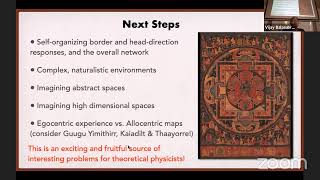
Imagining Space
Explore the neuroscience of spatial perception, from neurons to grid patterns, and discover how the brain constructs our sense of place and navigation.

Algorithmic Foundations of Emergent Behavior in Analog Collectives
Explore self-organizing systems, programmable matter, and algorithms driving emergent behavior in analog collectives. Discover challenges and applications in this cutting-edge field.
Emergence of Life in the Brain
Explore the potential emergence of a new form of life within the brain, examining neural matter, replicators, and the intersection of evolution and learning.
Natalie Grefenstette on Agnostic Biosignature Detection
Exploring agnostic biosignature detection for extraterrestrial life, discussing innovative approaches to define and identify living systems beyond Earth's biology.
Fractal Conflicts & Swing Voters with Eddie Lee
Explore the fractal nature of armed conflicts, swing voters, and pivotal components in society through complex systems research, revealing hidden patterns and influential factors shaping human behavior.
The Art & Science of Resilience in the Wake of Trauma with Laurence Gonzales
Explore resilience after trauma through psychology and neuroscience. Learn strategies for coping, finding wisdom, and living fully despite hardship. Gain insights on the body-mind connection and personal growth.
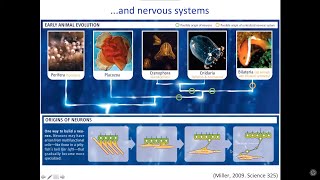
The Evolution of Agency
Explore the emergence of agency in living organisms, challenging reductionist views and proposing a framework for understanding purposeful behavior, free will, and mental causation in biological systems.
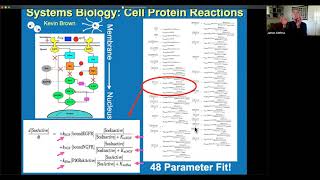
Sloppy Models, Differential Geometry, and Why Science Works
Explore how complex systems can be modeled despite parameter uncertainties, using differential geometry to understand 'sloppiness' and its implications for scientific comprehension and prediction.
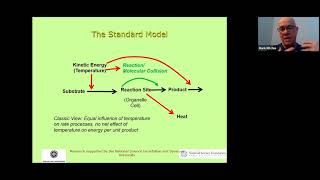
Thermodynamics of Far From Equilibrium Systems, Biochemistry, and Life in a Warming World
Explores new thermodynamic approaches to biological temperature responses, challenging traditional enzyme stability theories and offering insights into optimum temperatures for biochemical reactions and ecological impacts.
Education Psychology - Mitchell Nathan, University of Wisconsin
Explore the impact of technology on education equity, examining opportunities and challenges revealed by the pandemic. Gain insights into optimizing learning experiences and ensuring access to quality content for all students.
The Future of the Human Climate Niche with Tim Kohler and Marten Scheffer
Exploring the narrow climate range suitable for human habitation and its implications for our future as global temperatures rise. Discusses adaptation challenges, migration pressures, and potential solutions.
The Evolutionary Causes of Quantitative Genetic Variation
Explore the genetic architecture of quantitative traits, examining how mutation, selection, and drift shape heritable variation. Gain insights into missing heritability and interpret genome-wide association studies findings.

Invasion of the Inferential Cell
Explore the evolution of intelligence on Earth, from cellular behavior to complex cognition, examining common principles across biological systems and the unique aspects of human thought.
Function in an Abiotic World
Explore the interplay of function, stability, and competition in abiotic systems, examining selection processes and constraint satisfaction through examples and metaphors.
DNA, Love, and Gender
Explore epigenetics: how environment alters DNA, impacting behavior, health, and even love. Discover the role of RNA molecules in understanding complex epigenetic phenomena and their potential applications.
A Statistical Physicist Looks at Some Complex Systems
Explore complex systems through statistical physics, examining random walks, lead changes in sports, and data analysis techniques for understanding dynamic processes.
The Landauer Limit and Thermodynamics of Biological Computation
Explore the intersection of physics, information theory, and biological computation, focusing on the Landauer limit and its implications for engineered and natural systems.
Modeling Computer Networks from Chips to the Internet
Explore network modeling strategies for the Internet, from chip-level communication to global-scale simulations, examining scaling laws, biological concepts, and socio-economic factors shaping its future.

Why is Time a One-Way Street?
Explore the paradox of time's arrow with physicist Leonard Susskind, delving into how the past differs from the future and examining current perspectives in physics and cosmology on this intriguing phenomenon.
Metabolic Ecology of Humans
Explore how human metabolism relates to ecology, geography, and civilization through scaling perspectives and energy dynamics.

The Myth of Common Sense- Why Everything that Seems Obvious Isn't
Challenging common sense assumptions in complex social problems. Learn to question shared beliefs and apply scientific methods for better solutions in government, business, and marketing.